How Studying Great Photographers Makes You Better
Better cameras and more tutorials can only take you so far. Studying great photographers teaches you to notice, anticipate, choose, and edit with a more developed eye.
There comes a point in photography when the usual forms of progress stop working.
You understand exposure. You can focus accurately. You know what aperture does. You have watched tutorials about composition, light, lenses, autofocus modes, editing, and color grading. Your camera is probably more capable than the one many celebrated photographs were made with.
Yet your results remain inconsistent.
Some photographs feel alive, but you cannot say exactly why. Others are technically clean and strangely forgettable. You recognize a strong photograph when you see one, but that recognition does not reliably arrive while you are standing in front of the scene. Buying another lens may change the pictures you can make, but it does not tell you which picture is worth making.
This is the point at which studying great photographers becomes especially useful.
Not because their work contains recipes to copy. Not because every famous photograph is beyond criticism. And not because looking at beautiful pictures will somehow improve your instincts through exposure alone.
The value is more practical: great photographs give you unusually rich examples of visual decisions. When you study those decisions carefully, compare them, test them, and bring the results back to your own work, you begin to notice possibilities that previously passed unseen.
Tutorials teach you how to make a photograph. Great photographers teach you what a photograph can do.
The Problem Is No Longer the Camera
Technical knowledge solves technical uncertainty. If you do not understand shutter speed, a lesson about shutter speed can produce an immediate improvement. If your photographs are consistently out of focus, learning an autofocus mode can help.
Visual judgment is different. There is rarely one setting that resolves a weak relationship between a person and the background. No camera menu can tell you whether to wait for a gesture, leave a figure small, let a reflection obscure the subject, or exclude an attractive detail that weakens the whole frame.
These are decisions about meaning and visual consequence.
The serious amateur often knows enough to produce a competent photograph but has not yet developed a dependable way to distinguish competent from necessary. That gap can feel mysterious because people describe it vaguely as “having an eye.”
But a photographic eye is not one mysterious gift. It is a collection of trainable abilities.
Ability | What it looks like in practice |
|---|---|
Noticing | You see the bright edge, repeated shape, awkward overlap, or fleeting gesture before taking the picture. |
Predicting | You anticipate what moving, waiting, changing height, or altering exposure will do to the frame. |
Choosing | You select the viewpoint, distance, moment, and visual emphasis that serve the idea. |
Editing | You can tell why one frame succeeds and a nearly identical frame does not. |
Connecting | You recognize recurring concerns and begin making bodies of work instead of isolated keepers. |
Studying accomplished photographers can strengthen all five—but only if looking becomes an active practice.
Experts Do Not Simply Look Longer. They Look Differently
Research into visual expertise offers a useful clue about what changes with experience.
In one eye-tracking study, researchers compared artists with artistically untrained viewers as they looked at a range of pictures. The untrained viewers showed a greater preference for recognizable objects and human features. The artists spent more time on structural and abstract features and later remembered more pictorial details.[1]
It was a small study, and it was about artists rather than photographers specifically. It should not be treated as proof that studying photographs automatically creates expertise. But its central observation is valuable: trained viewers distribute their attention differently.
Imagine looking at Henri Cartier-Bresson's Hyères.
At first, you may see a cyclist passing below a staircase. Look structurally and the picture changes. The spiral railing commands the foreground. Its curve is echoed by the road. The architecture establishes a stable design while the blurred cyclist supplies movement, time, and uncertainty. The person is not merely the subject; the person's position completes a relationship that was already waiting in the scene.
Miru's analysis of Hyères examines that tension between fixed geometry and passing motion. Studying it can change what you look for on your next walk. Instead of hunting for an interesting cyclist, you may first find a structure and then recognize the instant when life activates it.
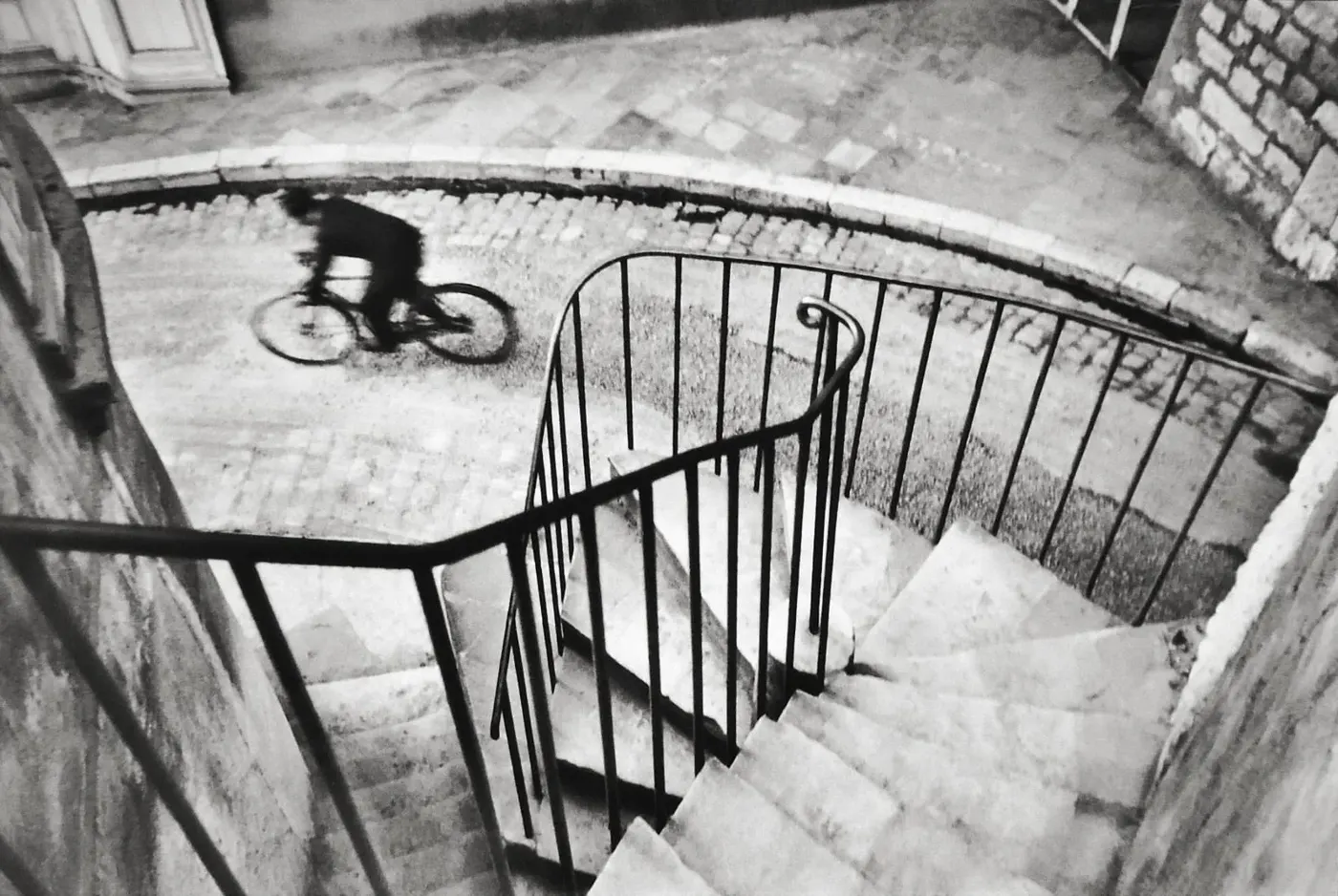
Henri Cartier-Bresson, Hyères. Read Miru's analysis.
That is a meaningful change in seeing.
Great Photographs Give You a Library of Visual Solutions
Perceptual-learning research describes how experience can improve the extraction of useful information from complex stimuli.[2] In plain language, practice can make relevant patterns easier to notice.
For a photographer, repeated close study builds a mental library of relationships:
a small figure balancing a large field;
a bright hand carrying the emotional force of a portrait;
a reflection dividing a scene into layers;
one saturated color organizing an otherwise muted frame;
repeated forms interrupted by a single irregular element;
weather simplifying a background or turning distance into atmosphere;
an elevated viewpoint transforming objects into pattern.
This library matters because photography happens quickly. You may not consciously recall a particular image while shooting. But prior study can help you recognize that a patch of red has enough visual weight to carry a gray street, or that a person will become legible only after stepping into a geometric opening.
The point is not to remember photographs as trivia. It is to become sensitive to the kinds of relationships photographs can contain.
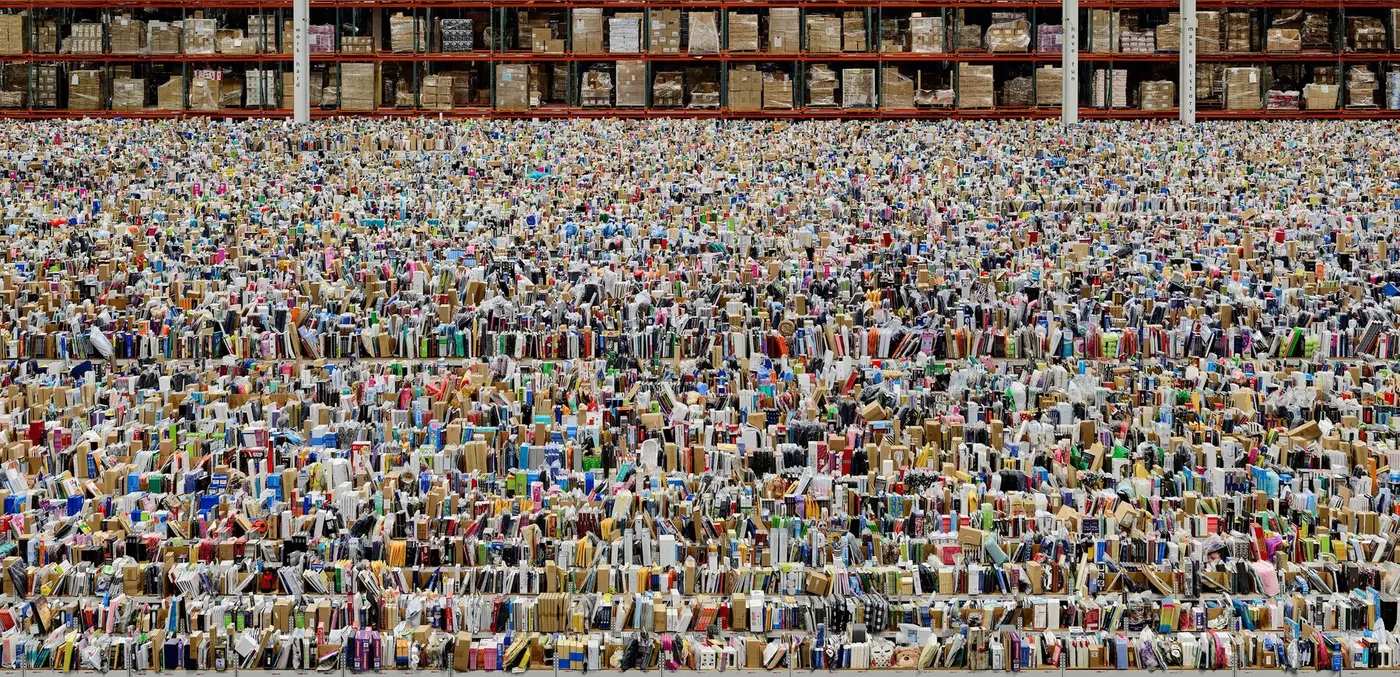
Andreas Gursky, Not Abstract II. Read Miru's analysis.
Study Decisions, Not Subjects
Copying subject matter is the least interesting lesson a master can teach.
If you study Saul Leiter and conclude that you should photograph umbrellas through fogged glass, you have borrowed his furniture. If you conclude that partial obstruction can create depth, that color can establish hierarchy, and that concealment can make a scene more suggestive, you have extracted principles that can travel.
The same distinction applies across genres:
Do not study Cartier-Bresson merely to photograph bicycles. Study how geometry prepares a frame for chance.
Do not study Fan Ho merely to photograph silhouettes. Study how light divides space and makes separate gestures read together.
Do not study Annie Leibovitz merely to imitate a pose. Study how pose, spacing, light, and detail reveal character.
Do not study Andreas Gursky merely to photograph large buildings or crowds. Study how viewpoint and repetition change our perception of scale.
Do not study Gregory Crewdson merely to imitate cinematic color. Study how every visible element can support one psychological atmosphere.
This is the difference between imitation and translation. Imitation reproduces the surface. Translation carries an underlying idea into a different subject, place, and visual language.
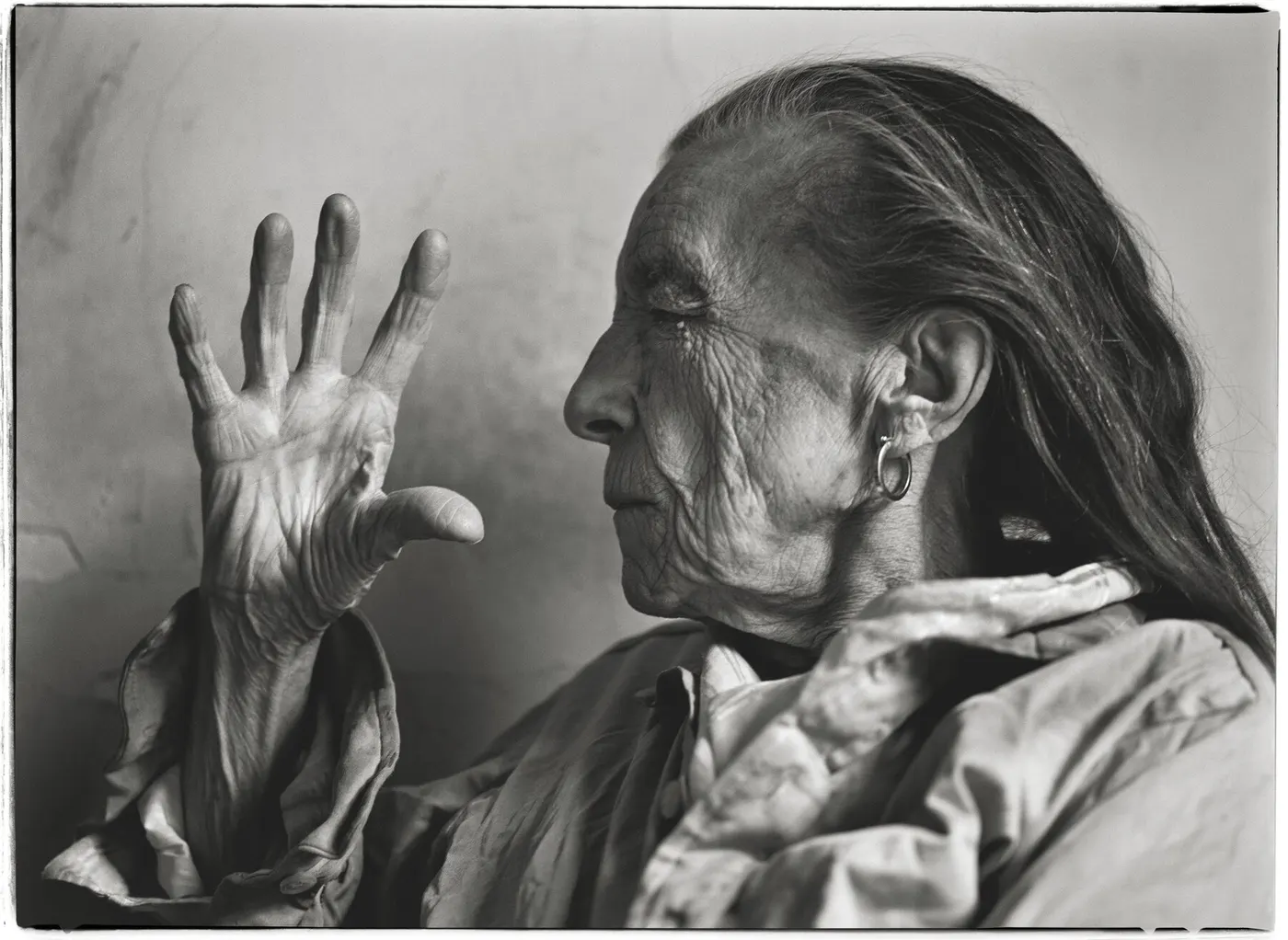
Annie Leibovitz, Louise Bourgeois, New York City, 1997. Read Miru's analysis.
Collective Lessons From Miru's Master Studies
One analysis can reveal how a particular photograph works. A group of analyses can reveal something larger: the different ways accomplished photographers repeatedly solve the same visual problem.
That turns Miru's Learn From Best archive into more than a collection of individual articles. It can be read as a curriculum. Start with the part of photography you want to strengthen, absorb several different solutions, and then take one deliberately narrow assignment into your own world.
Strength | The collective lesson | Examples from Miru | Try this yourself |
|---|---|---|---|
Light and shadow | Great photographers do not merely look for “good light.” They notice how light organizes the frame. A shaft of sunlight can isolate a person, a doorway can become a luminous stage, and deep shadow can reduce a busy place to a few essential shapes. Across Schaller, Fan Ho, and Meyerowitz, light repeatedly determines what the viewer sees first and what disappears. | Fan Ho's Theater of Light and Silhouette, Alan Schaller's Beam of Light, Joel Meyerowitz Turns a Night Street Into Theater | Find one stable composition and wait for people to enter and leave its light. Make ten frames without changing position. |
Framing and geometry | Strong composition often begins with the underlying structure of the world: curves, rectangles, diagonals, openings, repeated lines, and frames within frames. Geometry creates order, but the most memorable image often arrives when a figure, gesture, or movement briefly completes that order. | Cartier-Bresson's Hyères, Alan Schaller's Circular Layers, Margaret Bourke-White's Monumental Geometry | Ignore subjects for ten minutes and photograph only shapes. Then wait for a person to activate the strongest arrangement. |
Layering and depth | A photograph becomes richer when different visual planes interact. Leiter uses windows, reflections, signs, and obstructions; Maier uses wet glass and reflected streets. Foreground elements do not always need to be removed. They can create mystery, context, and the sensation of looking into a world. | Comparing Saul Leiter's Photographs, Vivian Maier: Rain, Motion, and Glass, Saul Leiter's Taxi Window | Spend 30 minutes photographing only through windows, reflections, or foreground objects. Make no unobstructed frames. |
Scale and negative space | Empty space is not necessarily empty. Arnold, Koudelka, Schaller, and Erwitt use a small subject inside a much larger environment to communicate solitude, vulnerability, grandeur, or calm. Scale becomes emotional when the photographer decides how much of the world to leave around the subject. | Eve Arnold's Quiet Marilyn, Josef Koudelka's Fog-Bound Solitude, Elliott Erwitt's Wyoming | Make one close, one medium, and one extremely distant version of the same subject. Compare how its emotional weight changes. |
Portraiture and presence | The strongest portraits are not primarily about flattering light or shallow depth of field. They are about presence: gaze, posture, hands, expression, clothing, and the subject's relationship with the space. Cameron finds intensity through gaze and softness; Leibovitz through pose, environment, and gesture; Sartore through clarity and eye contact. | Leibovitz's Louise Bourgeois, Cameron's J.F.W. Herschel, Joel Sartore's Winter Portrait | Make a portrait in which the hands matter as much as the face. Then make another in which the environment carries half the story. |
Timing and gesture | Many great photographs are structurally promising before the decisive event arrives. The photographer waits for a cyclist, raised hand, glance, child, passerby, or interaction that suddenly completes the composition. Timing is not only reacting quickly; it is recognizing a good stage and waiting for the right actor. | Cartier-Bresson's Charged Encounter, Meyerowitz and Shared Motion, Homai Vyarawalla's Bombay Zoo | Find a promising background and stay for fifteen minutes. Watch hands, feet, glances, and the spaces between people. |
Color and tonal design | Color works best as structure rather than decoration. Leiter builds frames around a small red or orange accent surrounded by muted tones. In monochrome, Salgado and Leibovitz achieve a similar hierarchy through tonal separation, texture, and contrast. In both cases, the palette controls attention. | Comparing Saul Leiter's Photographs, Leiter's Winter Threshold, Salgado's South Sandwich Islands | Choose either one accent color or three tonal zones. Do not take the picture unless that limited palette organizes the frame. |
Atmosphere and weather | Rain, snow, fog, and haze do more than provide mood. They change visual structure by softening backgrounds, revealing silhouettes, creating reflections, compressing depth, and withholding information. Imperfect visibility can make a photograph more evocative, not less successful. | Koudelka's Fog-Bound Solitude, Maier's Rain, Motion, and Glass, Leiter's Snowstorm Seen as Memory | Revisit a familiar location in poor weather. Photograph what the weather removes, reflects, or makes newly visible. |
Motion and rhythm | Movement can appear directly as blur, but rhythm also comes from repetition and spacing. Birds across a sky, penguins along ice, walking figures, or architectural elements create visual beats. The photographer controls whether that rhythm feels orderly, energetic, or deliberately interrupted. | Joel Sartore's Sky Turned to Rhythm and Fire, Frans Lanting's Penguins, Cartier-Bresson's Hyères | Photograph one repeating movement three ways: frozen, blurred, and interrupted by an element moving against the pattern. |
Environmental storytelling | Context frequently makes the photograph. A workshop, room, ruined street, road, or landscape tells us who the subject is and gives meaning to an action. The task is not to include more information indiscriminately, but to decide which details deepen the story and which distract from it. | Eve Arnold's Quiet Marilyn, Saul Leiter's Working Portrait, Crewdson's Untitled Merchants Row | Make five portraits that each include one object or spatial detail essential to understanding the person. Remove everything merely decorative. |
Abstraction and pattern | Skilled photographers can temporarily stop seeing objects by name and instead see lines, blocks, repetition, texture, and color. Gursky turns racetracks and warehouses into large graphic systems; Leiter compresses streets into colored planes. Abstraction helps you recognize a composition before worrying about what its objects are called. | Gursky's Not Abstract II, Gursky's Bahrain, Leiter's Street Slice | Squint or mentally defocus until the scene becomes shapes. Make a frame that remains coherent before its subject is recognizable. |
The table is not a list of formulas. It is a set of doors. Follow one row through several analyses, then repeat its assignment until the underlying principle starts appearing in situations that look nothing like the source photographs.
Why Comparison Is More Powerful Than Admiration
An isolated masterpiece can look inevitable. Every part appears so perfectly placed that it is difficult to imagine the uncertainty that preceded it.
Comparison makes the choices visible.
Research on contrasting cases suggests that comparing related examples can prepare learners to notice underlying distinctions that a single example leaves hidden.[3] Research on analogical transfer likewise suggests that multiple examples can help people extract a more general structure instead of remembering only surface details.[4]
Photography provides several useful forms of comparison:
Compare neighboring frames
A contact sheet shows that the famous frame was not the only possibility. The photographer changed position, waited, missed, reconsidered, and selected. Even when you cannot see the original contact sheet, you can imagine the adjacent possibilities: a half-second earlier, a step to the right, a wider crop, an absent gesture.
Compare strong pictures by the same photographer
This reveals recurring intelligence. In Miru's comparison of Saul Leiter photographs, windows, gates, snow, reflections, passing people, and color accents recur in different combinations. The comparison shows not only what Leiter photographed, but how he repeatedly turned obstruction, weather, and urban structure into visual order.
It also makes quality differences easier to name. Some frames contain rich atmosphere but diffuse hierarchy. Others have an appealing idea weakened by excessive obstruction. Footprints stands out because color, space, weather, and human presence resolve into one especially clear statement.
That is a more useful lesson than “I like this one.”

Saul Leiter, Footprints. Compare it with seven other Leiter photographs.
Compare photographers solving the same problem
Place two approaches to solitude beside each other. Alan Schaller may use hard graphic separation and monumental architecture. Saul Leiter may use weather, color, and partial concealment. Josef Koudelka may reduce the world to mist, ground, trees, and a distant figure.
The shared subject does not produce one correct solution. It reveals a field of possible decisions.
Compare a master's photograph with your own
This is not a contest. The useful question is not, “Why am I not this good?” Ask instead:
What relationship did the photographer control that I left accidental?
Where does attention go in each image?
Is my frame carrying one clear idea or several competing ones?
What did the photographer exclude?
Which problem could I deliberately practice next?
Comparison becomes productive when it produces a diagnosis.
Self-Explanation Turns Looking Into Learning
There is a major difference between recognizing that a photograph works and explaining how it works.
Research on learning from worked examples found that stronger learners generated more explanations for themselves. They connected specific steps to underlying principles and developed knowledge they could use beyond the original example.[5] The study concerned mechanics problems, not art, so the connection to photography is an application of the principle rather than direct proof.
Still, the habit translates well.
Suppose your first response to a photograph is, “The light is beautiful.” That reaction is real, but it gives you little to use. Continue asking questions:
Where is the brightest area?
Where is the strongest edge contrast?
What does the light reveal, and what does it withhold?
Does it separate the subject or merge forms together?
Does it create depth, flatten space, or establish a visual route?
Would the photograph still work in different light?
Now “beautiful light” becomes an account of what the light is doing.
The same is true of mood. “Cinematic” is a response, not yet an explanation. In Gregory Crewdson's Untitled Merchants Row, the feeling emerges from a small pedestrian, broad wet roadway, receding storefronts, subdued blue-gray color, haze, and small points of warmer light. Naming those contributions does not drain the photograph of mystery. It gives you a more precise understanding of how the mystery is sustained.
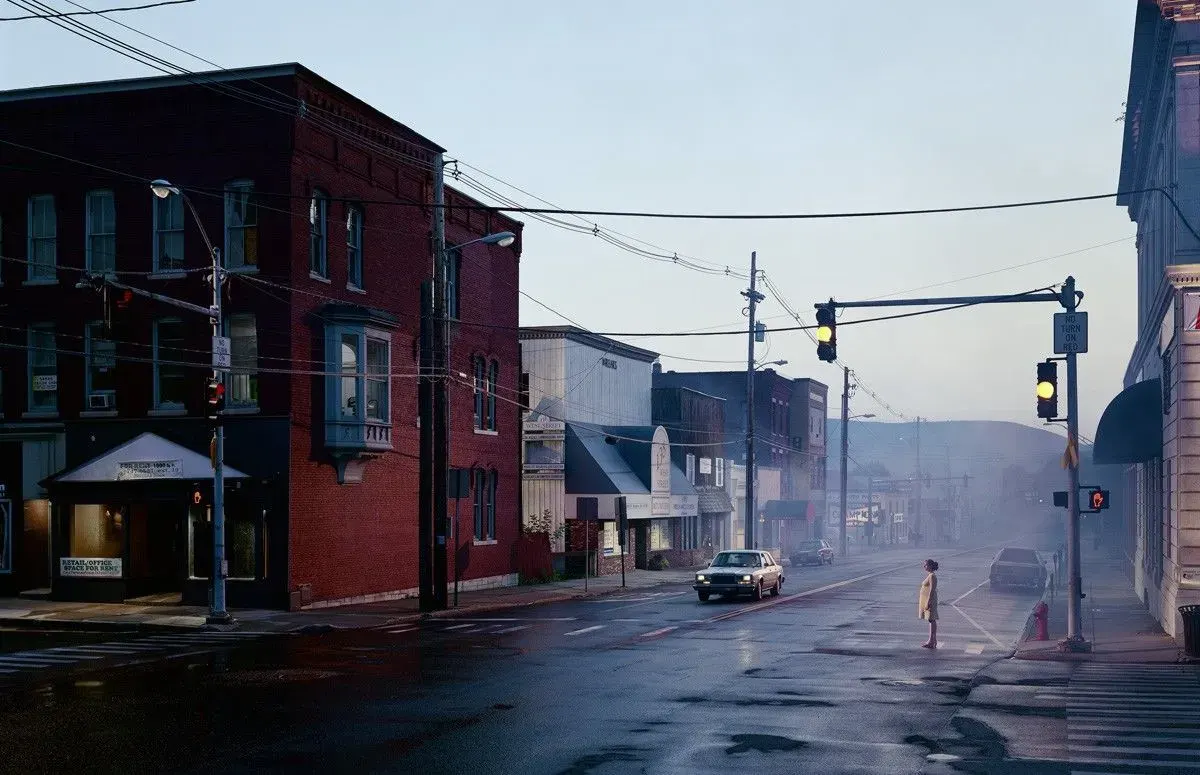
Gregory Crewdson, Untitled Merchants Row. Read Miru's analysis.
The Five-Step Master-Study Method
Use this process with one photograph at a time. A serious twenty-minute study is more valuable than scrolling past a hundred celebrated images.
Step | What to do | What it trains |
|---|---|---|
Look | View the photograph before reading its title, caption, or analysis. | Independent attention and first impressions |
Explain | Describe what creates the effect using specific visual evidence. | Visual vocabulary and causal reasoning |
Compare | Place it beside related images or imagine credible alternatives. | Discrimination and editing judgment |
Translate | Turn the observation into a constraint for your own subject. | Transfer rather than imitation |
Review | Evaluate the resulting frames, diagnose one weakness, and reshoot. | Feedback, calibration, and deliberate practice |
1. Look before being told what to see
Give the photograph a full minute without commentary.
Write down what you noticed first, second, and third. Then list only what is visibly present: shapes, edges, figures, tonal masses, colors, gestures, intervals, and areas of sharpness. Delay interpretation.
This prevents the photographer's reputation or a critic's language from replacing your own encounter with the image.
2. Explain the effect through evidence
Choose your initial response—quiet, tense, tender, chaotic, distant—and identify the visible decisions that produced it.
Try to complete this sentence:
The photograph feels ______ because ______, ______, and ______ work together.
If your explanation would apply equally well to a thousand other photographs, make it more specific.
3. Compare it with alternatives
Open several photographs by the same artist. Better still, compare photographs from one project rather than a greatest-hits collection.
Ask what repeats. Is it the camera height, distance, palette, kind of gesture, use of shadow, relationship to strangers, or tolerance for ambiguity? Then ask which frame is strongest and force yourself to give reasons.
You can also create counterfactual versions in your imagination:
What happens if the figure disappears?
What if the camera moves lower?
What if the frame includes more context?
What if the exposure occurs half a second earlier?
What if the accent color becomes neutral?
What if the foreground obstruction is removed?
Counterfactuals expose the load carried by each decision.
4. Translate one principle into your own world
Choose one relationship—not an entire style—and create a small assignment.
After studying Fan Ho, you might photograph five scenes in which separate pools of light organize different human actions. After studying Gursky, you might find three viewpoints that turn ordinary accumulation into pattern. After studying Leibovitz's Louise Bourgeois portrait, you might make portraits in which the subject's hands carry as much meaning as the face.
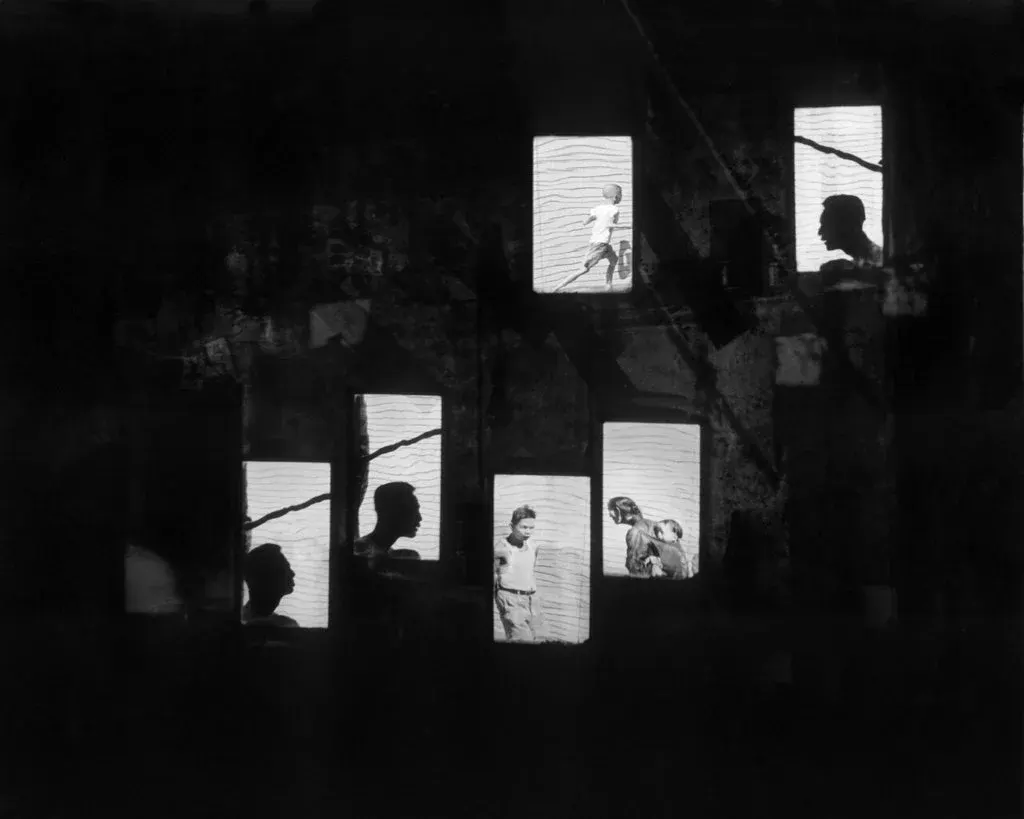
Fan Ho, Behold, Man! 鏡裡真真. Read Miru's analysis.
Your subject, location, and visual language should remain your own. The constraint is borrowed; the result should not be.
5. Review, diagnose, and reshoot
Place the resulting frames together. Do not ask only which one you like. Ask which one most clearly demonstrates the relationship you intended to practice.
Name the main failure precisely. Perhaps the gesture is strong but the background splits the head. Perhaps the red accent attracts attention but leads it away from the human event. Perhaps the silhouette reads clearly but has no relationship with the surrounding shapes.
Then reshoot that problem.
This final step matters because expertise is not built by exposure alone. The influential deliberate-practice framework emphasizes focused tasks, repetition, feedback, and work directed at weaknesses.[6] Photography is not identical to the domains in which that framework was originally studied, and practice is not the only cause of expertise. But the underlying distinction is valuable: repetition becomes developmental when it is guided by a specific diagnosis.
What Each Photographer Can Teach Is Larger Than a Style
The risk of any short analysis is that a photographer becomes a label.
Cartier-Bresson becomes “the decisive moment.” Leiter becomes “reflections and umbrellas.” Fan Ho becomes “dramatic silhouettes.” Crewdson becomes “cinematic staging.” These descriptions are not entirely wrong, but they are too compressed to be educational.
Study enough work and contradictions appear.
You find quiet Cartier-Bresson photographs in which little seems to happen. You find Leiter pictures held together by graphic structure rather than color. You see that Fan Ho's light matters because of the human relations it reveals, not simply because the contrast is dramatic. You recognize that Crewdson's production scale would mean little without restraint, ambiguity, and an exact distribution of attention.
The purpose of studying a body of work is to move from signature effects toward deeper questions:
What does this photographer consistently notice?
How close do they stand to the world?
What do they permit to remain ambiguous?
What kinds of order do they find or construct?
How do they treat people—as individuals, symbols, shapes, collaborators, or witnesses?
Which emotions recur without being explicitly illustrated?
What does the photographer leave outside the frame?
Style is the visible residue of many decisions. Study the decisions.
Studying Masters Can Improve Your Editing More Than Your Shooting
Many photographers assume the main benefit will appear when they raise the camera. Often it appears first in the edit.
Shooting is crowded with sensation: movement, conversation, weather, effort, anticipation, and attachment to the circumstances. Those memories can make an ordinary frame feel important. The viewer receives none of them. The photograph must create its own experience.
Close study gives you standards that are visible inside the frame. You become better able to ask:
Does the picture establish a clear visual hierarchy?
Does every prominent element support the same idea?
Is complexity organized or merely busy?
Does the empty space create meaning?
Is the moment genuinely expressive, or only difficult to capture?
Does the photograph become richer after the first glance?
Is this image distinct from the others in the series?
That last question matters. A photographer does not build a body of work by selecting every individually attractive image. Editing also requires rhythm, variation, continuity, and omission.
Studying great work gives you a more demanding internal reference. At first, this may make your own photographs seem worse. That is not regression. Your judgment has advanced ahead of your execution.
The gap can be uncomfortable, but it is useful. You can now see what to practice.
How to Study Without Losing Your Own Voice
Some photographers resist influence because they fear becoming derivative. The greater danger is usually unconscious imitation: absorbing the most visible conventions of contemporary photography without examining them.
Intentional study makes influence easier to understand and transform.
Study widely
Do not build your entire visual education around one photographer, genre, country, period, or institution. A broad set of influences makes literal imitation less likely and exposes you to incompatible solutions.
Compare documentary observation with constructed photography, intimate portraiture with distant typology, monochrome geometry with complex color, and celebrated Western canons with photographers from other traditions.
Borrow constraints, not signatures
Give yourself an assignment based on a relationship: one color against neutrality, a gesture balanced by negative space, three spatial layers, or a figure interrupting repetition.
Avoid borrowing the recognizable costume of the source—the same subject, palette, weather, pose, and processing all at once.
Return to your own concerns
Your voice develops through what you continue to care about. The master provides a way of thinking, but your family, street, landscape, work, fears, humor, and curiosities supply the reason to make the photograph.
Let the influence disappear
An exercise may visibly resemble its source. That is acceptable. It is a study, not necessarily a finished work. Keep practicing until the principle becomes available without announcing where it came from.
Originality is not freedom from influence. It is influence transformed by attention, experience, and purpose.
A Sustainable Weekly Practice
You do not need an art-history degree or hours every day. Try one compact cycle each week.
Day 1: Study one photograph
Use the Look and Explain stages. Write no more than 200 words, but make every observation concrete.
Day 2: Compare a small set
Choose four to eight related photographs. Rank them for one specific quality—timing, spatial clarity, color structure, gesture, or atmosphere—and defend the ranking.
Day 3: Design one constraint
Translate the lesson into a short assignment that can be completed in your own surroundings.
Day 4 or 5: Photograph
Work on the chosen relationship. Do not try to fix every aspect of your photography at once.
Day 6: Edit after some distance
Choose the strongest frame and one near miss. Explain the difference without referring to how difficult either was to make.
Day 7: Diagnose the next attempt
Name one problem to reshoot. If you want a larger menu of focused practice, use Ten Photography Exercises That Will Actually Improve Your Eye.
Over time, keep a study notebook containing the source photograph, your observations, the principle you extracted, your resulting contact sheet, and what you would change. This turns inspiration into a record of development.
The Real Sign That Your Eye Is Improving
A better eye does not mean every photograph becomes good. It does not mean you can enter any situation and manufacture a masterpiece. It does not eliminate luck, access, subject knowledge, patience, or emotional connection.
The clearest sign of progress is that your decisions and failures become more specific.
Instead of saying, “This photo doesn't work,” you can say:
the brightest object contradicts the intended subject;
the gesture arrived before the figures separated;
the foreground adds obstruction but not depth;
the repeated shapes create rhythm, but nothing interrupts them;
the negative space is attractive but emotionally inactive;
the color palette is appealing, yet it does not organize attention;
the series repeats the same distance and emotional note.
That precision changes the next photograph. It tells you where to stand, what to wait for, what to exclude, and what to practice again.
Great photographers do not give you a bag of effects. They enlarge the number of possibilities you can recognize. They demonstrate that weather can become structure, that space can become emotion, that a hand can carry a portrait, that a tiny figure can animate a vast frame, and that an ordinary street can hold several pictures depending on where and when you look.
Study them slowly. Explain what you see. Compare their choices. Translate one principle into your own world. Then return to your photographs and look again.
That is how another photographer's work begins to change your eye without replacing your voice.
Research Sources
Stine Vogt and Svein Magnussen, “Expertise in Pictorial Perception: Eye-Movement Patterns and Visual Memory in Artists and Laymen,” Perception 36, no. 1 (2007): 91–100. View source
Philip J. Kellman and Patrick Garrigan, “Perceptual Learning and Human Expertise,” Physics of Life Reviews 6, no. 2 (2009): 53–84. View source
Daniel L. Schwartz and John D. Bransford, “A Time for Telling,” Cognition and Instruction 16, no. 4 (1998): 475–522. View source
Mary L. Gick and Keith J. Holyoak, “Schema Induction and Analogical Transfer,” Cognitive Psychology 15, no. 1 (1983): 1–38. View source
Michelene T. H. Chi, Miriam Bassok, Matthew W. Lewis, Peter Reimann, and Robert Glaser, “Self-Explanations: How Students Study and Use Examples in Learning to Solve Problems,” Cognitive Science 13, no. 2 (1989): 145–182. View source
K. Anders Ericsson, Ralf T. Krampe, and Clemens Tesch-Römer, “The Role of Deliberate Practice in the Acquisition of Expert Performance,” Psychological Review 100, no. 3 (1993): 363–406. https://doi.org/10.1037/0033-295X.100.3.363. For a broader account of how domain-specific visual expertise develops, see Andreas Gegenfurtner et al., “Learning to See Like an Expert: On the Practices of Professional Vision and Visual Expertise,” International Journal of Educational Research 98 (2019): 280–291. View source