Saul Leiter’s Street Slice: Abstraction Held Together by a White Convertible
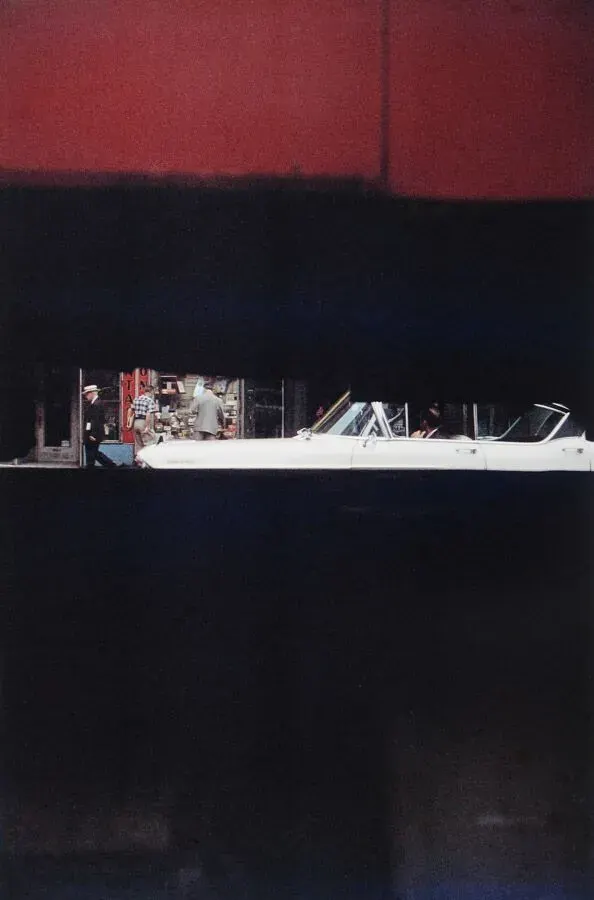
A white convertible glides through a narrow band of visibility while red and black planes compress the city into pure graphic form. The photograph feels both street scene and color field, with just enough human detail to keep the abstraction alive.
Watch the video
This photograph distills a city moment into a few unforgettable elements: a white convertible, a thin strip of street life, and large planes of red and black that nearly overtake the frame. What makes it so memorable is the balance between concealment and clarity. The image feels abstract at first glance, then slowly opens into narrative as the eye discovers people, shop windows, and the car’s sleek profile.
A bright car becomes the frame’s quiet center
The white convertible is the picture’s anchor. Its long, luminous body cuts horizontally through the narrow visible band and instantly organizes the composition. Against the surrounding dark fields, the car reads with remarkable clarity, giving the photograph a calm, decisive focal point. The contrast is simple but masterful: one bright shape, held inside a mostly shadowed world.

The white convertible gives the image a crisp focal point and an elegant horizontal rhythm.
Color planes turn the street into modernist design
The stacked red and black areas do far more than frame the scene. They flatten the city into bold graphic bands, making the photograph feel closer to a painting than a descriptive street view. The red upper field carries warmth and pressure, while the black bands below and through the middle create a strong visual architecture. This reduction to color and shape is what gives the image its distinctive, cinematic presence.

The broad red and black planes transform an everyday view into striking graphic abstraction.
Small storefront figures keep the moment alive
On the left side of the slit, the storefront activity adds a subtle but essential human pulse. The standing figures, bits of merchandise, and glimpse of interior space suggest a larger city life continuing just beyond what the frame allows us to see. These details give the image narrative without disturbing its formal restraint. The photograph stays spare, but it never becomes empty.

The tiny human details enrich the abstraction with lived-in street energy.
Concealment becomes part of the picture’s poetry
One of the image’s great pleasures is how much it withholds. The car is not presented as a full object on display; it is revealed through a narrow opening, as though the city is being glimpsed between curtains. That partial view creates mystery and compression, letting the viewer experience the scene as a fleeting visual event rather than a complete record. The result feels intimate, elusive, and unmistakably urban.
The restricted view gives the photograph its mystery and its sense of passing, half-seen life.
Why this photograph stands out
What lingers here is the fusion of precision and suggestion. A bright convertible, a few storefront figures, and monumental color fields are enough to create an image that feels both immediate and abstract. The photograph shows how a street scene can become unforgettable when shape, color, and timing are reduced to their most essential and beautiful form.
About the photographer
Saul Leiter
Saul Leiter was known for his poetic, painterly approach to street photography, finding beauty in quiet, everyday moments rather than dramatic events. He used reflections, fogged windows, rain, vibrant color, and layered compositions to create images that feel intimate and dreamlike. His work often obscures or partially hides his subjects, inviting the viewer to discover the scene rather than simply observe it. Leiter’s photographs are celebrated for their subtle mood, ambiguity, and extraordinary use of color and light.