Julia Margaret Cameron’s Poetic Study of Presence
A luminous portrait in which flowing hair, a cloudlike beard, and sepia quiet turn an elderly sitter into an unforgettable presence.
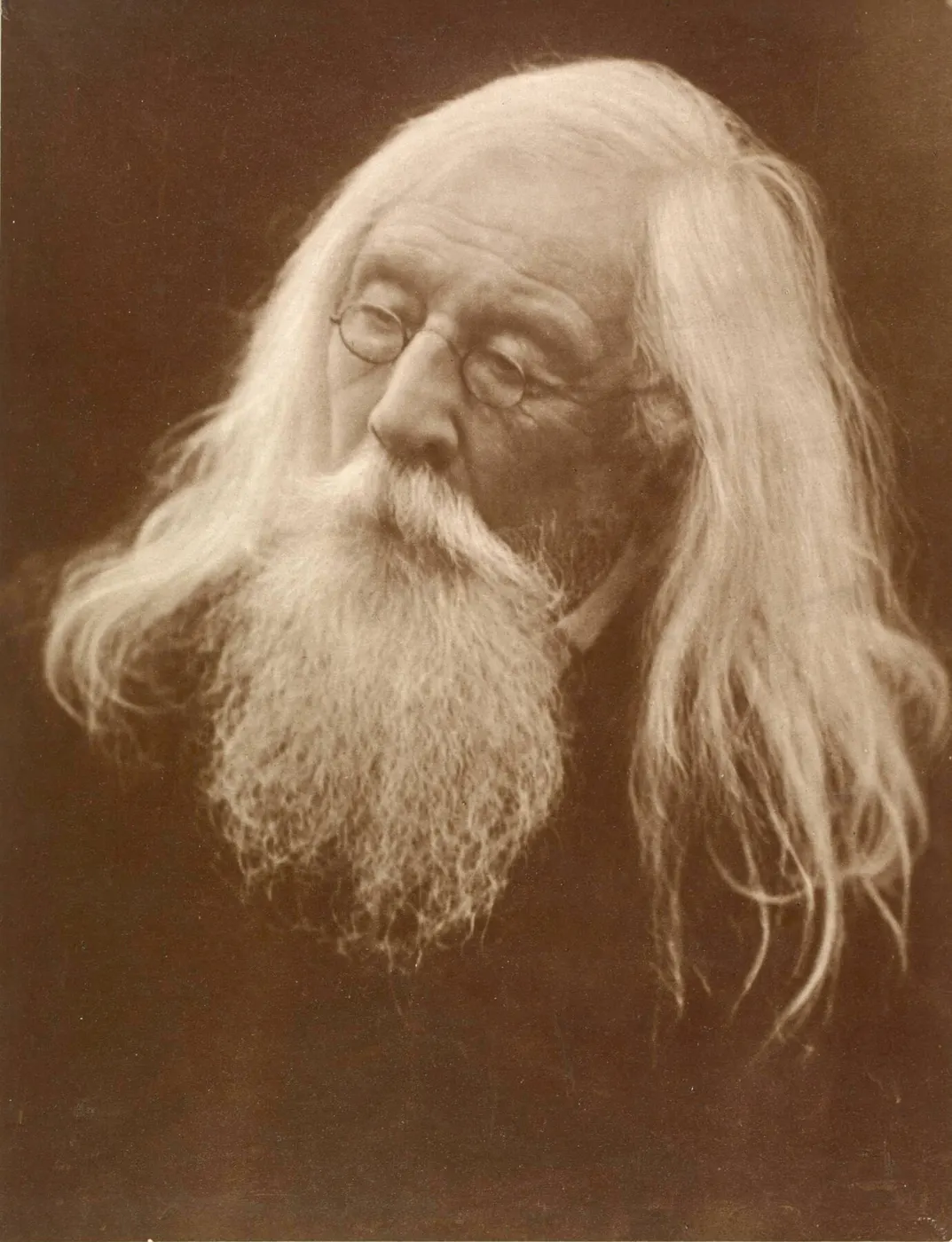
Julia Margaret Cameron’s portrait of Charles Hay Cameron is memorable for its stillness. The image does not depend on props or setting. Instead, it builds its power through face, hair, beard, and a lowered gaze that feels inward and humane. Cameron’s gift for intimate, expressive portraiture is fully present here: softness becomes atmosphere, and simplicity becomes grandeur.
A face shaped by thought and tenderness
The sitter’s head tilts gently downward, and that small gesture gives the portrait its contemplative center. His round spectacles, lightly traced against the face, add intellectual character without breaking the quiet mood. The expression feels absorbed rather than performed, which gives the portrait unusual intimacy. Cameron lets the features remain calm and unforced, so the viewer meets not a pose but a presence.

The lowered gaze and delicate glasses give the portrait a rare sense of inward life.
Hair and beard as living architecture
One of the photograph’s great beauties is the way the long white hair and full beard create the whole structure of the frame. The beard gathers visual weight at the center, dense and feathery at once, while the hair sweeps outward in pale ribbons on both sides. On the right, the bright fall of hair makes a clean silhouette against the dark ground, turning the sitter’s outline into something almost monumental. These textures do more than describe age; they give the portrait rhythm, grace, and authority.

The flowing hair and richly textured beard turn the sitter’s silhouette into the photograph’s defining shape.
Soft light with a painterly hush
The light is gentle and high enough to brush the forehead, hair, and beard with a pale glow. That restraint matters. Nothing feels sharp or theatrical; the illumination is soft, even forgiving, and it lets the portrait breathe. Across the forehead and crown, the highlights feel luminous rather than bright, which gives the image its painterly calm. Cameron uses light here not to dramatize but to reveal character with tenderness.
The soft highlights across the forehead and hair create a luminous, painterly calm.
Sepia tonality and the power of subtraction
The nearly featureless dark background and deep clothing remove every distraction. Out of that darkness, the pale face, hair, and beard emerge with striking clarity. The sepia palette unifies everything into one sustained mood, warm and archival, intimate and timeless. This tonal minimalism is one of the picture’s quiet triumphs: by giving us less, Cameron makes us feel the sitter more fully.
The sepia palette and dark surroundings make the sitter appear to emerge from silence itself.
Why this photograph stands out
What makes this portrait lasting is its confidence in essentials. Julia Margaret Cameron trusts expression, light, and texture to carry the image, and they do. Charles Hay Cameron appears as both individual and archetype: scholarly, aged, serene, and vividly human. The photograph’s softness is not a veil over character but the very means by which character is felt.
About the photographer
Julia Margaret Cameron
Julia Margaret Cameron was known for her **intimate, expressive portraits**, using photography to explore character, emotion, and the inner presence of her subjects. Rather than pursuing technical perfection, she embraced soft focus, dramatic lighting, and imperfect details to create images with a distinctly painterly and poetic quality. Her distinctive style is characterized by **close framing, luminous faces, atmospheric softness, and a dreamlike sense of intimacy**. Cameron deliberately used blur and shallow focus as expressive tools, giving her portraits a romantic, almost ethereal quality and helping establish photography as a medium capable of personal artistic expression.