Wyoming and the Drama of Shared Distance by Elliott Erwitt
A road, a car, and a steam locomotive move through the same Wyoming valley, but the photograph’s real grandeur comes from how scale, atmosphere, and direction are fused into one unforgettable black-and-white design.
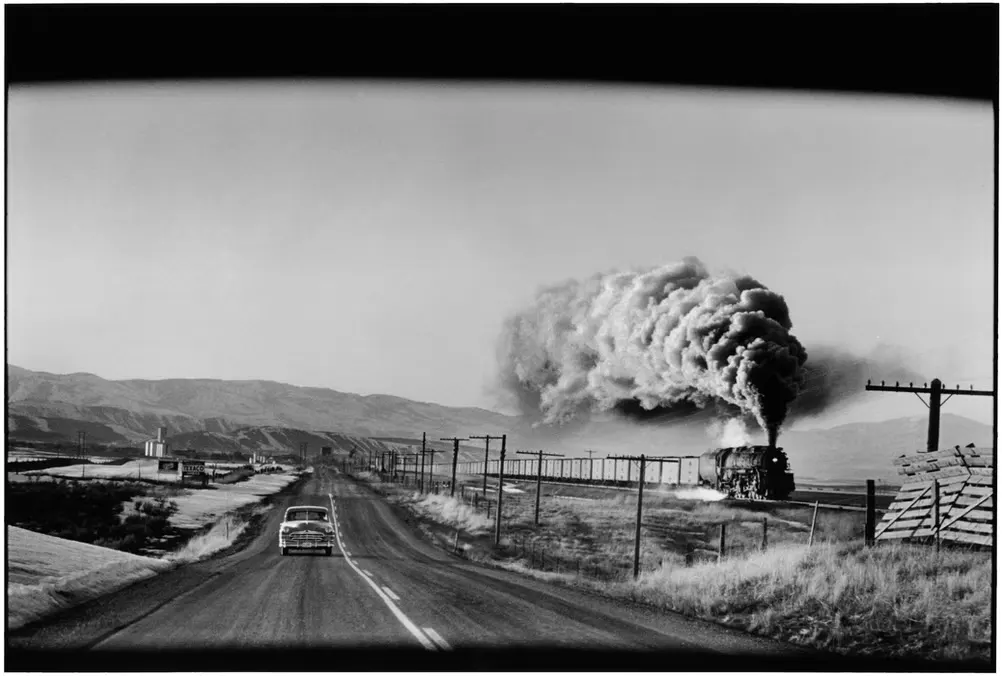
This photograph turns a passing scene into something mythic. A car approaches on the road while a steam locomotive runs alongside on the right, and the whole image is bound together by distance, direction, and open land. What makes it memorable is how clearly every major element contributes: the road pulls us inward, the train gives the frame its force, and the valley lets the picture breathe at an epic scale.
The steam plume gives the image its emotional center
The photograph announces itself through the locomotive’s plume. It rises low on the right, then swells outward into a huge, textured mass that dominates the sky without flattening the scene. Its bright highlights and deep grays create a sculptural presence, and its shape makes the train feel powerful far beyond its actual size in the frame. The plume is not just atmosphere; it is the picture’s main dramatic form, the thing that turns motion into spectacle.

The steam plume is a commanding visual anchor that gives the photograph scale, energy, and unforgettable mood.
The road builds depth with remarkable clarity
The centerline begins near the bottom edge and carries the eye straight into the valley. That direct pull creates immediate depth, but it also does something more subtle: it links the viewer’s position to the car, the horizon, and the train beyond. The road is both a graphic line and a narrative path, making the scene feel traveled rather than merely observed. Its dark surface and pale edges read cleanly in black and white, so the perspective arrives with striking simplicity.

The road provides a beautifully strong perspective line that unifies foreground, subject, and distance.
Asymmetry keeps the frame alive
The locomotive sits low on the right third, allowing the plume to expand into open space while the left side remains available for the road and approaching car. That imbalance is exactly what gives the picture its vitality. The image never feels centered or settled; it feels in motion. By letting the train occupy a relatively small area while its steam claims the sky, the photograph balances precision and grandeur at once.

The right-third placement of the train creates a dynamic balance between mass, motion, and open space.
Repeating lines create a precise industrial rhythm
Telegraph poles, fence posts, and trackside structures repeat across the middle distance in a measured cadence. These elements reinforce the long pull of the road and tracks, giving the image an underlying order that supports its drama. They also add texture to the journey: this is not empty land, but a worked corridor shaped by travel and infrastructure. The repetition is elegant because it never overwhelms the larger forms; it quietly sharpens them.
The repeating poles and fences add a satisfying linear rhythm that deepens the sense of distance and movement.
The landscape turns the scene into a larger American story
The broad valley and low mountain backdrop prevent the photograph from becoming only a study of machinery. They place both car and train inside a wider geography, where travel feels continuous and expansive. The land opens behind every element, giving the picture a sense of freedom and endurance that suits the subject perfectly. In black and white, the mountains sit as calm tonal bands behind the busier foreground, adding scale without competing for attention.
The wide valley gives the photograph a grand sense of place, turning parallel motion into a full travel narrative.
Why this photograph stands out
What lasts in this image is the way it combines monumentality with clarity. The steam plume, the road, the train, the car, and the long Wyoming valley all work together in one decisive visual statement. It feels at once documentary and cinematic—a photograph rooted in a real place, yet elevated by form, rhythm, and atmosphere into something iconic.
About the photographer
Elliott Erwitt
Renowned for his **witty, observant street photography**, finding humor, irony, and tenderness in the ordinary moments of everyday life. He had a remarkable eye for unexpected gestures, visual coincidences, and situations where people, animals, and surroundings come together in amusing or revealing ways. His work is distinguished by **timing, simplicity, strong composition, and a playful sense of the absurd**. Erwitt often turned seemingly insignificant moments into memorable photographs, showing that great street photography can be both **funny and deeply human**.