Bombay Zoo by Homai Vyarawalla
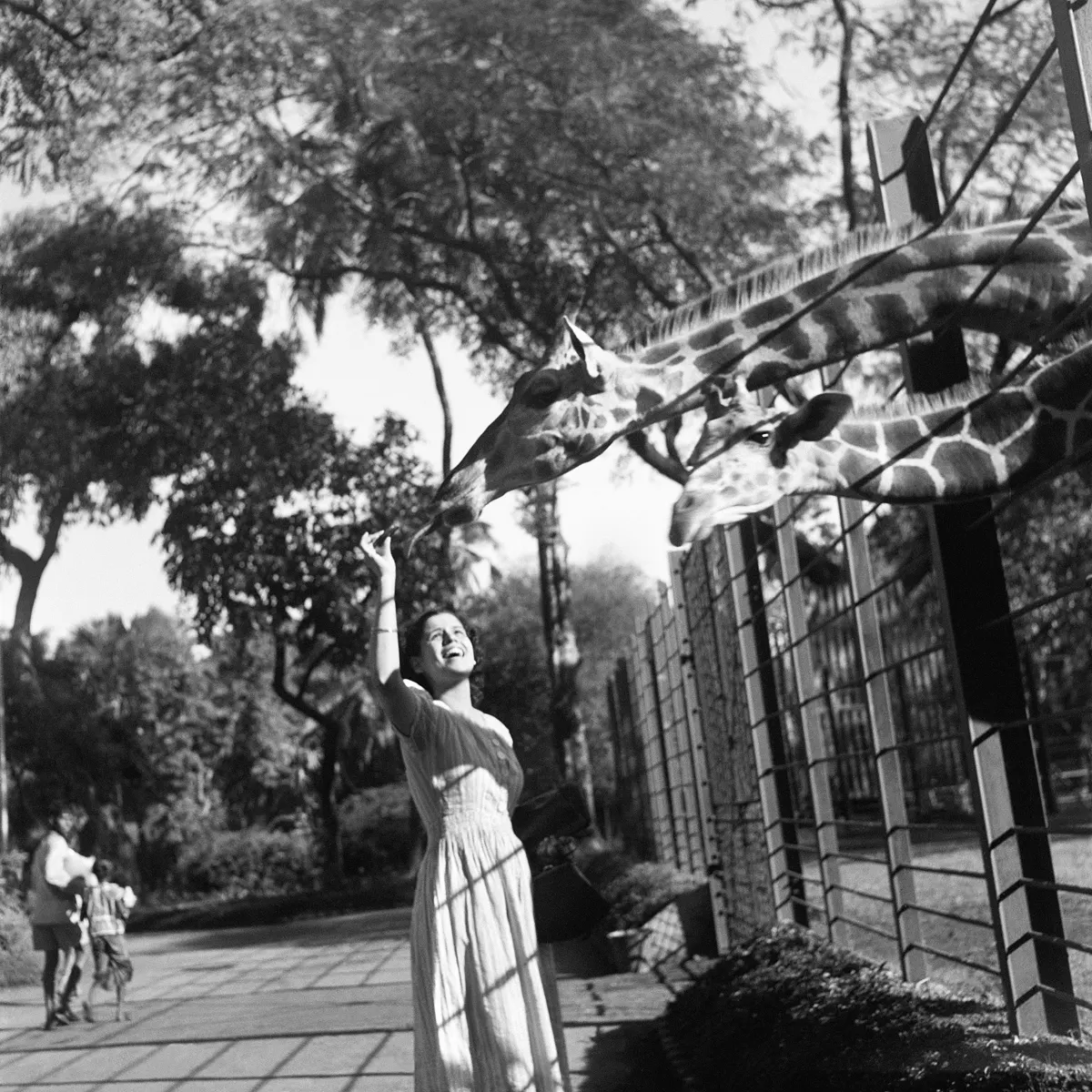
A black-and-white zoo photograph turns a fleeting reach into something lyrical, using gesture, diagonals, and texture to make a joyful exchange between woman and giraffe feel immediate and unforgettable.
Watch the video
"Bombay Zoo" is memorable for how clearly it turns a brief interaction into a fully felt scene. A woman’s raised arm, her open smile, and the giraffe’s lowered head meet at exactly the right instant, giving the photograph both tenderness and energy. The black-and-white rendering sharpens that effect, stripping the scene down to gesture, pattern, and light so the moment reads with unusual directness.
The image finds the exact instant of connection
The photograph’s emotional center is the near-touch between the woman’s hand and the giraffe’s mouth. That small gap carries all the suspense and delight of the frame. The timing is precise: the giraffe dips in, the arm reaches up, and both forms meet in a way that feels spontaneous yet visually complete. Because the interaction is so legible at a glance, the story lands immediately.

The near-contact between hand and giraffe gives the photograph a vivid, perfectly timed narrative center.
Joy is carried through expression and pose
The woman’s face is bright with pleasure, and her upward stretch gives the image its emotional lift. Her gesture is beautifully readable from head to fingertips, turning her body into a clear human counterpoint to the animals’ long, slanting forms. That combination of smile and reach makes the scene feel openhearted rather than merely observed.

The subject’s smile and upward reach make the scene feel warm, playful, and instantly human.
The giraffes create elegant movement across the frame
The overlapping heads and necks are a major compositional strength. They sweep in from the upper right as long diagonals, guiding the eye directly toward the interaction. Their layering also adds depth, so the animals feel present as a group rather than as a single silhouette. The result is a frame with strong directional flow and a graceful sense of rhythm.

The giraffes’ layered diagonals give the picture motion, depth, and a striking visual rhythm.
Monochrome brings out pattern and surface
Black and white suits this scene exceptionally well. Without color competing for attention, the giraffes’ markings become crisp graphic patterns, and the contrast between hide, fence, dress, and trees becomes more pronounced. The tonal treatment lets texture do expressive work: the animals feel tactile, the enclosure feels structural, and the scene gains richness through surface detail alone.
The monochrome treatment turns giraffe markings and surrounding textures into a beautifully graphic part of the image.
Light and shadow quietly organize the scene
The woman’s light dress gives her immediate presence against the darker surroundings, making her the visual anchor on the ground plane. Across the pavement, shadow lines echo the picture’s larger geometry, extending the image’s linear design beneath the figures. These quieter tonal structures help hold the composition together while keeping the central interaction lively and clear.
Tonal separation and shadow geometry give the frame structure while keeping the subject beautifully clear.
Why this photograph stands out
What makes "Bombay Zoo" so appealing is how many strengths arrive at once: exact timing, unmistakable feeling, graceful line, and richly graphic black-and-white tonality. The picture feels alive because it balances intimacy with design. It preserves a simple zoo moment, but with enough elegance and emotional clarity to make it linger.
About the photographer
Homai Vyarawalla
Homai Vyarawalla was one of India’s pioneering photojournalists, known for her **observant, candid photographs of public life and historic moments**. Her work captured the early decades of independent India, from political leaders and cultural figures to everyday scenes, with a strong sense of composition and visual storytelling. Her photographs are distinguished by their **quiet intimacy, sharp observation, and understated elegance**. Rather than simply recording events, Vyarawalla often found revealing human moments within them, creating a visual record of a country undergoing profound social and political change.