A Charged Encounter Framed by Pattern and Light (Henri Cartier-Bresson)
This photograph turns a passing moment into a lasting image through stark human contrast, commanding silhouettes, and the ornate architecture that fixes the scene unmistakably in place.
Watch the video
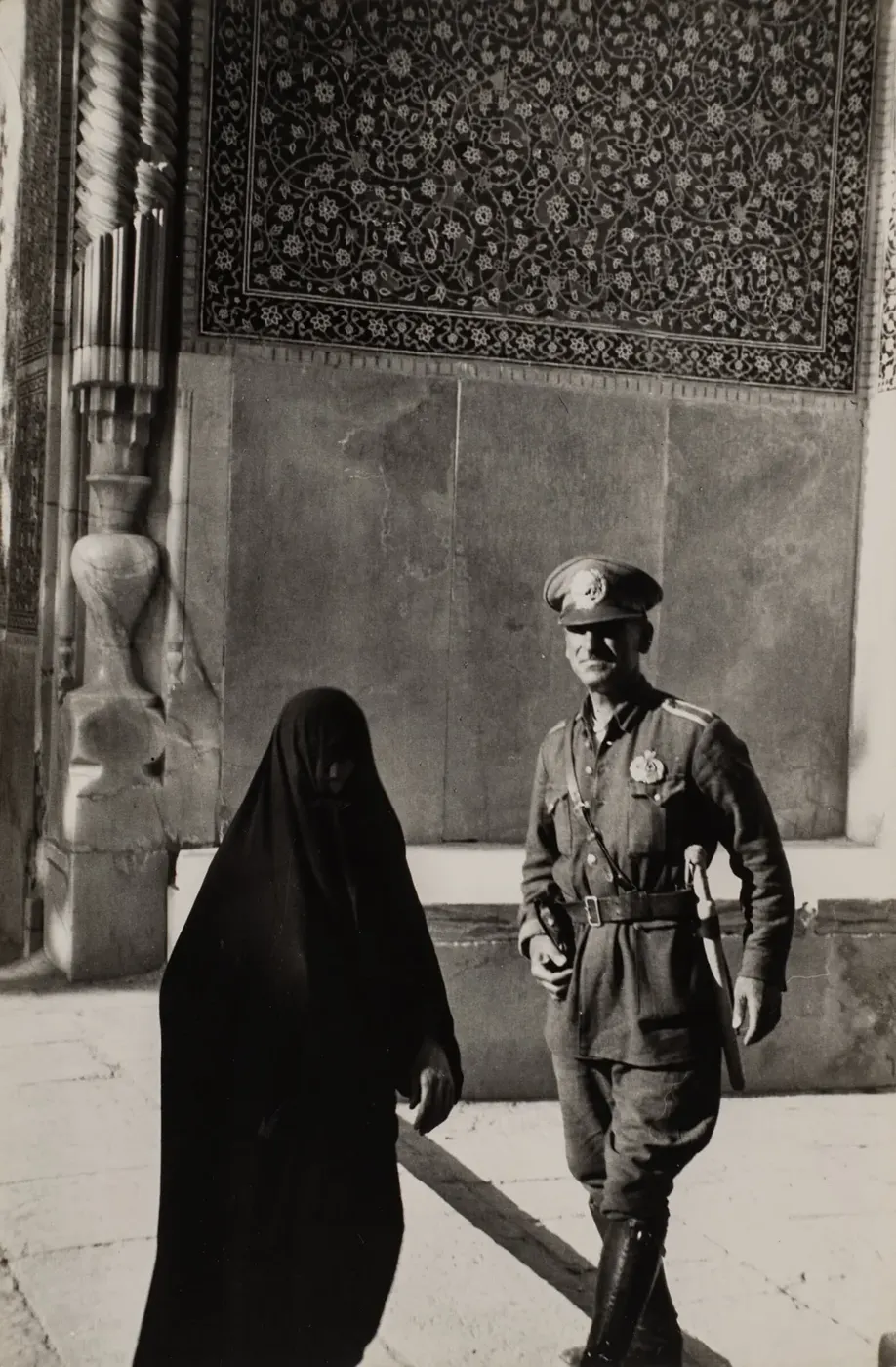
"Iranian Woman In Chadar" is memorable for how quickly it establishes a world. Two figures occupy the foreground with completely different visual identities, while the architecture behind them gives the scene cultural specificity and formal elegance. The photograph feels documentary and composed at once: immediate in its human presence, deliberate in its arrangement of tone, pattern, and shape.
Two figures create the image’s lasting drama
The photograph’s emotional force begins with the encounter between the woman in chadar and the uniformed officer. Their clothing, stance, and social presence are legible at a glance, so the frame carries narrative weight without needing explanation. The officer’s tailored uniform, cap, and forward stride read against the woman’s enveloping dark garment and slower, more inward posture. That contrast gives the image its charge and makes the scene feel observed at exactly the right instant.

The juxtaposition of the two figures gives the photograph immediate narrative power.
The chadar becomes a beautifully graphic form
The woman’s figure is rendered as a near-solid dark shape, and that simplicity is one of the picture’s strongest visual decisions. Her silhouette anchors the lower half of the frame and gives the eye an immediate point of recognition. Because the garment reads as one continuous mass, it brings calm and gravity to the composition while setting up a striking tonal counterpoint to the officer and the pale paving.

The cloaked silhouette is bold, elegant, and instantly legible.
Ornament and structure root the scene in place
The upper portion of the image is rich with patterned tilework, and it does more than decorate the background. The dense floral geometry establishes a vivid sense of location and culture, while its rectangular framing introduces order above the looser human movement below. On the left, the carved architectural column adds another layer of texture and vertical rhythm, balancing the figures and deepening the sense of setting. Together these details make the photograph feel inseparable from its architectural context.

The architectural detail gives the image both cultural specificity and formal richness.
Shadows and paving carry the eye through the frame
The geometry underfoot quietly strengthens the composition. A diagonal shadow cuts across the paving and leads the eye toward the figures, reinforcing the officer’s motion and giving the lower half of the image directional energy. The pavement lines, the wall panels, and the rectangular tile field all work together to create a structured stage for the human moment. That combination of movement and order is part of what makes the photograph feel so resolved.
The diagonal shadow adds movement and ties the whole composition together.
Why this photograph stands out
What makes this photograph enduring is its clarity. The human contrast is immediate, the silhouette is unforgettable, and the architecture transforms a fleeting street moment into something iconic. Every major element in the frame—figure, wall, tile, column, shadow—contributes to a picture that feels both documentary and deeply designed.
About the photographer
Henri Cartier-Bresson
Henri Cartier-Bresson was renowned for capturing spontaneous moments of human life with remarkable precision and timing. He pioneered the idea of the “decisive moment”—waiting for the instant when gesture, emotion, geometry, and circumstance come together perfectly. His photographs are known for elegant composition, natural light, and an ability to find extraordinary meaning in ordinary scenes. His work helped establish street photography as both a documentary practice and a form of visual art.