Andreas Gursky Bahrain
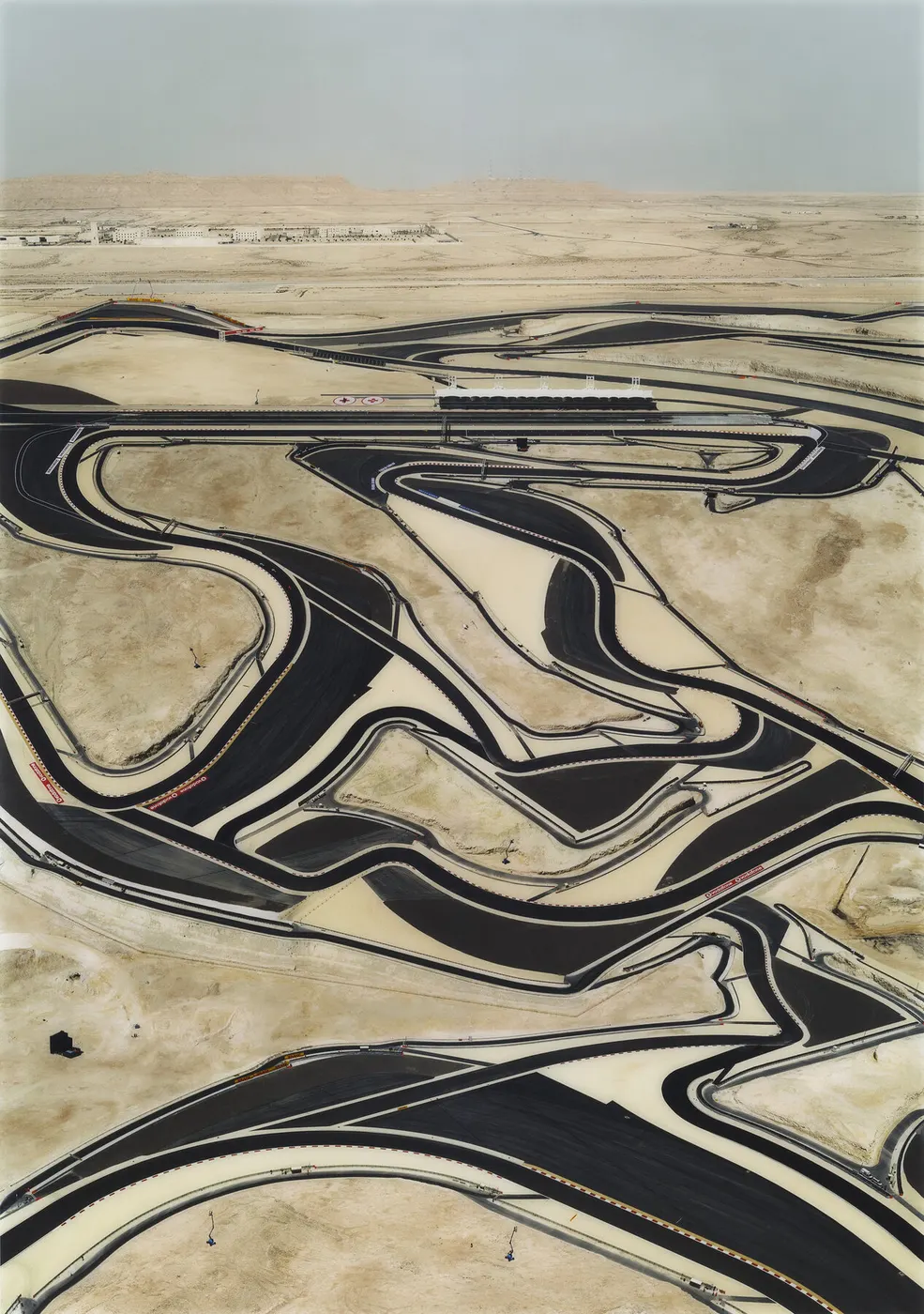
Seen from above, the Bahrain circuit becomes a vast drawing in black ribbon and pale sand. The photograph turns infrastructure into calligraphy, where sweeping loops, sharp switchbacks, and long horizontal cuts create a mesmerizing balance of rhythm and order.
Watch the video
This photograph is unforgettable for the way it transforms a race circuit into pure visual language. From the elevated vantage, asphalt reads as ink laid across desert paper: fluid, precise, and monumental at once. The image holds its power by making scale and abstraction coexist, letting the viewer read the track both as a real place and as a beautifully controlled arrangement of line, curve, and contrast.
The track becomes calligraphy
The central field of linked bends gives the image its signature rhythm. The repeated S-curves and switchbacks flow through the frame like connected brushstrokes, carrying the eye without interruption. What makes this so memorable is the balance between repetition and variation: each turn echoes the next, but none feels mechanically identical. The circuit becomes less a piece of engineering than a piece of drawing.

The interlocking curves give the photograph a striking sense of motion, rhythm, and graphic identity.
Straight lines sharpen the composition
Amid the loops and coils, the horizontal crossing near the upper middle provides a crucial structural counterpoint. Its firmness steadies the image and makes the surrounding curves feel even more fluid. This contrast between strict linear engineering and free-flowing bends is one of the photograph’s most elegant choices. The straight section does not interrupt the design so much as clarify it, giving the eye a moment of orientation before it returns to the maze below.

The long horizontal crossing gives the composition poise and makes the surrounding curves more vivid.
A clear path for the eye
The broad loop on the left side acts as an ideal visual entry point. Its generous arc has real weight, then leads inward toward tighter and more intricate formations in the center. That transition from large, open shape to compact complexity gives the frame a strong internal movement. The photograph feels carefully navigable even at this scale, with each major turn handing attention to the next.

The large left-side loop anchors the frame and guides the eye gracefully into the denser interior patterns.
Dark asphalt, pale desert
The tonal contrast is beautifully decisive. The track surfaces appear almost velvety black against the dry, light sand, so every edge stays legible even when the layout becomes highly intricate. That clean separation is essential to the photograph’s success as abstraction. It allows the viewer to appreciate complexity without confusion, and it gives the entire image a crisp, almost printed quality.
The bold contrast between asphalt and sand makes the circuit read with exceptional clarity and elegance.
Why this photograph stands out
What endures here is the photograph’s extraordinary control. Gursky sees the race circuit not only as a place but as a system of forms: loops, slashes, crossings, and tonal blocks arranged across an immense desert plane. The image is both coolly architectural and deeply lyrical. Its beauty comes from that rare combination of precision and flow, where infrastructure is elevated into something graphic, spacious, and quietly mesmerizing.
About the photographer
Andreas Gursky
Andreas Gursky is known for creating large-scale photographs that reveal the patterns, structures, and complexity of modern life. He often photographs crowds, architecture, landscapes, and commercial spaces from elevated viewpoints, turning real scenes into almost abstract compositions. His work is characterized by precise detail, repetition, symmetry, scale, and carefully controlled color. Gursky’s photographs invite viewers to step back and consider how individuals, systems, and environments fit into a much larger picture.