Andreas Gursky: Not Abstract II - When Inventory Becomes Landscape
"Not Abstract Ii" turns a warehouse of books into a vast visual terrain, where repetition, color, and structure make abundance feel monumental.
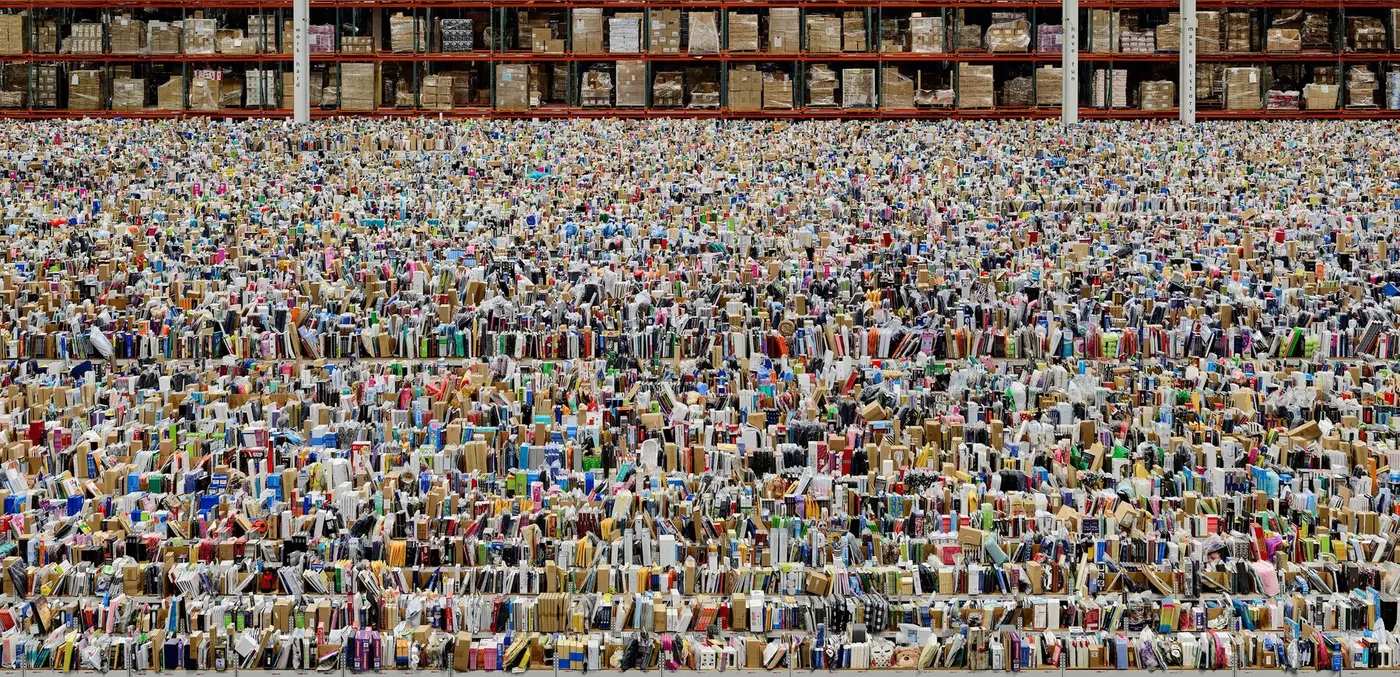
"Not Abstract Ii" is compelling because it shifts a familiar subject into something grander and more surprising. A warehouse full of books becomes a landscape of repetition, texture, and scale. The photograph feels documentary at first glance, then slowly reveals itself as something almost aerial and abstract, built from thousands of individual spines, covers, and packages.
A frame filled with abundance
The image’s greatest strength is how completely it commits to density. Books occupy nearly the entire frame, creating an immediate sense of vastness. What could have been simple inventory instead reads as a continuous surface, like a city seen from above or a field stretching to the horizon. That edge-to-edge fullness gives the photograph its memorable force.

The sea of books turns sheer quantity into a striking visual experience.
Shelving that sets the scale
The horizontal shelving band at the top is a decisive compositional choice. It anchors the picture with a clean industrial structure and gives the viewer a measuring device for the mass below. Because the shelves are orderly and elevated above the books, they make the lower field feel even larger, reinforcing the photograph’s sense of immensity.

The top shelving line gives the scene clarity, context, and an impressive sense of scale.
Repetition with just enough interruption
The photograph is rich in rhythm. Row after row of upright books creates a tightly packed pattern, while the warehouse supports above break that repetition at measured intervals. Those pale vertical columns keep the geometry active without disrupting the overall order. The result is highly structured but never mechanical.
The repeating geometry feels lively because the structure includes subtle, well-placed variation.
Color that rewards close looking
Although the palette is dominated by cardboard browns, off-whites, and muted warehouse tones, small bursts of bright color are scattered throughout the frame. Blues, reds, pinks, and greens appear in little pockets among the books, keeping the image visually alive. These accents prevent the density from becoming monotone and encourage the eye to keep exploring.
Small flashes of color energize the repetition and enrich the photograph’s detail.
Light that preserves every surface
The diffuse warehouse light suits the subject beautifully. It keeps the scene legible from front to back, allowing the textures of paper, plastic wrapping, cardboard, and printed covers to remain visible across an extremely busy frame. Because there are no harsh shadows competing for attention, the photograph can sustain this level of complexity while still feeling open and readable.
Soft, even light lets the photograph hold an extraordinary amount of texture and information.
Why this photograph stands out
What makes "Not Abstract Ii" so memorable is its ability to balance documentary precision with visual transformation. Every visible choice in the frame—density, structure, rhythm, color, and light—supports the idea that books can become a landscape. It is a photograph about inventory, but it is also about scale, pattern, and the quiet beauty of accumulation.
About the photographer
Andreas Gursky
Andreas Gursky is known for creating large-scale photographs that reveal the patterns, structures, and complexity of modern life. He often photographs crowds, architecture, landscapes, and commercial spaces from elevated viewpoints, turning real scenes into almost abstract compositions. His work is characterized by precise detail, repetition, symmetry, scale, and carefully controlled color. Gursky’s photographs invite viewers to step back and consider how individuals, systems, and environments fit into a much larger picture.