Hyeres by Henri Cartier-Bresson
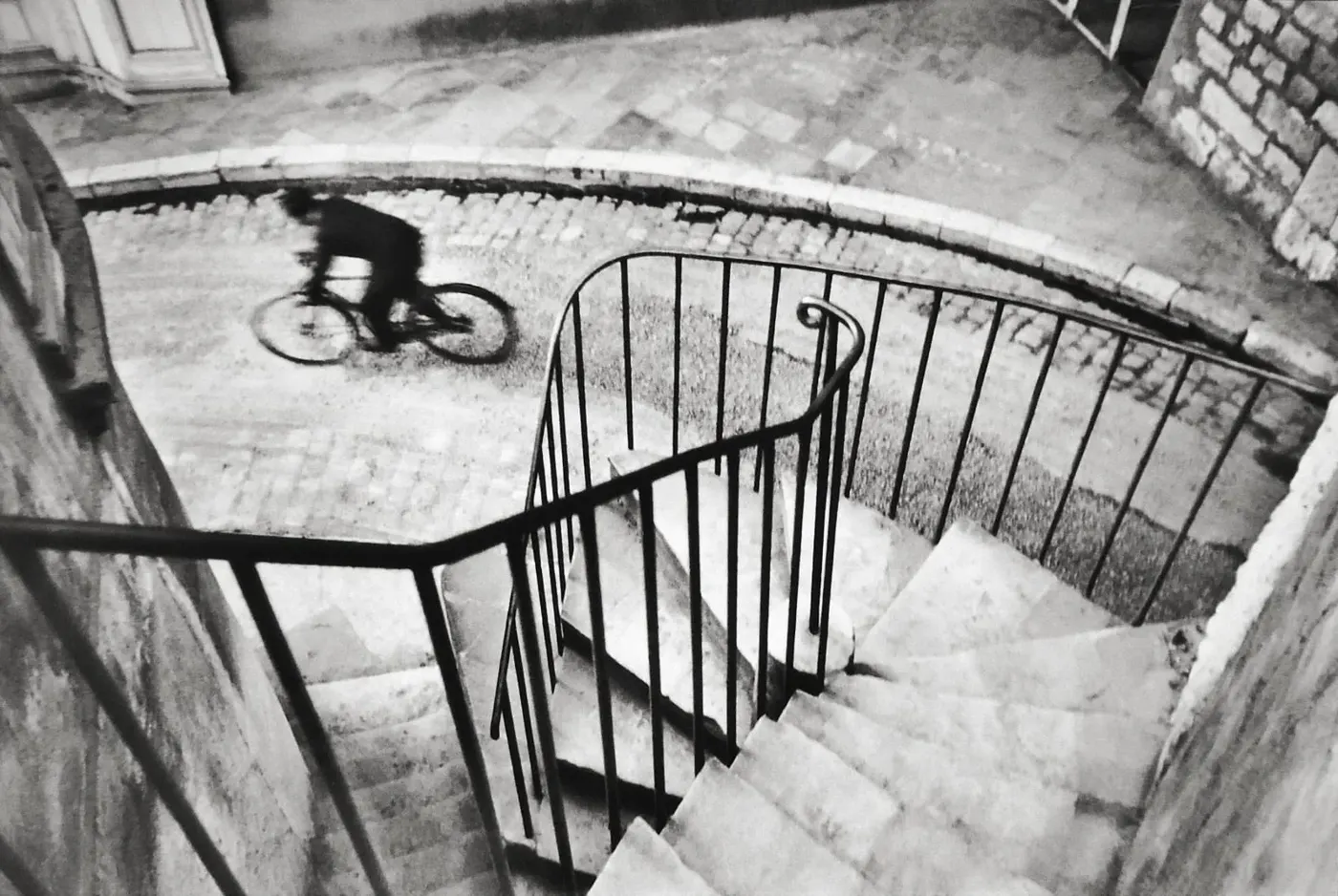
A spiral stair, a curved street, and a passing cyclist come together in a black-and-white frame that feels both rigorously composed and vividly alive.
Watch the video
This photograph turns an everyday street corner into a piece of visual choreography. The descending spiral stair gives the frame its commanding shape, while the blurred cyclist slipping through the bend below introduces speed, chance, and life. What makes the image memorable is how confidently it balances those two forces: fixed architecture and passing motion.
A staircase that organizes the entire frame
The spiral railing is the picture’s central act of design. Its dark curve sweeps through the foreground with real authority, pulling the eye down the steps and into the street below. Because the photograph is made from above, the stair becomes more than a setting; it becomes the structure that holds the whole image together. The repeating vertical bars keep the curve legible and rhythmic, giving the scene a strong internal order.

The staircase provides a bold compositional anchor that gives the image depth, rhythm, and immediate identity.
Motion used as a living counterpoint
The cyclist is rendered as a blur, but the effect feels expressive rather than loose. Against the stillness of stone and iron, that softened figure suggests velocity and a fleeting moment caught at exactly the right time. The rider’s path across the upper left of the frame gives the photograph narrative tension: something is passing through this carefully ordered space, and the image becomes about time as much as place.

The motion-blurred cyclist brings energy and human presence to a scene defined by structure.
Curves that echo across the picture
One of the photograph’s most elegant qualities is the visual rhyme between the staircase and the street. The arc of the railing is answered by the bend of the curb, so the image feels unified by repeated shape rather than assembled from separate elements. That echo creates a subtle harmony: the geometry of the built environment flows from foreground to background in one continuous movement.
The repeated arcs of stair and street give the photograph a graceful geometric cohesion.
Monochrome that heightens touch and structure
Black and white suits this scene beautifully. Without color to compete for attention, the materials stand out with clarity: worn stone steps, rough cobbles, pale pavement, and dark iron bars all register as distinct surfaces. The tonal treatment lets the photograph lean into texture and form, reinforcing its tactile quality and giving the architecture a sense of age and weight.
The monochrome rendering makes texture and material contrast feel vivid and tactile.
Why this photograph stands out
Hyeres is memorable because it makes design and spontaneity feel inseparable. The spiral stair supplies a striking graphic framework, the cyclist introduces a fleeting human note, and the monochrome palette sharpens every curve, bar, and stone surface. The result is a street photograph with both formal elegance and lived immediacy.
About the photographer
Henri Cartier-Bresson
Henri Cartier-Bresson was renowned for capturing spontaneous moments of human life with remarkable precision and timing. He pioneered the idea of the “decisive moment”—waiting for the instant when gesture, emotion, geometry, and circumstance come together perfectly. His photographs are known for elegant composition, natural light, and an ability to find extraordinary meaning in ordinary scenes. His work helped establish street photography as both a documentary practice and a form of visual art.