Julia Margaret Cameron’s J.F.W. Herschel and the Poetry of Presence
In J.F.W. Herschel, Julia Margaret Cameron turns a portrait into an encounter, using luminous hair, sculpted light, and a searching gaze to give the sitter extraordinary inner life.
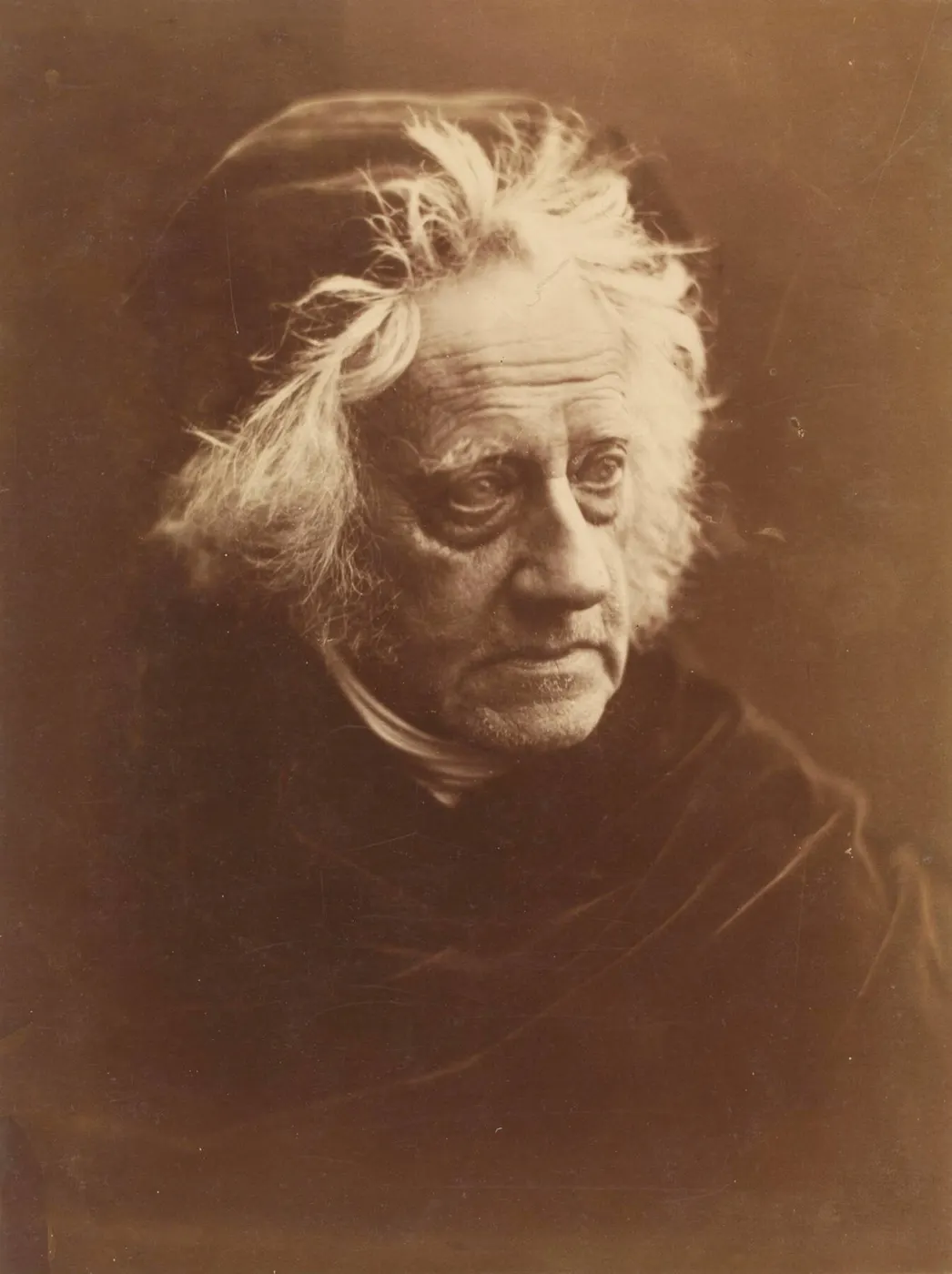
Julia Margaret Cameron’s portrait of J.F.W. Herschel feels less like a document than a revelation. The photograph holds on character with remarkable intensity: the distant gaze, the luminous disarray of the hair, and the gentle sculpting of the face all work together to suggest thought in motion. Cameron’s gift for expressive portraiture is fully visible here, turning age, texture, and softness into something intimate and quietly monumental.
A gaze that opens an inner life
The emotional center of the portrait is Herschel’s look away from the camera. His eyes do not meet the viewer; instead, they travel outward into space, and that simple choice gives the image its reflective power. The face appears caught in thought rather than posed for inspection, which makes the portrait feel deeply human. The heavy lids, shadowed eye sockets, and slight downward set of the mouth reinforce that sense of inward attention.

The off-camera gaze gives the portrait its unforgettable psychological presence.
Hair as halo, energy, and signature
Herschel’s white hair is one of the image’s most memorable visual elements. It lifts and spreads around his head in loose, bright strands, creating a living frame for the forehead and eyes. The effect is almost halo-like, but it never feels ornamental; it feels expressive, as if thought itself has stirred the surface of the portrait. Against the darker background, this unruly shape gives the sitter an immediate and distinctive silhouette.

The luminous, untamed hair turns the sitter into an instantly recognizable presence.
Light that carves the face with tenderness
Cameron uses side light to model the face with exceptional sensitivity. The bridge of the nose, the cheek plane, and the brow emerge clearly, giving the head a sculptural firmness within the photograph’s overall softness. At the same time, the lighting remains gentle enough to preserve vulnerability. The result is a beautiful balance between structure and feeling: the face feels solid, but never hard.
The side lighting gives the portrait both sculptural strength and emotional softness.
Age rendered as character, not surface
The lines across the forehead, the hollows beneath the eyes, and the fine texture around the mouth are all visible, yet nothing feels clinical. Cameron records these details with warmth, allowing age to read as experience and presence rather than mere description. Even with the image’s soft focus and atmospheric diffusion, the face keeps enough specificity to feel vivid and personal. This handling of texture is one reason the portrait seems so alive.

The facial texture conveys intelligence, weariness, and dignity with great sensitivity.
Space and tone that sustain the mood
The open area to the right of Herschel’s face gives his gaze room to travel, which quietly strengthens both the composition and the narrative. Nothing crowds him. The warm brown tonality and soft edge falloff deepen that sense of stillness, wrapping the portrait in a unified atmosphere. The dark clothing and background recede, allowing the illuminated face and hair to hold the frame without interruption. Everything is reduced to what matters most: presence, thought, and form.
The negative space and warm monochrome palette give the portrait its calm, timeless atmosphere.
Why this photograph stands out
J.F.W. Herschel shows why Julia Margaret Cameron remains one of photography’s great portraitists. She finds grandeur not through spectacle, but through attention to expression, light, and the subtle drama of a face in thought. The image lingers because every major choice—the searching gaze, the radiant hair, the sculpted planes, the warm surrounding hush—serves the same end: to make inner presence visible.
About the photographer
Julia Margaret Cameron
Julia Margaret Cameron was known for her **intimate, expressive portraits**, using photography to explore character, emotion, and the inner presence of her subjects. Rather than pursuing technical perfection, she embraced soft focus, dramatic lighting, and imperfect details to create images with a distinctly painterly and poetic quality. Her distinctive style is characterized by **close framing, luminous faces, atmospheric softness, and a dreamlike sense of intimacy**. Cameron deliberately used blur and shallow focus as expressive tools, giving her portraits a romantic, almost ethereal quality and helping establish photography as a medium capable of personal artistic expression.