How to Develop Your Own Photography Style
A personal photography style usually does not begin as a signature look. It emerges from repeated choices about subject, framing, timing, light, and editing across a body of work.
TL;DR
Style is better understood as a pattern of repeated decisions than as a preset, genre label, or decorative look.
Your strongest clues are already in your archive: recurring subjects, distances, light, framing habits, and editing choices.
Studying great photographers helps most when you analyze structure and decision-making rather than copy subjects or color grading.
A personal style becomes clearer across projects, contact sheets, and sequences than in isolated single images.
Editing is not just cleanup; it is where your actual preferences and repeated visual solutions become visible.
If you force uniqueness too early, you often get gimmicks. Coherence usually matters more than instant originality.
Many serious amateur photographers ask the wrong question too early. They ask, What is my style? and imagine the answer will arrive as a recognizable look: a certain preset, a lens choice, a genre label, a moody palette, a way of composing, or a type of subject. The evidence behind photographic practice suggests something less glamorous but more useful. Style is usually not something you invent on demand. It is something that becomes visible after enough repeated choices about subject, framing, time, vantage point, and editing accumulate across your work.
MoMA materials on The Photographer's Eye frame photography around medium-specific problems such as the thing itself, detail, frame, time, and vantage point.
That shift matters because many photographers hit a plateau after technical competence. The files are sharp, exposure is reliable, and compositions are no longer chaotic, but the work still feels inconsistent or generic. Miru's archive repeatedly describes this stage as a transition from operating the camera to making better visual decisions: noticing relationships, controlling hierarchy, reading light, and editing more honestly. A style worth having grows out of those decisions, not around them. The Miru archive emphasizes hierarchy, relationships, and editing as core to stronger photographs.
External practice-based sources point in the same direction. Getty's educational material teaches close description and formal analysis of photographs as learnable skills, while Magnum and Aperture material emphasize editing, sequencing, notes, repetition, and sustained bodies of work. Taken together, these sources support a practical argument for serious amateurs: stop trying to look distinctive on command, and start tracking what you repeatedly notice, exclude, and keep. Getty teaches formal analysis; Magnum and Aperture emphasize editing, sequencing, and body-of-work development.
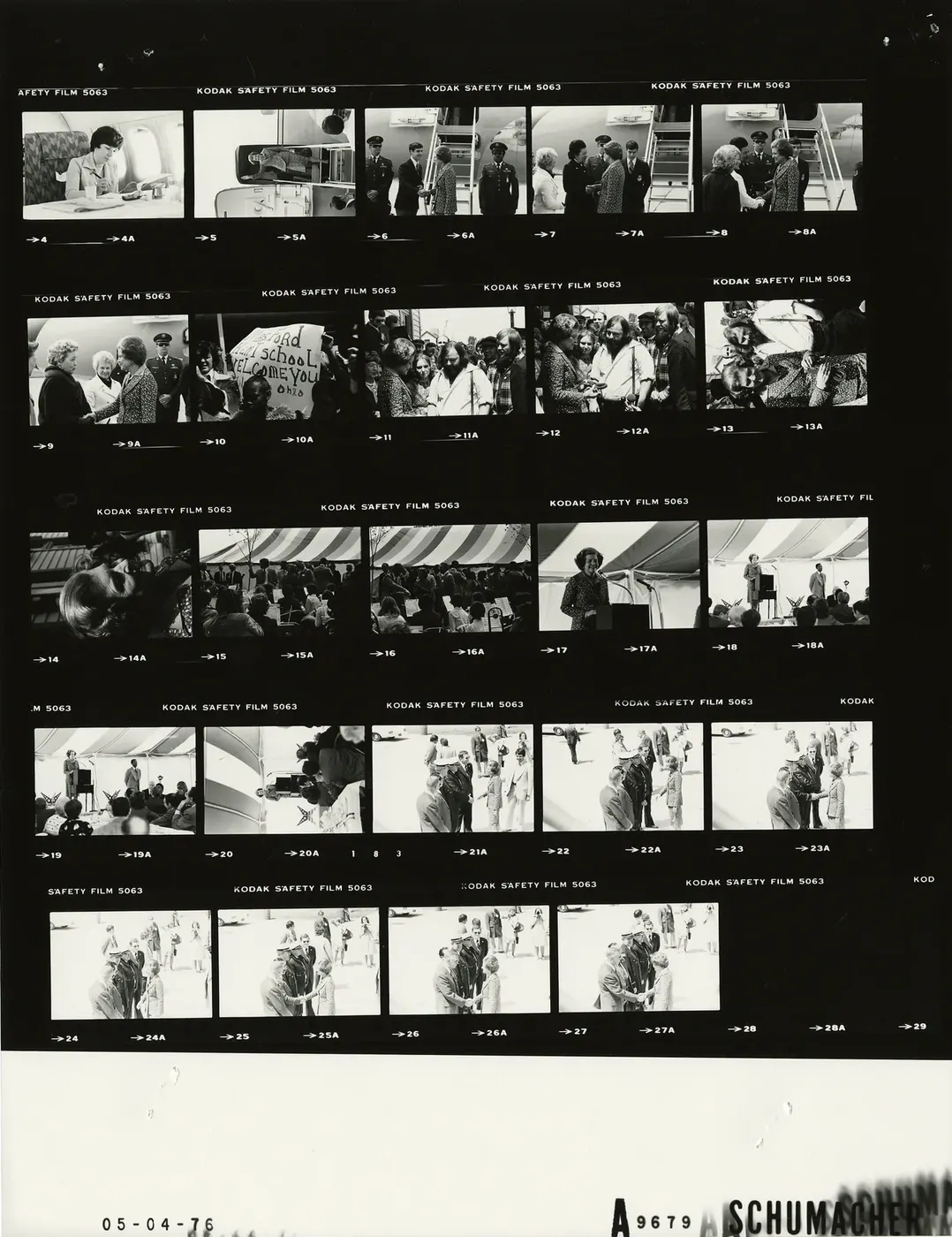
White House Photographic Office (WHPO) - Schumacher — Public domain. Resized and compressed to WebP; visual content unchanged. Original image.
Why 'finding your style' is the wrong first question
The phrase find your style sounds helpful, but it often pushes photographers toward shortcuts. If you assume style means a signature surface, you start searching for one obvious identifier: dramatic contrast, muted color, cinematic grading, wide-angle street scenes, centered portraits, foggy landscapes, black-and-white conversions. Those choices can become part of a style, but the research supplied here does not strongly support reducing style to any one of them. The stronger support is for a medium-specific view: photographs are built through recurring decisions about what to show, what to exclude, when to press the shutter, and from where to stand. MoMA's The Photographer's Eye organizes photography around frame, time, detail, and vantage point rather than surface treatment.
This is also why famous labels can mislead. ICP's material on Henri Cartier-Bresson notes that the English title The Decisive Moment simplified a broader original idea. That is a useful warning for anyone trying to build a style around a slogan. Even one of photography's most repeated phrases does not fully explain the work it is attached to. Timing mattered, but so did geometry, selection, framing, and organization. ICP notes that the English title simplified the original French framing.
In practice, the wrong first question produces two predictable problems. First, photographers force consistency before they have enough real evidence about what they care about. Second, they confuse recognizability with depth. A recognizable look can be shallow if it survives only by repetition. A stronger style usually has deeper roots: recurring concerns, recurring formal habits, and recurring editing preferences. Miru's pieces on boring photos and developing your eye are useful here because they redirect attention from novelty and gear toward the act of noticing. Style begins there. Miru articles argue that technically competent images still fail when the photographer has not learned to notice relationships and meaning.
Ask first: What kinds of visual problems do I keep trying to solve?
Ask later: Do those solutions create a coherent body of work?
Ask last: Is there a recognizable look emerging from those choices?
Common shortcut | Why it fails | Better question |
|---|---|---|
Pick a preset first | Surface consistency can hide weak seeing | What decisions repeat in my strongest work? |
Copy a favorite photographer's subject matter | Borrowed subjects rarely produce authorship | What problem is that photographer solving? |
Try to be unique immediately | Forced originality often becomes gimmick | What do I reliably notice that others miss? |
Judge single images in isolation | Style is hard to see one frame at a time | What patterns appear across 20 to 50 images? |
Style is a pattern of repeated decisions
A useful definition for serious amateurs is this: photography style is the visible pattern created by your repeated decisions. Some of those decisions are obvious, such as your preferred subjects or whether you work in color or black and white. Others are subtler: how close you stand, how much context you include, whether you wait for a gesture, whether you prefer calm or tension, whether you simplify backgrounds aggressively, whether you like deep space or flat graphic arrangements, and whether your final edit favors quiet frames over spectacular ones.
MoMA's framing of photography through subject, detail, frame, time, and vantage point is especially helpful because it gives you categories you can actually inspect in your own archive. If your best pictures repeatedly isolate small details from larger scenes, that tells you something. If they rely on a wide view with figures held small inside structured space, that tells you something else. If they depend on waiting for one event to activate an already chosen frame, that is stylistic evidence too. MoMA presents these categories as central photographic concerns.
Miru's archive adds a practical layer to this definition by emphasizing hierarchy and relationships. Strong photographs are not just records of interesting things; they are decisions about what matters most and what must stay subordinate. If your pictures consistently use light to isolate the subject, or if they often depend on one small bright accent in a quieter field, or if you repeatedly choose moments where gesture completes geometry, those are not random habits. They are the beginnings of style. Miru articles emphasize hierarchy, edge control, timing, line, rhythm, and light as compositional decisions.
Subject choice
Distance and vantage point
Timing and waiting
Light preference
Complexity versus simplicity
Editing tolerance for ambiguity
Decision area | What to look for in your archive | What it may reveal |
|---|---|---|
Subject | People, spaces, objects, routines, transitions | What you care to return to |
Frame | Tight, layered, minimal, centered, edge-heavy | How you organize attention |
Time | Peak gesture, stillness, aftermath, repetition | How patient or reactive you are |
Light | Soft, hard, backlit, flat, high-contrast | What mood and hierarchy you prefer |
What to track in your own work
If style is an emergent pattern, you need evidence. That means reviewing your own photographs in groups rather than relying on memory. Memory is unreliable because it preserves the experience of making the picture: the trip, the weather, the difficulty, the subject's importance, the excitement of the scene. The viewer sees only the rectangle. Miru's writing on critique and editing makes this point clearly: contact sheets and near-duplicates reveal what actually changed, and what truly mattered, better than memory does. Miru emphasizes review of contact sheets, near-duplicates, and distance from the shooting experience when judging work.
Start with six categories: subject, distance, frame, time, light, and exclusion. Subject is not just genre. It includes what kinds of human situations, spaces, objects, or atmospheres keep attracting you. Distance asks whether you prefer intimacy, observational distance, or environmental context. Frame asks how you arrange the rectangle: dense and layered, sparse and graphic, centered and static, or asymmetrical and tense. Time asks whether your pictures depend on climax, anticipation, stillness, repetition, or aftermath. Light asks what conditions you repeatedly favor or reject. Exclusion asks what you routinely remove from the picture and what you tolerate.
You can also track emotional temperature, though that category should be handled carefully because interpretation is less stable than visible structure. Still, over time you may notice that your strongest work leans toward calm observation, tension, humor, melancholy, theatricality, ambiguity, or intimacy. Treat that not as a fixed identity but as a clue. Style often includes a repeated way of approaching experience, not just a repeated visual layout.
Review 100 to 200 images, not your last 10.
Group similar photographs together.
Save near-duplicates instead of deleting them immediately.
Write one sentence about why each keeper survives.
Mark recurring failures too; they show your unfinished style.
Category | Questions to ask | Example pattern |
|---|---|---|
Subject | What do I keep returning to without assignment or pressure? | Transit spaces, family rituals, edges of cities |
Distance | Do I shoot close, mid-distance, or with large context? | Figures kept small within architecture |
Time | Do I react fast or build a frame and wait? | Patch of light first, person second |
Exclusion | What do I crop out or simplify consistently? | Bright clutter removed to protect hierarchy |
How studying great photographers helps without trapping you in imitation
Studying admired photographers is still one of the best ways to improve, but only if you study decisions instead of appearances. Getty's teaching material supports formal analysis as a learnable practice: description, reflection, and close attention to how a photograph works. That is a better route to style than copying a subject category or preset because it expands your sense of what photographic decisions are possible. Getty's curriculum emphasizes description, reflection, and formal analysis.
For example, do not ask only, Why do I like this image? Ask: what is being emphasized, what is excluded, why this distance, why this moment, and what would collapse if the frame changed? That line of questioning converts admiration into method. You begin to see how another photographer solves the problems of frame, time, and vantage point, which are exactly the medium-specific concerns highlighted by MoMA. MoMA foregrounds frame, time, and vantage point; Getty teaches formal analysis.
Miru's article on studying great photographers makes a similar point in more practical language: build a mental library of visual solutions, not a mood board of surfaces. You are trying to become sensitive to relationships you might otherwise miss, such as a figure small enough to establish scale, a reflection that divides space, a repeated form interrupted by one variation, or a geometry that needs a live event to activate it. Those are the kinds of lessons that strengthen style because they change how you see. Miru describes studying photographers as building a library of visual solutions.
Borrow methods of seeing.
Borrow questions, not aesthetics.
Borrow patience, not only framing.
Borrow editing discipline, not just subject matter.
Weak study habit | Stronger study habit | Likely result |
|---|---|---|
Copy the look | Analyze the decisions | Broader visual vocabulary |
Copy the subject | Study the structure | More adaptable shooting |
Memorize famous images | Compare near-variations and alternatives | Better timing and editing |
Collect inspiration endlessly | Test one borrowed method on your own work | Real change in practice |
Why style becomes visible in projects, sequences, and contact sheets
One of the clearest themes in the external research is that style becomes easier to see at the level of a body of work. Magnum's Gregory Halpern emphasizes editing, sequencing, notes, and time, while Aperture's material on finishing bodies of work similarly frames photographic development as something discovered through sustained process rather than declared in advance. Magnum and Aperture emphasize editing, sequencing, time, and body-of-work development.]
This matters because single images can hide inconsistency. You can make one successful photograph in many different ways. A body of work exposes what keeps returning. Maybe your strongest images all depend on a person held slightly distant in a structured environment. Maybe they consistently favor transitions between public and private space. Maybe your best sequences rely on quiet intervals rather than climactic action. Those recurrences are stronger evidence of style than any isolated keeper.
Projects help because they narrow the field enough for patterns to emerge. If you photograph one neighborhood repeatedly, one family ritual, one workplace, one stretch of coast, or one type of urban edge, your attention stops feeding on novelty. What remains is your way of working: where you stand, what you wait for, what you ignore, what light you accept, and which images survive editing. That is much closer to style than a randomly assembled portfolio of unrelated wins.
A project reduces novelty and reveals habits.
A sequence shows what your pictures say together.
A contact sheet shows how small variations matter.
A body of work reveals concerns that single images conceal.
Unit of review | What it reveals | Why it matters for style |
|---|---|---|
Single image | Whether one frame works | Useful but limited |
Near-duplicate pair | Why one moment or framing is better | Reveals preferences |
Contact sheet | How you approached the scene | Reveals process |
Small project | What concerns and methods persist | Reveals style most clearly |

A contact sheet with dense rows of negatives and many closely related frames, illustrating how sequences can reveal repeated choices in timing, distance, and editing. David Hume Kennerly — Public domain. Resized and compressed to WebP; visual content unchanged. Original image.
Editing is where your style becomes legible
Editing is often described as selection, but for style development it is closer to diagnosis. Halpern's emphasis on editing and sequencing is important because repeated comparison shows not only which images are strongest, but what kinds of solutions you keep preferring. When you choose one frame over another, you reveal standards: cleaner edges, quieter backgrounds, more ambiguous expression, stronger geometry, gentler light, more tension, less explanation. Magnum material emphasizes editing and sequencing.
This is also why Miru's advice about critique questions is so valuable. Instead of asking only whether a photo is good, ask what the viewer notices first, what supports the main subject, what feels accidental, and why this frame works better than the one before or after it. Those questions shift editing from taste to evidence. Over time, your answers form a map of your style. Miru recommends more diagnostic critique questions centered on attention, support, distraction, and comparative review.
Be careful not to confuse consistency with narrowness. A style is not the habit of making the same photograph forever. Editing should reveal both continuity and range. The question is not whether every image looks identical. It is whether the work feels related by attention, values, and decision-making. A body of work can contain different subjects and still feel coherent if the underlying choices are recognizably yours. Keep alternate frames during editing.
Compare images side by side, not one by one.
Write down why the survivor wins.
Look for repeated reasons across different shoots.
Editing question | What it uncovers | Style clue |
|---|---|---|
Why does this frame survive? | Selection criteria | What you value |
Why does this near-duplicate fail? | Tolerance for distraction or ambiguity | How exacting you are |
What kinds of pictures keep reappearing? | Recurring concerns | What you care about |
Which good images feel unlike the rest? | Outliers versus core work | What is central to your style |

Another contact sheet with multiple related frames across interiors, crowds, and speeches, showing how editing across variations can reveal a photographer's recurring preferences. David Hume Kennerly — Public domain. Resized and compressed to WebP; visual content unchanged. Original image.
A practical style audit for your last 100 to 200 images
If you want a concrete exercise, audit your last 100 to 200 serious images. Do not choose only your favorites at first. Include work from different shoots but not casual test frames. Your goal is to discover patterns, not flatter yourself. This number is practical editorial guidance rather than a documented threshold from the sources, but it aligns with the research emphasis on bodies of work, contact sheets, and repeated review. Sources emphasize body-of-work review and editing over isolated judgment.
First pass: mark any image that still holds your attention after a few seconds. Second pass: group them by visual resemblance rather than by date or location. You may discover clusters such as backlit figures, quiet interiors, graphic street geometry, intimate portraits with low contrast, layered public scenes, or small human gestures in larger spaces. Third pass: write one short note for each cluster explaining what makes it work. Keep the language visual and specific.
Then run a failure audit. Choose 20 near-misses and explain why they fail. Weak style development often hides inside weak review habits. If you repeatedly ruin pictures with edge clutter, rushed timing, over-explaining context, or background competition, that tells you as much about your current style as your keepers do. It shows where your eye is already leaning and where it still loses control. Miru's exercises on edge patrol, timing, and figure-ground separation are especially relevant here. Miru recommends drills for edge awareness, timing, and figure-ground clarity.
Make two sets: persistent keepers and persistent near-misses.
Group by visual logic, not by genre or location.
Name each cluster in plain language.
Turn repeated failures into your next practice drills.
Audit step | What to do | What you learn |
|---|---|---|
Select | Mark images that still hold attention | Initial evidence of taste |
Cluster | Group by visual resemblance | Recurring choices |
Describe | Write why each cluster works | Style language |
Diagnose | Review near-misses and failures | What to improve next |
How to refine your style without forcing it
Once you can see patterns, you can refine them deliberately. The goal is not to exaggerate them into a gimmick. The goal is to test them under more conditions. If you notice that your strongest work depends on waiting for figures to enter structured backgrounds, spend a month working that way in different places and light. If your pictures are strongest when they isolate small gestures in domestic spaces, build a small project around that. If your best work depends on quiet tonal control, work in conditions that challenge it rather than abandoning it.
This is where limits become productive. Miru's exercises suggest working one decision at a time: one focal length, one subject with many interpretations, one background with multiple events, one type of color relationship, one timing problem. Those drills are useful for style because they reveal preference under pressure. When the easy options are removed, your real habits become easier to see. Miru provides exercises using fixed focal length, repeated subject interpretation, timing drills, and constrained shooting.
You can also refine style through projects that have a working question rather than a visual costume. Miru's subject-finding article is strong on this point: categories are not enough. A subject becomes richer when tied to a question you want to understand. The same is true of style. If your work is anchored to a real curiosity, formal consistency has something to organize around. Miru argues that subjects become stronger when connected to a question rather than a mere category.
Strengthen what is already promising.
Use constraints to expose real habits.
Build projects around questions, not costumes.
Test your preferred approach in unfamiliar conditions.
If you notice this pattern | Try this refinement | What to watch |
|---|---|---|
Small figures in large spaces | Work one location repeatedly with patient timing | Whether scale remains legible |
Quiet low-contrast images | Photograph in flatter light and edit carefully | Whether subtle hierarchy survives |
Gesture-driven work | Turn off burst mode and time single frames | Whether anticipation improves |
Graphic compositions | Use one focal length and inspect edges obsessively | Whether structure gets stronger without formula |
Mistakes to avoid when building a personal style
The first mistake is copying appearances instead of methods. If you imitate someone's grading, subject matter, or lens choice without understanding the problem they were solving, your results will usually feel secondhand. Getty's formal-analysis approach and Miru's study-admiration guidance both point toward a better route: learn how a photograph works before you borrow anything from it. Getty emphasizes analysis; Miru emphasizes studying decisions rather than copying subjects.
The second mistake is chasing novelty for its own sake. New places and dramatic subjects can be useful, but novelty often hides weak attention. Miru's archive repeatedly argues that the photographer's real task is not merely to find interesting things, but to discover what is visually interesting about them as photographs. A stable style usually develops faster when you return to accessible subjects than when you keep resetting yourself with spectacle. Miru emphasizes the distinction between an interesting subject and an interesting photograph.
The third mistake is mistaking post-processing consistency for authorship. Editing matters, and many photographers do have recognizable tonal or color preferences. But the supplied research did not strongly support the idea that style is fundamentally a grading problem. If the photographs themselves are indecisive, no consistent preset will rescue them. Processing can reinforce style; it usually cannot create one from nothing. The research report found no strong museum or archive support for reducing style to presets or color grading.
Do not force originality before you have evidence.
Do not confuse recognizability with depth.
Do not let editing replace seeing.
Do not expect one slogan to explain your work.
Mistake | Why it is tempting | Better alternative |
|---|---|---|
Copying aesthetics | It produces fast visible change | Study decision-making and structure |
Chasing novelty | New subjects feel automatically important | Return to accessible subjects repeatedly |
Preset-driven consistency | It creates an instant look | Build consistency through framing, timing, and editing judgment |
Declaring a style too early | It reduces uncertainty | Let patterns emerge from real work |
What remains uncertain
It is worth being careful about claims of originality and uniqueness. Within the supplied research, I did not find strong primary-source support for saying that photographers should pursue uniqueness as an early-stage priority. The evidence is stronger for long-term refinement through looking, project work, editing, and repeated decision-making. So if you feel you do not yet have a distinctive style, that may not be a problem. It may simply mean you are still generating the evidence from which one becomes visible. The research report did not find strong support for originality as an early-stage priority.]
It is also worth noting that the research base here is stronger on photographic theory, museum framing, pedagogy, and expert practice than on peer-reviewed cognitive science about exactly how personal style develops. Getty is an educational source, and Magnum and Aperture are expert editorial sources rather than neutral scientific authorities. That does not make them unhelpful; it means their guidance is best treated as informed practice rather than universal law. The research report explicitly notes these evidentiary limits.]
For that reason, treat every recommendation in this article as a practical method to test, not a fixed doctrine. Your style may emerge faster in one genre than another. It may be easier to detect in black and white than in color, or in one project and invisible in the next. What matters is not perfect self-definition. What matters is becoming able to see your own repeated decisions clearly enough to strengthen or challenge them on purpose.
The advice here is practice-based, not a scientific formula.
Originality may be a byproduct, not a starting point.
Different genres reveal style at different speeds.
Style development is easier to test than to define abstractly.
A personal photography style is not something you paste onto pictures after the real work is done. It is what becomes visible when your ways of noticing, framing, waiting, excluding, and editing begin to repeat with purpose. For serious amateurs, that is good news. You do not need to invent a brand for yourself before you have made enough photographs. You need to look harder, review more honestly, and work long enough in related directions for your preferences to become undeniable. Study photographs structurally. Build small projects. Keep contact sheets and near-duplicates. Audit your archive for recurring choices. Then refine the patterns that survive. If you do that, style stops being a mysterious identity problem and becomes what it should be: the visible shape of your decisions.
Sources and further reading
Henri Cartier-Bresson: The Decisive Moment - International Center of ...
PhotoWork: Forty Photographers on Process and Practice - Aperture
https://assets.moma.org/documents/moma_press-release_326341.pdf
https://www.icp.org/browse/archive/constituents/henri-cartier-bresson
https://www.getty.edu/education/for_teachers/curricula/exploring_photographs/lesson03.html
https://store.moma.org/products/the-photographers-eye-paperback
https://www.getty.edu/education/teachers/trippack/activity_during_interviewwith.html
https://shop.icp.org/exhibitions/past-exhibitions/love-songs-photography-and-intimacy/
https://www.magnumphotos.com/theme/expert-advice-from-magnum/
https://www.magnumphotos.com/theory-and-practice/refining-your-practice/
https://www.magnumphotos.com/theory-and-practice/photography-insiders-interview-with-alexia-singh/
https://www.magnumphotos.com/theory-and-practice/creating-a-portfolio/
https://aperture.org/editorial/12-photographers-concept-photowork/
https://www.magnumphotos.com/theory-and-practice/magnum-online-portfolio-reviews/
https://www.magnumphotos.com/theory-and-practice/online-portfolio-reviews-highlights/