The Quiet Authority of a Winter Wolf Portrait
This portrait turns a direct encounter into something iconic: a wolf facing the camera head-on, its pale eyes steady, its winter coat luminous against a cool blurred forest.
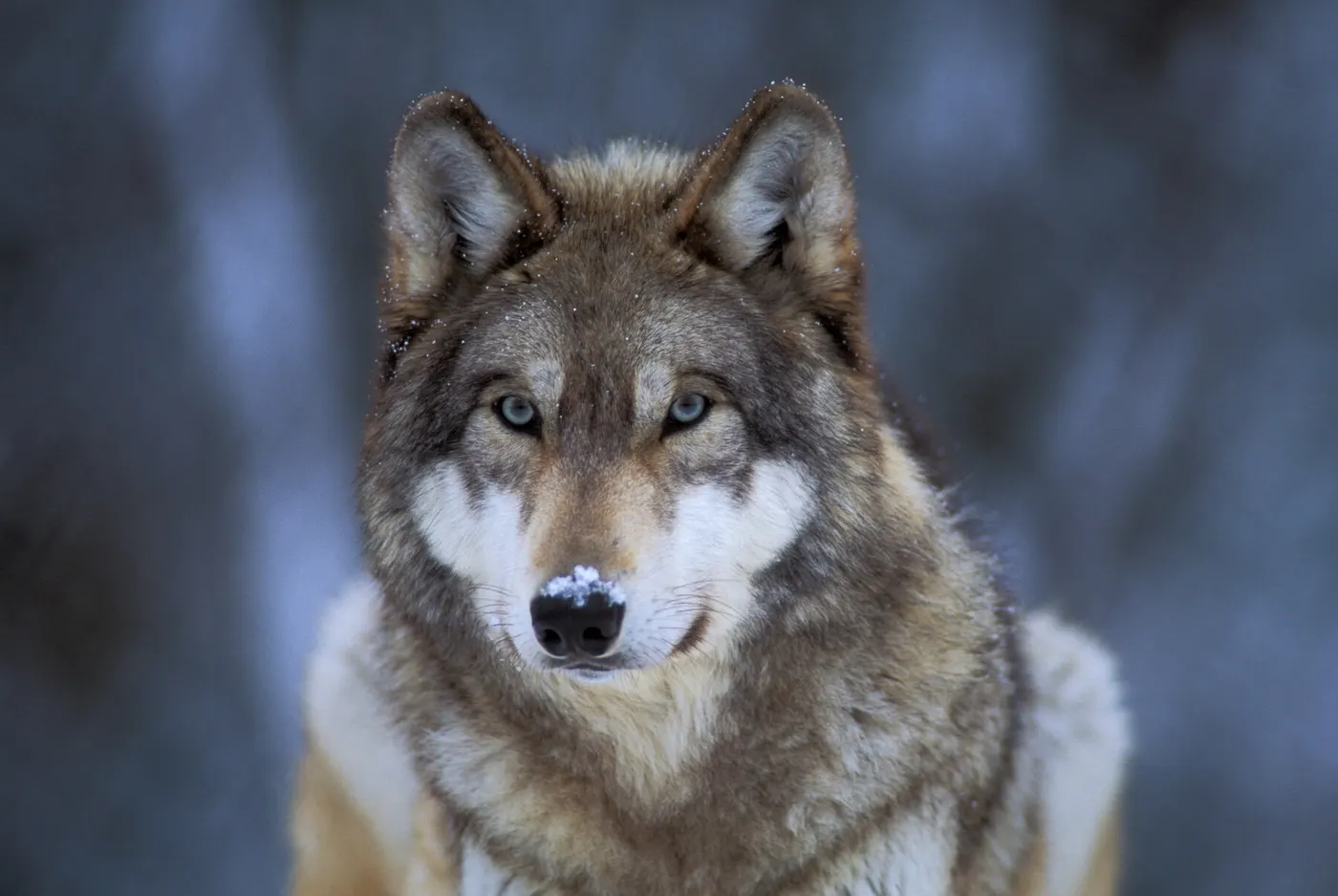
This photograph achieves its power through restraint. A gray wolf stands frontally in soft winter light, centered against a blue-gray woodland blur, and the image lets that simple arrangement do its work. The result feels intimate and monumental at once: a close portrait built on eye contact, calm symmetry, and the tactile beauty of a thick winter coat.
Eyes that hold the entire frame
The wolf’s eyes are the unmistakable anchor of the picture. Set near the center and rendered with crisp clarity, they establish immediate connection and give the portrait its composure. Their pale tone stands out subtly within the darker facial mask, so the gaze feels calm rather than theatrical. Everything in the image seems to organize itself around that steady look.

The centered, sharply rendered eyes give the portrait its emotional force and visual authority.
A frontal composition with iconic presence
The head-on pose is a perfect match for the subject. The wolf’s face, ears, and muzzle create a near-symmetrical structure that feels formal and stately, almost heraldic. Centering the animal reinforces that effect, turning the portrait into something emblematic rather than merely observational. The posture is calm, but the composition gives it unmistakable presence.

The centered frontal pose gives the wolf an iconic, self-possessed presence.
A winter detail that makes the moment memorable
The small patch of snow resting on the wolf’s nose is a beautiful narrative touch. It is tiny, but it changes the picture from a generic animal portrait into a specific winter moment. That fleck of white suggests cold air, movement through snow, and a life unfolding just beyond the frame. Because the detail is so understated, it feels discovered rather than arranged.

The snow on the nose adds vivid seasonal specificity and quiet storytelling.
A background that supports mood without stealing attention
The forest behind the wolf is rendered as a soft field of cool blue-gray verticals. Those blurred shapes clearly suggest trees, so the setting remains legible, yet nothing competes with the subject. The cool palette harmonizes with the snow and the gray-brown fur, giving the portrait a restrained winter atmosphere. This is subject separation handled with great sensitivity: enough context to create place, enough softness to preserve focus.

The subdued woodland blur creates atmosphere and separation while keeping the wolf dominant.
Texture that makes the animal feel present
The fur detail through the cheeks, neck, and chest gives the portrait much of its physical weight. Layered strands of brown, gray, cream, and white describe the density of the winter coat with real tactility. That textural richness balances the softness of the background, so the wolf feels solid and immediate within the frame. It is one of the image’s strongest pleasures: you can almost feel the thickness of the animal’s coat in the cold air.
The richly described winter coat gives the portrait tactile beauty and a strong sense of presence.
Why this photograph stands out
What makes this image so memorable is how confidently it embraces simplicity. A direct gaze, a balanced composition, a muted winter palette, and one perfect fleck of snow are enough to create a portrait with lasting impact. The photograph honors the wolf by presenting it as both animal and icon: alert, composed, and wholly at home in the cold hush of the scene.
About the photographer
Joel Sartore
Joel Sartore is known for his **powerful, intimate portraits of wildlife**, often photographing animals against simple backgrounds to make each species the unmistakable focus of the image. His work combines striking visual simplicity with a mission to raise awareness about endangered species and conservation. Through the Photo Ark project, Sartore uses **clean composition, expressive eye contact, controlled lighting, and a consistent visual style** to give animals a sense of individuality and presence. His photographs are designed not only to be beautiful, but to create an emotional connection that encourages people to care about protecting biodiversity.