South Sandwich Islands, 2009
A sloping iceberg becomes both stage and structure in this striking black-and-white photograph, where a procession of penguins turns monumental ice into a scene of rhythm, wit, and suspense.
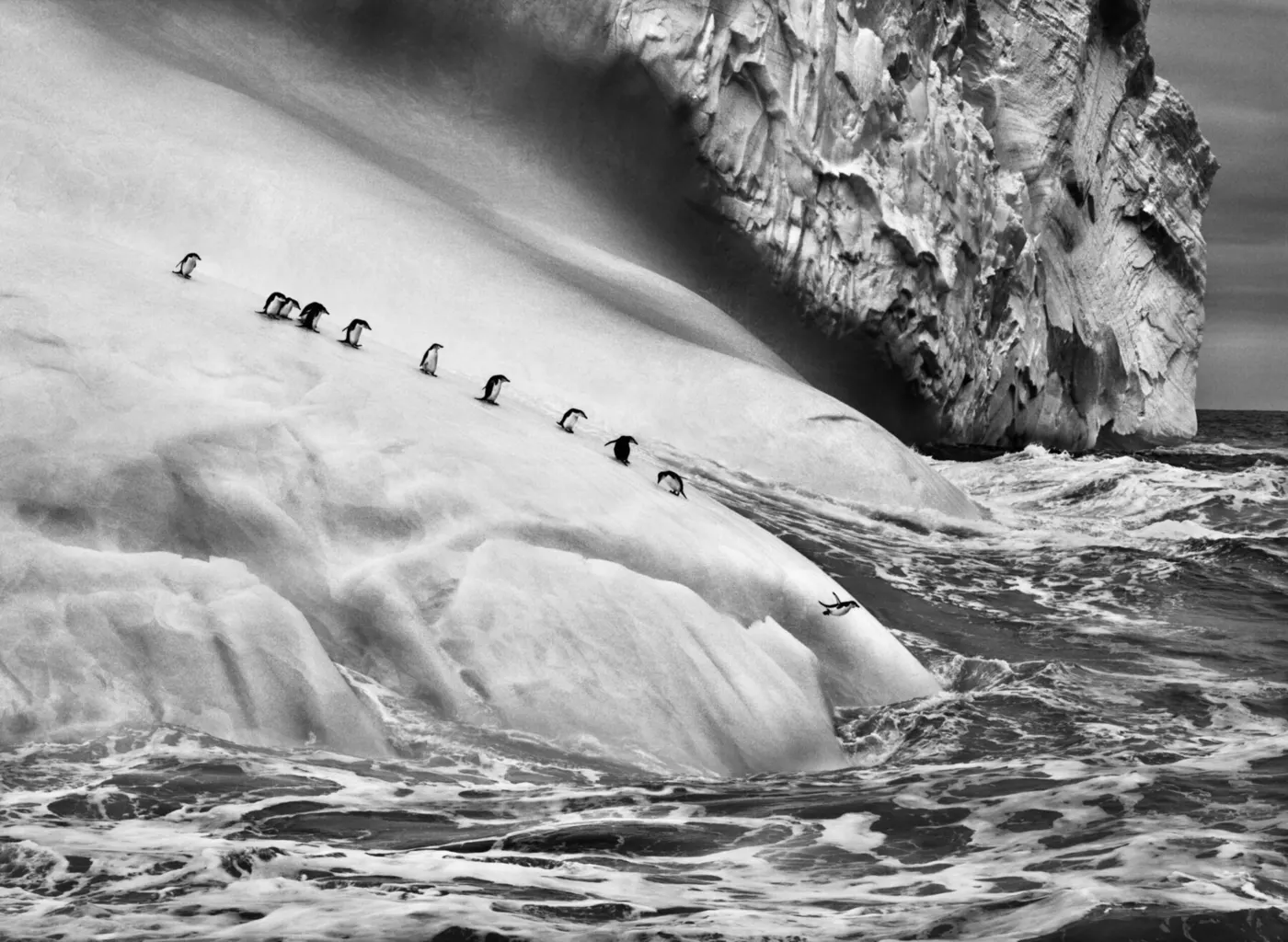
This photograph finds grandeur and play in the same frame. The iceberg is massive, sculptural, and austere, yet the tiny procession of penguins gives it pulse and personality. In black and white, the scene becomes beautifully elemental: slope, cliff, foam, shadow, and a line of figures moving through an inhospitable world with remarkable grace.
A diagonal that carries the entire picture
The composition is built on the iceberg’s sweeping incline, and that single decision gives the image its momentum. The penguins are spaced along the slope like notes on a staff, each one reinforcing the angle while also breaking it into lively intervals. The eye naturally follows them across the frame, reading the landscape through their movement. It is a brilliant example of structure and subject working as one.

The penguin procession turns the iceberg’s diagonal into a precise, elegant visual rhythm.
A behavioral moment with perfect dramatic timing
Near the lower right, one penguin has left the ice and entered open space above the water. That tiny action transforms the photograph from a stately wildlife landscape into a scene with suspense and release. The leap gives the frame a climax, and because it happens at the edge where ice meets sea, it concentrates the picture’s themes of risk, adaptation, and motion into one unforgettable gesture.

The airborne penguin provides a vivid narrative peak that makes the scene feel alive and immediate.
Texture creates scale and drama
One of the photograph’s great pleasures is its tactile richness. The smooth snow slope reads very differently from the shattered vertical wall of ice on the right, and both stand apart from the restless, streaked water below. These contrasting surfaces keep the monochrome palette vivid and varied. They also sharpen the sense of scale: the penguins appear even more delicate and determined against such immense, rugged forms.

The contrast between smooth snow, fractured ice, and turbulent sea gives the image exceptional physical presence.
Light that shapes the iceberg from within
The tonal control here is especially refined. A soft band of light and shadow curves along the crest of the iceberg, describing its volume with unusual delicacy. Instead of flattening into a field of white, the ice feels modeled and dimensional, with distinct planes turning toward and away from the light. That restraint makes the photograph feel both luminous and solid.

The nuanced light gives the ice sculptural depth while preserving the photograph’s luminous clarity.
Foam and surf as counterpoint
At the base of the iceberg, the sea churns into dark, swirling patterns edged with white foam. Those irregular marks provide a powerful counterweight to the clean sweep of the slope above. The water introduces instability and noise, which makes the penguins’ orderly passage across the ice feel even more striking. It is an elegant balance between graphic simplicity and natural chaos.
The animated water adds energetic contrast to the iceberg’s calm geometry.
Why this photograph stands out
What makes this photograph so memorable is the way it joins monumentality and intimacy. The iceberg feels ancient and immense, yet the penguins give it rhythm, humor, and purpose. Every major element—the diagonal slope, the leap, the carved cliff, the tonal shaping, the surf—contributes to a picture that is both formally exacting and deeply alive.
About the photographer
Sebastião Salgado
Sebastião Salgado is renowned for his **powerful black-and-white photographs that explore human life, labor, migration, and the natural world on a monumental scale**. His images often place individuals within vast landscapes or dramatic environments, emphasizing both human dignity and the forces shaping their lives. His work is distinguished by **rich tonal contrasts, dramatic light, layered compositions, and an almost epic sense of scale**. Salgado transforms documentary photography into something deeply poetic and immersive, creating images that confront difficult realities while celebrating the resilience and beauty of the people he photographs.