Raghu Rai’s Quiet Drama of a Street Crossing
In this black-and-white street photograph, Raghu Rai turns a passing encounter into something lasting through gesture, contrast, and the tactile weight of the wall behind it.
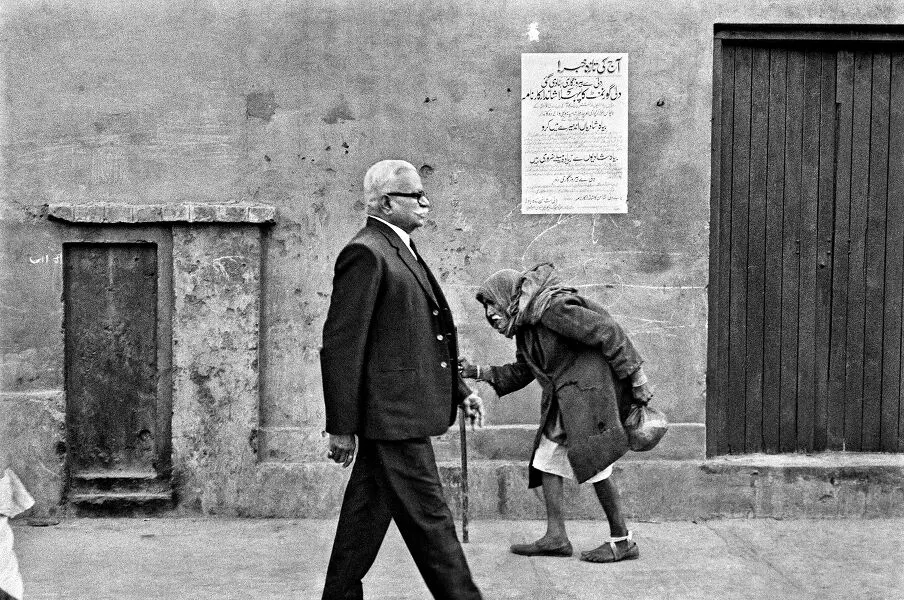
Raghu Rai has long been admired for finding human meaning inside ordinary public life, and this photograph shows that gift with remarkable economy. A suited man strides across the frame as an elderly woman, bent over her cane, reaches forward behind him. Nothing is overstated, yet the image feels full of social texture, movement, and feeling. Its power comes from how clearly Rai lets posture, timing, and place speak together.
A crossing that becomes a story
The photograph’s central force is the crossing of two figures moving through the same narrow strip of street in completely different ways. The man’s upright stride and formal clothes read as brisk, self-contained motion. The woman’s stooped posture, slower pace, and forward reach introduce vulnerability and persistence. Because they overlap at just the right instant, the image feels less like a record of two pedestrians and more like a compressed social drama.

The precisely timed overlap turns an everyday passing moment into a vivid human narrative.
Gesture carries the emotional weight
The woman’s body language gives the image its deepest emotional register. Her bent back, cane, lowered head, and outstretched hand are all plainly visible, and each element adds to the feeling of effort. Rai does not need facial expression to explain the scene; the posture tells everything. That clarity is part of what makes the photograph so moving.

The woman’s posture and gesture make the photograph immediately human and deeply affecting.
Architecture holds the scene in place
The wall is not just a backdrop. Its broad, worn surface creates a calm field where the figures stand out as silhouettes and gestures. On the right, the tall dark door forms a strong vertical block that steadies the composition and gives the woman a firm architectural frame. The image feels composed with great confidence because the geometry is simple, weighty, and exact.

The door and wall give the fleeting encounter a strong, sculptural sense of structure.
Black and white deepens the age of the place
Monochrome is essential here. Without color, attention goes straight to surfaces, contrast, and form: the rough plaster, the worn threshold, the dark suit, the faded wall, the soft gray pavement. These tonal relationships make the street feel old, inhabited, and tactile. The picture gains atmosphere not by embellishment but by letting texture become part of the meaning.
The black-and-white treatment brings out the wall’s texture and gives the scene its enduring mood.
Movement is written in the feet
The lower part of the frame quietly reinforces everything happening above. The man’s long step moves decisively across the pavement, while the woman’s smaller, careful foot placement suggests effort and caution. That contrast in rhythm is subtle but crucial. Even before the eye returns to their upper bodies, the ground-level movement tells us these lives occupy time and space very differently.
The contrast in stride and footing gives the scene a memorable physical rhythm.
Why this photograph stands out
What makes this photograph memorable is its concentration. Raghu Rai finds a complete world in one wall, two passersby, and a fraction of a second. The image is formally restrained yet emotionally expansive, turning a brief street encounter into something durable, humane, and unmistakably alive.
About the photographer
Raghu Rai
Raghu Rai is renowned for his **powerful, deeply human approach to documentary photography**, capturing the complexity of Indian life through moments of emotion, movement, and quiet observation. His images range from crowded streets and everyday life to major historical events, often revealing unexpected relationships between people and their surroundings. His work is distinguished by **expressive composition, rich tonal depth, and an instinct for capturing decisive moments**. Rai combines the immediacy of photojournalism with a strong artistic sensibility, creating photographs that are not only records of reality but also deeply evocative visual stories.