Josef Koudelka’s Theater of Light and Presence
Josef Koudelka turns a simple interior into a charged stage where shadow, posture, and gaze carry the drama.
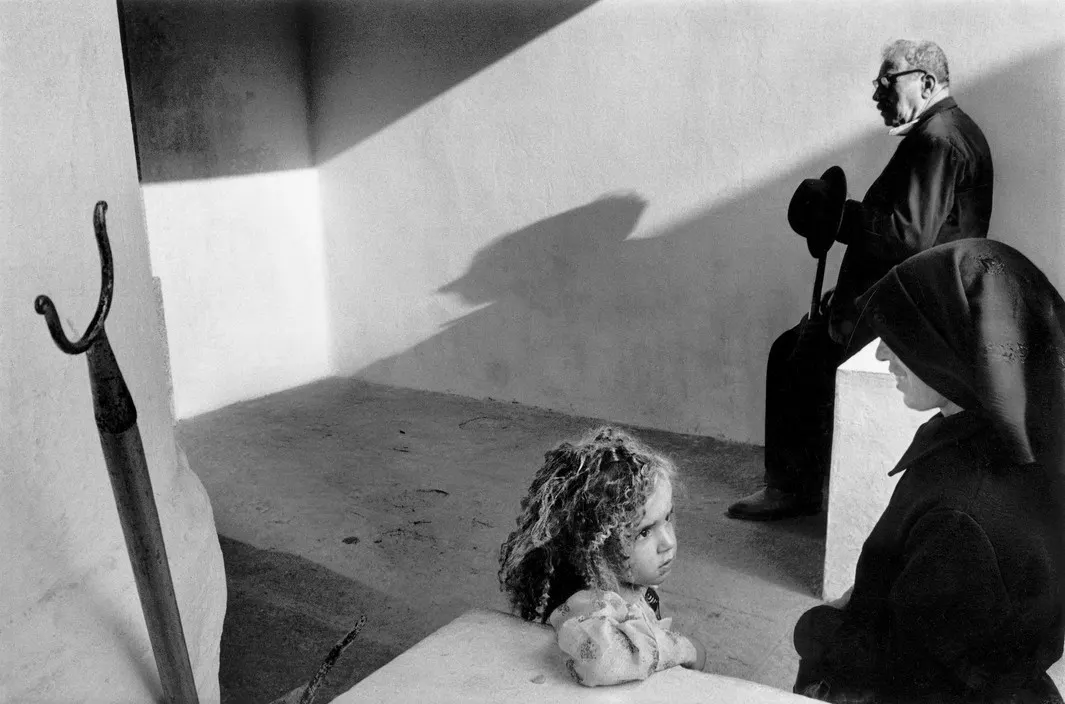
This photograph shows Josef Koudelka at his most distilled: ordinary people, bare architecture, and light sharp enough to become structure. The scene feels both observed and composed, with every figure held in tension by the wall, the floor, and the long diagonal of shadow. What stays with you is how naturally the picture joins human feeling to abstract form.
A shadow that doubles the man’s presence
The standing man at right is memorable not only for his profile, but for the large shadow he throws across the wall. Koudelka uses that projection as a second figure, giving the man added scale and inner gravity. The hat and upright silhouette read clearly, while the shadow stretches the moment into something more mythic than descriptive. It is a beautiful example of documentary observation becoming visual drama through timing alone.

The man and his projected shadow create a powerful double-presence that deepens the photograph’s sense of story.
The child as the emotional center
Near the bottom of the frame, the child anchors the image with extraordinary economy. Her face catches the eye immediately, and her upward glance opens the emotional space between all three figures. Surrounded by broad planes of wall and floor, she becomes the picture’s most delicate and human note. The placement is especially strong: low in the frame, yet central in feeling, she gives the geometry a pulse.

The child’s upward gaze gives the scene its emotional immediacy and quiet tension.
Hard light turned into architecture
The late-afternoon sun is handled with exceptional confidence. A dark triangular wedge at the upper left meets the long diagonal shadow on the wall, and together they organize the entire image. These shapes are not background effects; they are the compositional armature. Koudelka lets the light carve the room into planes, so the photograph feels built as much from shadow as from plaster.
The hard sunlight creates bold geometric forms that give the scene structure, rhythm, and force.
Layering that keeps every figure distinct
Despite the deep blacks and bright walls, the image never collapses into flat contrast. The standing man, his dark accessories, the seated block, the veiled figure, and the child all occupy separate tonal planes. That separation gives the picture depth and allows each presence to register clearly without breaking the unity of the whole. It is a refined black-and-white construction, where density and clarity work together.
Clear tonal layering gives the photograph depth while preserving the unity of its human relationships.
Why this photograph stands out
This photo is a superb example of how Koudelka turns a fleeting arrangement of people and light into something enduring. The picture feels immediate, yet every element—shadow, gaze, wall, posture, and spacing—locks into place with precision. Its beauty lies in that fusion of raw encounter and formal control.
About the photographer
Josef Koudelka
Josef Koudelka is known for his powerful documentary and street photography, particularly his images of Roma communities, political upheaval, exile, and the landscapes of Europe. His photographs often convey a strong sense of movement, displacement, and human resilience, turning fleeting encounters and ordinary scenes into deeply evocative visual stories. His distinctive style is characterized by dramatic black-and-white imagery, striking compositions, and an instinct for capturing decisive moments. Wide-angle perspectives, strong geometric forms, deep shadows, and carefully balanced figures give his photographs a raw, cinematic intensity, while his sense of timing makes moments of chaos, solitude, and human connection feel almost timeless.