William Eggleston’s Quiet Drama of Arrival
A pale car, two men, and a carpet of winter leaves become a remarkably charged scene in William Eggleston’s hands, full of social tension, atmosphere, and exact color control.
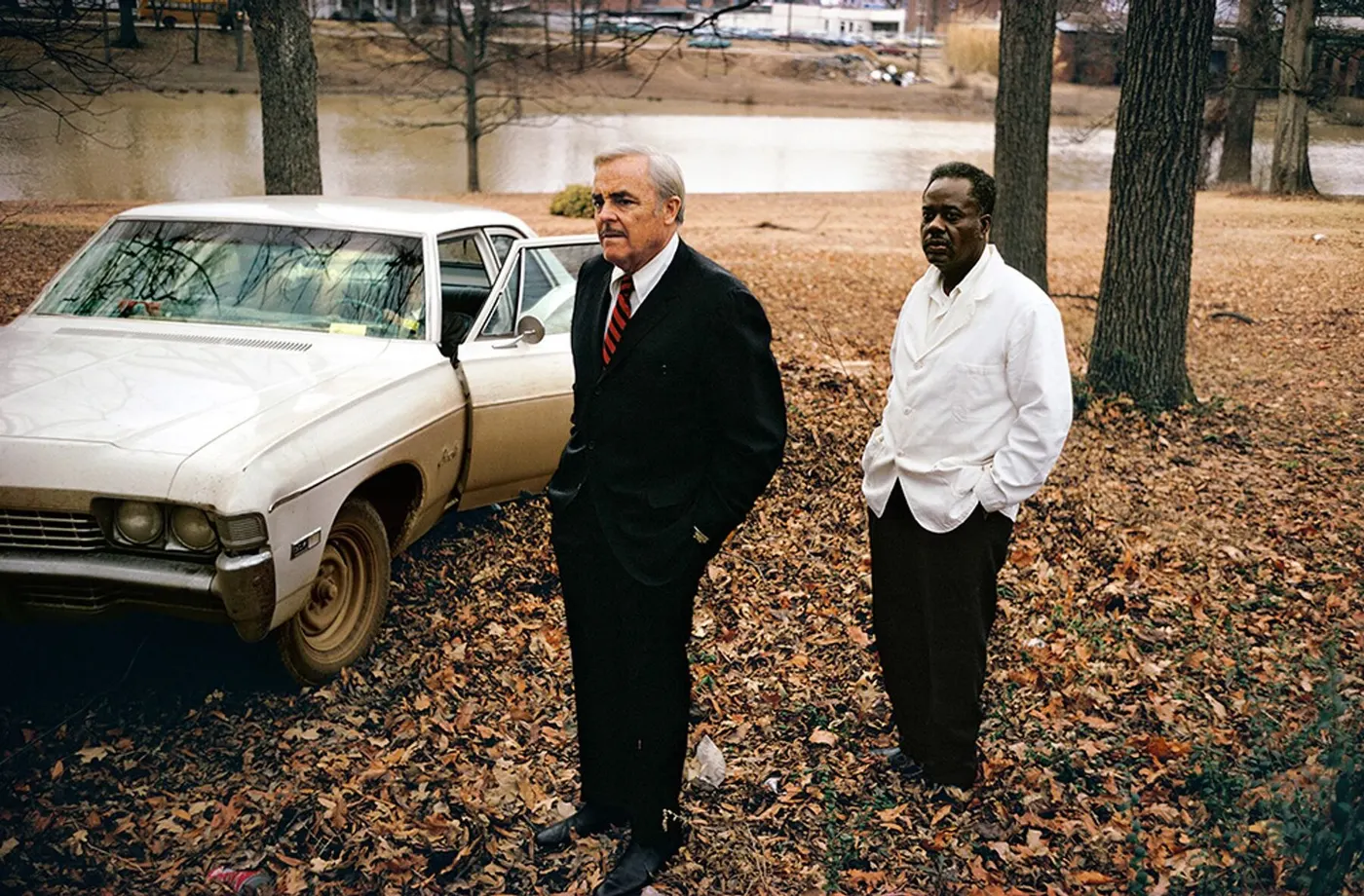
William Eggleston brings extraordinary precision to an apparently ordinary moment. A suited man stands beside an open car door, another man waits just behind him, and the bare riverside setting holds them in a hush of brown leaves and pale water. What makes the photograph memorable is its restraint: nothing is forced, yet every element feels loaded with time, place, and human meaning.
A figure who anchors the entire frame
The man in the dark suit gives the photograph its center of gravity. His posture is calm and self-possessed, with hands in his pockets and his body turned slightly forward, so the image settles around him immediately. Eggleston sharpens that presence through tonal contrast: the black suit holds dense weight against the lighter car, the pale water, and the tawny ground. The red striped tie is especially exact. It is small, but it concentrates the eye and lends the scene a formal note that feels both personal and emblematic.

The suited figure is unforgettable because his stance, dark clothing, and precise red tie create a powerful focal center.
The second figure deepens the story
The man in the white jacket transforms the picture from portrait into relationship. Standing just behind and to the right, he introduces distance, parallel presence, and a subtle social charge. Eggleston does not explain the connection between the two men, which is exactly why the image remains so alive. Their different clothes, positions, and expressions create a scene that feels observed rather than arranged. The photograph trusts posture and spacing to carry meaning, and that trust gives it lasting intrigue.

The pairing of the two men gives the photograph its enduring narrative richness.
An open car door turns stillness into an event
One of the photograph’s most elegant details is the open door of the vintage car. It suggests arrival, interruption, or a pause between actions, so the image feels suspended in real time. The car itself is not just a prop but a carrier of atmosphere: its long body, muted paint, and worn presence place the scene in a distinct American visual world. Eggleston excels at making everyday objects hold emotional and historical weight, and here the car quietly sets the whole drama in motion.

The open car door gives the image a vivid sense of timing, as if the scene has been caught mid-story.
A subdued palette with one unforgettable accent
Color is handled with remarkable discipline. The photograph is built from creams, browns, blacks, and grays: dry leaves underfoot, tree trunks, overcast water, pale metal, dark wool. This restraint gives the image its seriousness and its period atmosphere. Against that muted field, the red tie becomes a beautifully measured interruption. It never feels decorative; it feels decisive. Eggleston’s gift for color is clear here in how little he needs to do to make the palette feel complete and emotionally exact.
The limited palette feels richly cohesive, and the red tie lands as a perfectly judged color accent.
Texture and landscape as emotional setting
The leaf-covered ground and bare riverside trees give the picture its tactile depth. Every surface contributes to the mood: the crisp scatter of leaves, the rough bark, the soft dullness of the water, the smooth metal of the car. These textures create a season, a climate, and a pace of life without needing any explanation. The setting is quiet but never empty. It surrounds the figures with a distinctly Southern, late-year atmosphere that feels inseparable from Eggleston’s way of seeing the world.
The winter textures give the scene a palpable atmosphere, making place feel as important as gesture.
Why this photograph stands out
This photograph shows William Eggleston at his most penetrating and understated. He takes an ordinary arrangement of people, car, trees, and water and lets their exact relationships generate the drama. The result is memorable not because it announces itself, but because it is so assured in tone, color, and human observation. Every visible detail contributes to a scene that feels at once casual, historical, and deeply felt.
About the photographer
William Eggleston
Born 1939, an American photographer widely regarded as a pioneer of color fine-art photography. Working primarily in and around Memphis, Tennessee, he elevates everyday scenes—suburban streets, diners, domestic interiors, and roadside signs—through saturated color and a "democratic" approach that treats every subject equally