Watching A Film Shoot by Sooni Taraporevala
Sooni Taraporevala turns a street-side moment into a vivid social portrait, where one boy’s poised stance opens onto a whole world of watchful faces, textures, and domestic detail.
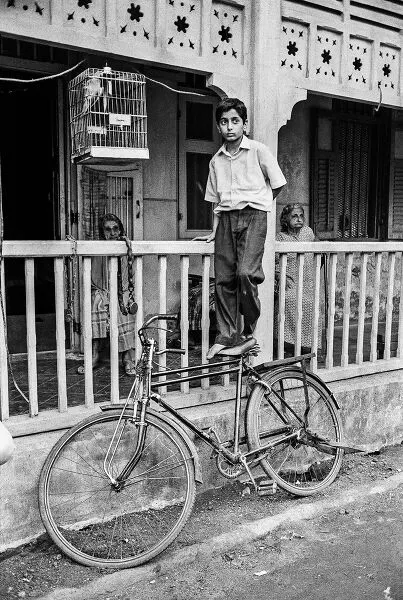
Sooni Taraporevala’s photograph finds drama in an ordinary threshold. A boy balanced on the porch railing becomes the image’s instant center, but the frame keeps unfolding beyond him: a bicycle at street level, a child in the doorway, an older face in the window, a birdcage overhead. The picture feels casual and exact at once, full of the intimacy, human detail, and sense of place that define Taraporevala’s work.
A poised central figure holds the whole scene together
The boy’s stance is unforgettable. He is neither fully at ease nor performing for the camera, and that slight tension gives the portrait its charge. His elevated position above the bicycle lifts him out of the everyday flow of the street, while his direct gaze meets the viewer with calm self-possession. The straight fall of his shirt and trousers, the bare feet on the rail, and the stillness of his posture make him read as both a child and a commanding presence within the frame.

The boy’s balanced stance and direct gaze create a focal point that feels immediate and quietly iconic.
The bicycle gives the photograph its graphic backbone
The bicycle does far more than describe the setting. Its angled frame and circular wheels organize the lower half of the image, setting up a strong contrast with the vertical porch balusters behind it. That exchange of diagonals, circles, and uprights gives the scene formal clarity without losing its spontaneity. It also fixes the picture firmly in lived reality: this is not a stage set but a used, inhabited street, and the bicycle carries that everyday truth beautifully.

The bicycle anchors the foreground with elegant geometry and unmistakable local character.
Multiple faces turn a moment into a social world
What makes the photograph linger is how many lives it contains. The child in the shadowed doorway and the older figure at the window widen the image from portrait to household tableau. Each figure occupies a different depth and a different pocket of light, so the eye moves through the scene slowly, discovering relationships rather than receiving them all at once. This layered staging feels unforced, as if Taraporevala simply recognized how much human presence was already gathered in one small slice of architecture.

The secondary figures give the image depth, intimacy, and the feeling of a whole community gathered around the moment.
Domestic details make the setting feel fully inhabited
The hanging birdcage near the top left is a wonderful touch: visually delicate, slightly unexpected, and perfectly placed to enrich the upper frame. Around it, the cutout patterns in the facade, the porch posts, and the open windows all contribute to a sense of a home observed from just outside. These details are not decorative extras. They carry the photograph’s atmosphere, showing how closely Taraporevala attends to the small objects and structures that make a place feel lived in.
The birdcage and architectural details give the photograph a vivid, lived-in sense of place.
Black-and-white tonality brings out structure and touch
The monochrome rendering is especially effective here because it sharpens attention on form, surface, and expression. The weathered wall, dusty street edge, metal bicycle, and worn porch all register with tactile precision. At the same time, the tonal range keeps the image supple rather than harsh, letting shadows hold mystery while preserving the clarity of the main figures. The result is documentary realism with elegance: a picture rooted in texture, age, and atmosphere.
The black-and-white tonality makes texture, mood, and structure feel inseparable.
Why this photograph stands out
Watching A Film Shoot is memorable because it feels so complete. A single boy may draw the eye first, but Taraporevala builds an entire world around him through gesture, layering, architecture, and detail. The photograph is affectionate without sentimentality and carefully composed without ever losing its candid life. It shows how a modest street-side moment can hold dignity, curiosity, and remarkable visual richness all at once.
About the photographer
Sooni Taraporevala
Sooni Taraporevala is known for her **intimate, deeply observant photographs of everyday life in India**, particularly Mumbai’s Parsi community and the people and places around her. Her images often find quiet humor, tenderness, and complexity in ordinary moments, creating a vivid portrait of a changing society. Her work is distinguished by **candid observation, rich human detail, and a strong sense of place**. Rather than relying on spectacle, Taraporevala allows gestures, expressions, relationships, and everyday environments to reveal the character of her subjects, giving her photographs an unusually personal and authentic quality.