Unseen Newspaper Girl
Eve Arnold finds a quiet, unforgettable presence in a young newspaper seller, building the picture through profile, papers, and the lived texture of the street.
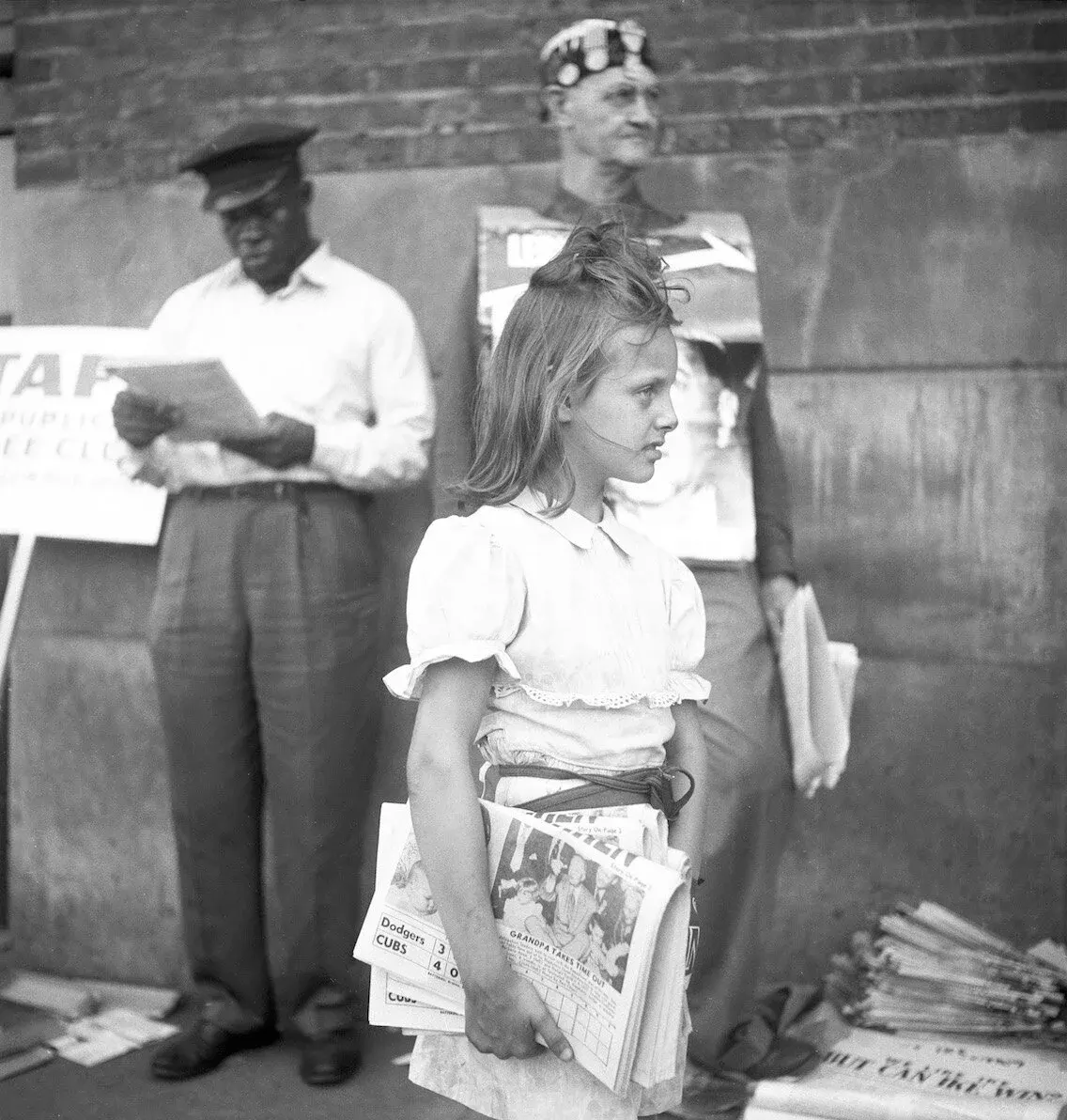
Eve Arnold’s gift for intimacy is fully present in this photograph. A young girl stands in profile with a bundle of newspapers at her side, and the picture becomes both a character study and a street document. Nothing is overstated. The power comes from her absorbed expression, the ordinary dignity of her task, and the way the surrounding figures and surfaces quietly widen the story.
A profile that holds the whole frame
The girl’s face is the emotional center of the photograph. Seen in profile, she appears self-contained and alert, with a seriousness that gives the image its lasting weight. Arnold lets the line of the forehead, nose, and chin do the work, while the slightly wind-tossed hair keeps the portrait feeling immediate rather than posed. Her stance is calm and firm, which makes the moment feel observed rather than arranged.

The girl’s profile creates a clear, memorable human presence with extraordinary quiet strength.
The newspapers turn portrait into story
What she carries matters as much as how she looks. The bundle of papers tucked against her dress identifies her role instantly and grounds the image in daily work. Visible print, photographs, and mastheads add factual richness, so the scene reads as lived reality rather than symbol. The papers also echo the adults behind her, creating a subtle network of reading, selling, and public life around one child.

The newspapers give the picture documentary precision and deepen its sense of everyday labor.
A bright figure set against the street
Arnold makes the girl legible at a glance by placing her light dress against darker masonry and trousers. The pale fabric catches the eye first, and its soft details—puffed sleeves, lace edging, gathered seams—add tenderness without weakening her solidity. That tonal separation gives the photograph a strong visual hierarchy while keeping the street atmosphere intact.

The contrast between light clothing and darker surroundings makes the subject immediately vivid.
Background figures that expand the world
The adults behind her are essential to the picture’s social life. On the left, a man reading a newspaper quietly reinforces the image’s theme without competing with the girl. Another standing figure adds a sense of public space and passing street activity. Arnold’s restraint is key here: these people remain secondary, yet they make the girl feel part of a larger urban rhythm rather than isolated from it.
The background figures enrich the scene with context while keeping the girl at the center.
Texture as evidence of place
The photograph is full of tactile detail. Brick, stone, paper, and cloth each register differently, giving the frame a convincing physical density. The rough wall anchors the scene in the city, while the layered newspapers add a crisp, handled texture that feels specific to the day. These surfaces are not decorative; they make the image believable and give Arnold’s observation its documentary authority.
The rich textures of masonry, fabric, and newsprint give the image depth and authenticity.
Why this photograph stands out
Unseen Newspaper Girl is memorable because it combines tenderness with precision. Eve Arnold sees the child clearly as an individual, but she also places her within a whole street ecology of work, reading, and public life. The result is intimate, specific, and deeply human—exactly the kind of unforced revelation Arnold made her own.
About the photographer
Eve Arnold
Eve Arnold was known for her **intimate, empathetic approach to documentary and portrait photography**, looking beyond public personas to capture people in unguarded, vulnerable, and often deeply human moments. She photographed everyone from Marilyn Monroe and Malcolm X to migrant workers and ordinary families, bringing the same curiosity and respect to each subject. Her work is distinguished by **natural observation, emotional honesty, and a remarkable ability to create intimacy in difficult or unfamiliar settings**. Arnold often worked unobtrusively, allowing gestures, expressions, and small interactions to carry the story rather than relying on spectacle or dramatic staging.