Time Held Against the City
Josef Koudelka’s photograph turns an urban avenue into a field of converging lines, with a wristwatch in the foreground anchoring the scene in lived time.
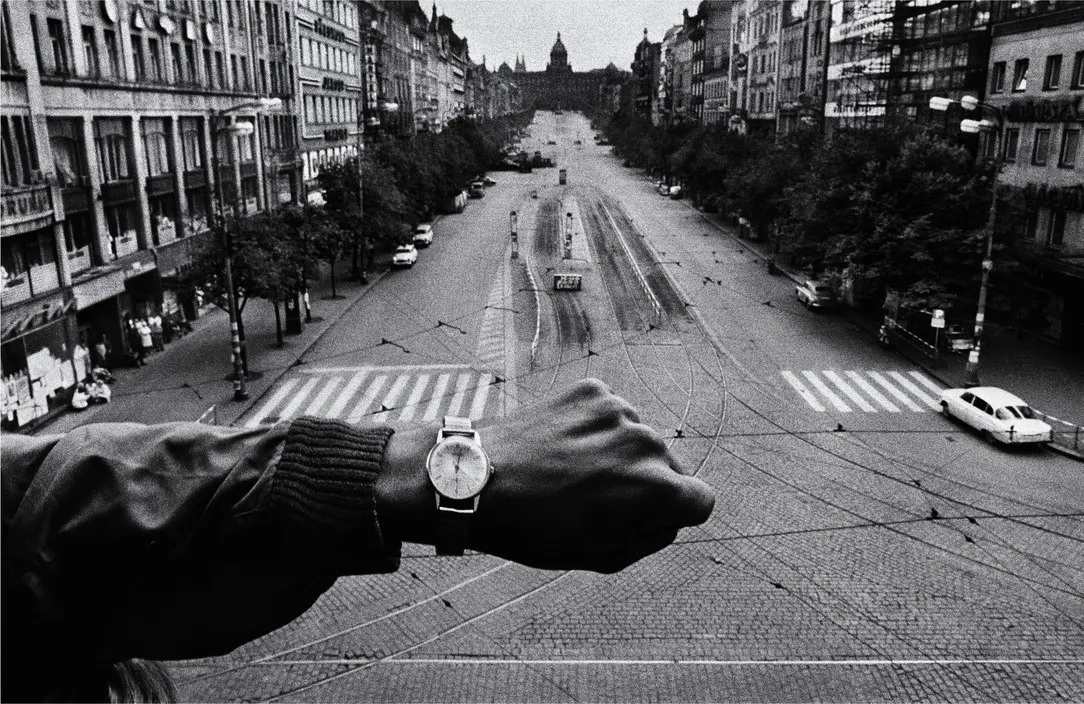
This photograph carries many of Josef Koudelka’s signature strengths at once: a dramatic black-and-white palette, a forceful wide view, and a human gesture placed inside a larger civic space. The image is memorable because it joins two scales of experience so naturally. A watch held close to the camera feels intimate and immediate, while the avenue stretching toward the distant dome opens into history, architecture, and movement. The result is both graphic and deeply felt.
A perspective line that pulls the whole picture together
The composition is built on a commanding one-point perspective. Buildings on both sides form a corridor, the tram tracks run forward in parallel and crossing lines, and the street narrows steadily toward the skyline. That structure gives the image exceptional clarity. Even with many details in the frame, the eye knows exactly how to travel through it. The depth feels measured and inevitable, which makes the scene read with the calm authority of a great city view.

The photograph’s strongest visual force is its beautifully controlled central perspective.
Street surfaces become graphic language
In monochrome, the avenue turns into a rich field of marks and textures. Cobblestones, rails, crossings, and worn street patterns create a dense but elegant network across the lower half of the frame. These details are not incidental background; they are the image’s visual vocabulary. Koudelka’s black-and-white treatment makes every line feel purposeful, giving the city a tactile and almost musical rhythm.

The street’s rails and paving are transformed into a vivid graphic pattern.
The foreground gesture gives the city a human pulse
What makes this cityscape distinctive is the arm extended into the frame. The wristwatch turns the photograph from a formal urban study into a lived moment. Time is no longer abstract; it is worn on the body, held against the sweep of the avenue. The ribbed cuff, the matte sleeve, and the smooth watch case add tactile contrast to the stone and steel of the street below. That physical presence keeps the image grounded in human experience.
The watch and sleeve introduce an immediate, tangible sense of human presence.
A distant destination gives the image narrative
At the far end of the avenue, the dome-like structure acts as more than a background landmark. It gives the eye a destination and the photograph a sense of journey. The long street no longer feels merely descriptive; it becomes directional, as if the image is moving toward a point of meaning. Paired with the watch in the foreground, that endpoint suggests duration, travel, waiting, and arrival without needing to explain any of them outright.
The far skyline gives the scene a clear destination and quiet narrative pull.
Why this photograph stands out
This is a photograph of striking economy: one arm, one watch, one avenue, and an entire world of time, distance, and structure contained within them. Josef Koudelka makes the city feel monumental without losing the intimacy of the body in the foreground. The image stays with you because it is both rigorously composed and emotionally open, turning a simple gesture into a meditation on how people move through places and through time.
About the photographer
Josef Koudelka
Josef Koudelka is known for his powerful documentary and street photography, particularly his images of Roma communities, political upheaval, exile, and the landscapes of Europe. His photographs often convey a strong sense of movement, displacement, and human resilience, turning fleeting encounters and ordinary scenes into deeply evocative visual stories. His distinctive style is characterized by dramatic black-and-white imagery, striking compositions, and an instinct for capturing decisive moments. Wide-angle perspectives, strong geometric forms, deep shadows, and carefully balanced figures give his photographs a raw, cinematic intensity, while his sense of timing makes moments of chaos, solitude, and human connection feel almost timeless.