The Grace of an Ordinary Exchange in Sooni Taraporevala’s Parsi Shop
Sooni Taraporevala turns a simple conversation at a pen shop counter into a vivid portrait of character, place, and lived urban memory.
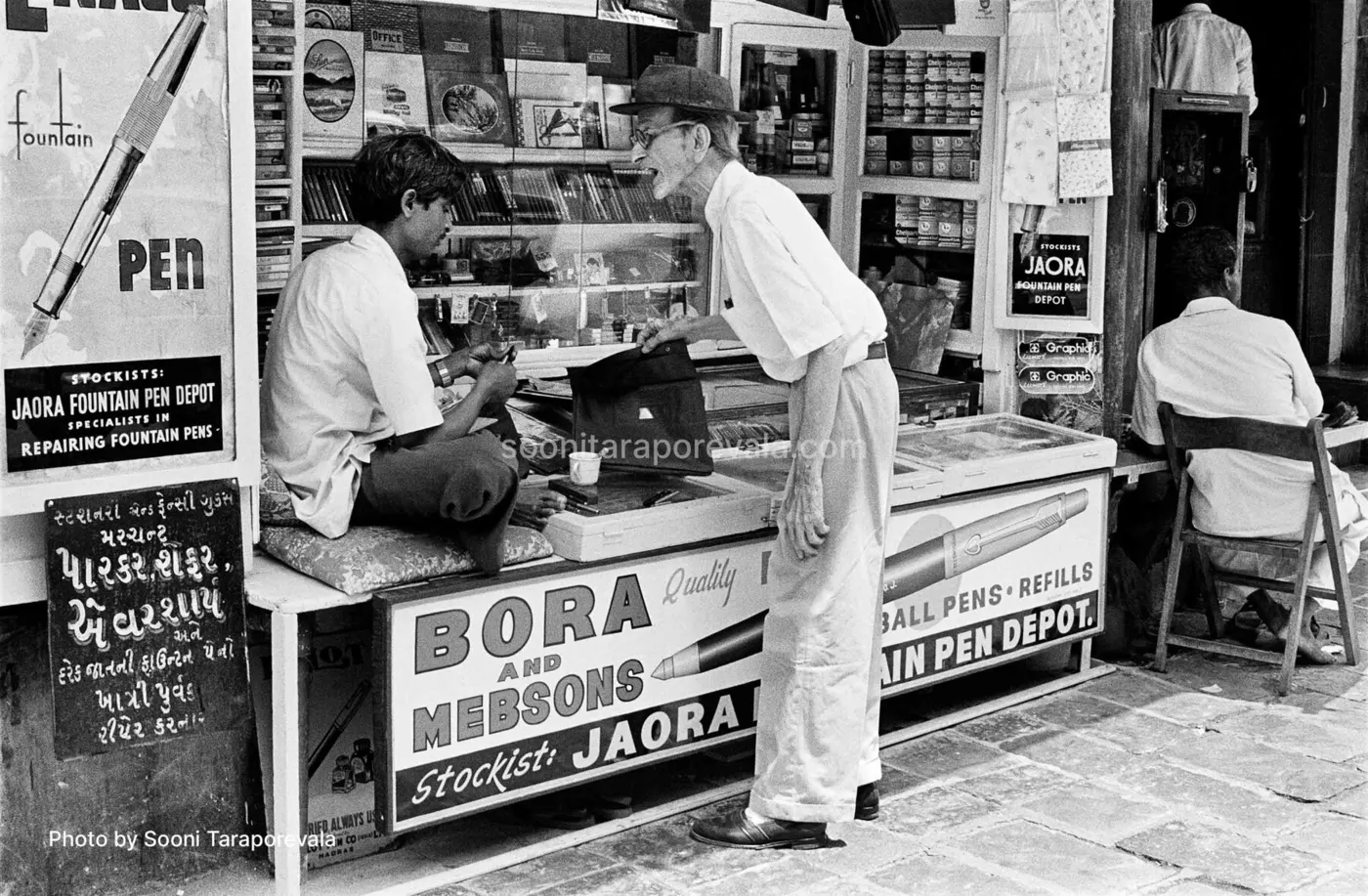
In "Parsi Shop," Sooni Taraporevala gives an everyday storefront encounter the weight of social history. The photograph is rich with human presence, but it never feels arranged. A customer leans in, a shopkeeper listens, and around them the signs, shelves, glass, and pavement describe a whole world with remarkable economy.
A conversation becomes the heart of the picture
The most memorable force in the image is the live exchange between the two central figures. The standing man bends forward with intent concentration, his mouth slightly open as if caught mid-sentence, while the seated shopkeeper holds his position with a quiet attentiveness. Their opposing postures create a natural tension: one figure advances, the other receives. Taraporevala catches that small but expressive distance between them where conversation becomes visible.

The photograph makes human interaction feel immediate through beautifully timed body language.
The shopkeeper’s pose gives the scene balance and intimacy
The seated figure is crucial to the image’s calm structure. Perched within the stall, he forms a compact, grounded shape against the taller customer’s diagonal lean. That contrast keeps the scene from becoming static while also conveying familiarity: this is not a dramatic confrontation, but an exchange unfolding in a known place between people fully at ease in its rhythms. His placement inside the shop also deepens the sense that the storefront is an extension of his presence.

The seated shopkeeper anchors the frame with a still, intimate presence.
Signs and shelves turn the storefront into a graphic stage
One of the picture’s great pleasures is how clearly the setting announces itself. The large fountain pen poster on the left acts almost like a title card, immediately telling us what kind of place this is. Behind the figures, the shelf compartments and cabinet panes create a disciplined grid of rectangles that holds the busyness of the shop together. Taraporevala lets these graphic elements do narrative work, so the image feels specific and rooted rather than merely picturesque.
The storefront graphics give the scene instant identity and lasting visual character.
Black and white gives the street its memory and texture
The monochrome rendering is especially beautiful here because it unifies many different surfaces without flattening them. Stone pavement, painted boards, fabric, glass, and worn cabinetry all register with distinct tactile weight. The tonal range suits the old commercial details and the lived-in feel of the shop, giving the scene the atmosphere of something observed carefully and remembered clearly. The pavement in the foreground is particularly effective, opening the image with a rough, grounded texture that leads naturally into the stall.
The black-and-white tonal treatment gives everyday materials a vivid, enduring presence.
A complete world exists beyond the main exchange
Even while the conversation commands attention, the photograph keeps widening its social space. The second seated figure at right, the packed shelves, the handwritten signs, and the branded counter panels all suggest a working environment with its own tempo and community. Taraporevala is known for finding tenderness and complexity in ordinary life, and that quality is everywhere here. The image does not isolate a single subject from context; it lets place and people define each other.
The surrounding details expand the scene into a fully inhabited world.
Why this photograph stands out
What makes "Parsi Shop" so affecting is its combination of clarity and richness. Taraporevala finds a perfect balance between gesture, setting, and atmosphere, allowing an ordinary shopfront conversation to stand for something larger: continuity, character, and the quiet beauty of daily life observed with affection.
About the photographer
Sooni Taraporevala
Sooni Taraporevala is known for her **intimate, deeply observant photographs of everyday life in India**, particularly Mumbai’s Parsi community and the people and places around her. Her images often find quiet humor, tenderness, and complexity in ordinary moments, creating a vivid portrait of a changing society. Her work is distinguished by **candid observation, rich human detail, and a strong sense of place**. Rather than relying on spectacle, Taraporevala allows gestures, expressions, relationships, and everyday environments to reveal the character of her subjects, giving her photographs an unusually personal and authentic quality.