Snow Mountains by Frans Lanting
A monochrome glacier study turns snow, rock, and cloud into a powerful piece of alpine sculpture, anchored by a dark central ridge and animated by drifting mist.
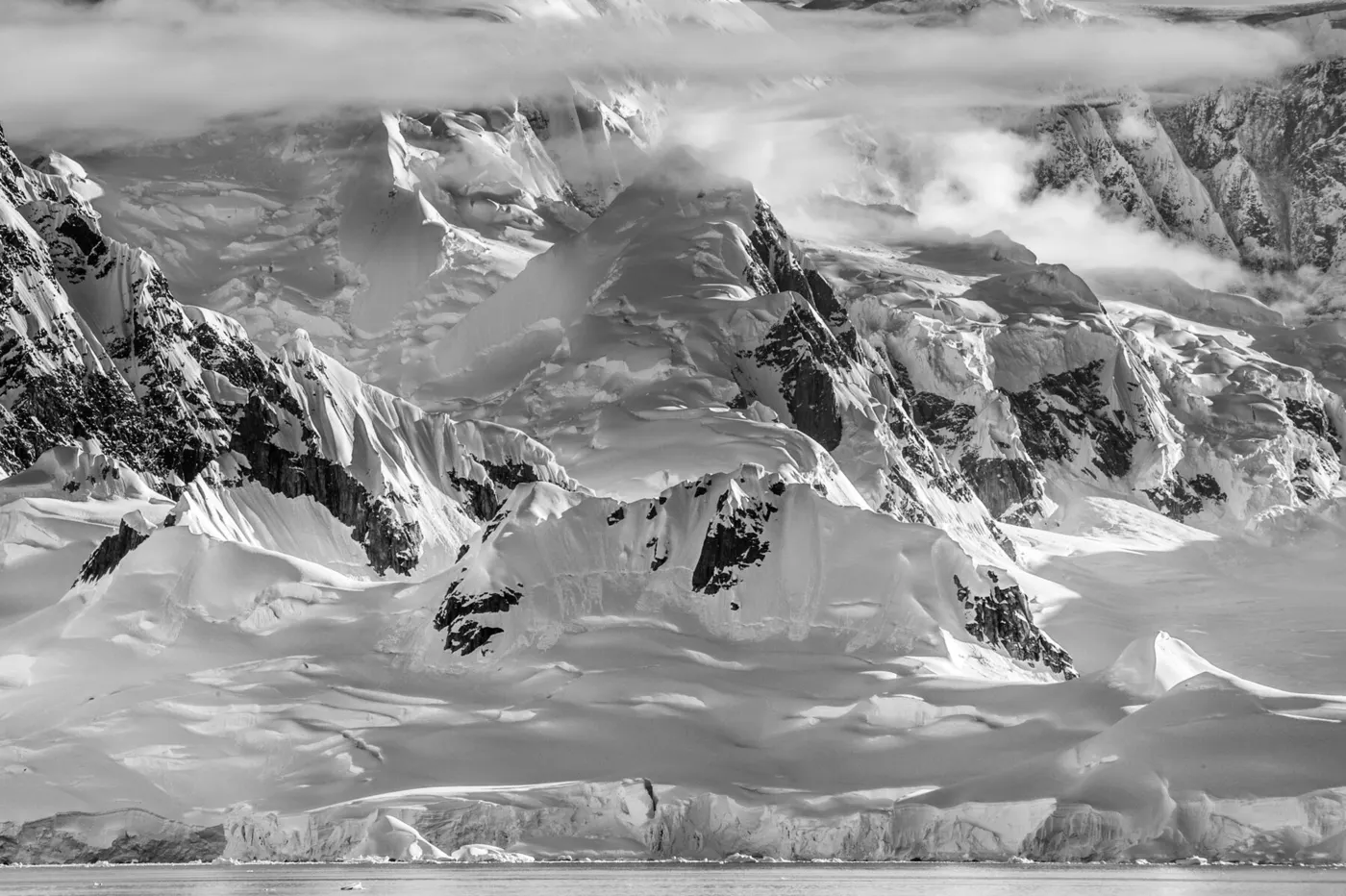
This photograph excels by treating the mountain not as a distant landmark but as a living mass of tone, texture, and weather. The black-and-white rendering sharpens every relationship in the scene: dark rock bites into luminous snow, soft cloud drifts through hard geometry, and the glacier reads like carved stone. What makes the image memorable is how it balances grandeur with intricacy, giving the eye a clear anchor and then rewarding closer looking with layer after layer of alpine detail.
A central ridge gives the scene its commanding presence
The image holds together around the dark, pyramidal ridge near the center. Its triangular shape is immediately legible against the surrounding snowfields, so the eye finds a strong point of entry before moving through the rest of the massif. That contrast between a dense, shadowed form and the lighter terrain around it gives the composition authority and keeps the mountain feeling monumental rather than diffuse.

The central triangular ridge gives the photograph a bold, memorable anchor.
Snow and rock are rendered with striking tactile contrast
One of the photograph’s great pleasures is the separation between surfaces. The snow appears velvety and sculpted, hanging in curtains and rounded drifts, while the rock faces break through in jagged, fractured seams. In monochrome, that contrast becomes especially vivid. The scene feels physical and touchable, with each ledge, crease, and exposed wall contributing to a rich sense of alpine structure.

The monochrome treatment beautifully heightens the tactile contrast between smooth snow and broken rock.
Cloud movement makes the landscape feel alive
The drifting cloud on the right side introduces motion into an otherwise immense and solid landscape. It wraps around the mountain forms instead of merely sitting behind them, which creates a sense of weather actively shaping the scene. That movement also deepens the scale of the image: the peaks feel larger because the mist reveals and conceals them in passing, turning the massif into something atmospheric and dramatic rather than static.
The wrapping cloud gives the mountain scene motion, scale, and alpine drama.
Tonal control keeps the snow luminous and dimensional
Bright snow can easily flatten into blank white, but here it retains delicate modeling throughout the frame. Gentle midtones describe folds, slopes, and wind-shaped surfaces, so the glacier keeps its volume even in the brightest passages. This tonal restraint is central to the photograph’s elegance: the snow glows, but it also holds structure, allowing the mountain to read as sculpture instead of silhouette.
The snow remains luminous while still holding delicate contour and form.
Why this photograph stands out
This is a memorable mountain photograph because it turns a complex glacier landscape into a clear, sculptural black-and-white statement. The central ridge, the tactile interplay of snow and rock, the moving cloud, and the finely held snow tones all work together to create an image that feels both severe and beautiful. It invites admiration first through its drama, then through the quiet richness of its detail.
About the photographer
Frans Lanting
Frans Lanting is renowned for his **immersive wildlife photography that portrays animals as sentient, expressive beings within their natural environments**. His images often go beyond straightforward documentation, using light, perspective, and intimate moments to create a strong emotional connection between the viewer and the natural world. His work is distinguished by **extraordinary patience, elegant composition, dramatic light, and a strong sense of visual storytelling**. Lanting combines the precision of a naturalist with the sensibility of a fine-art photographer, creating images that reveal both the beauty of individual animals and the larger story of life on Earth.