Saul Leiter’s Winter Minimalism, Carried by One Red Umbrella
From above, a snowy street becomes an elegant field of whites and grays, punctuated by a single red umbrella. Saul Leiter turns weather, distance, and trace into something lyrical and unforgettable.
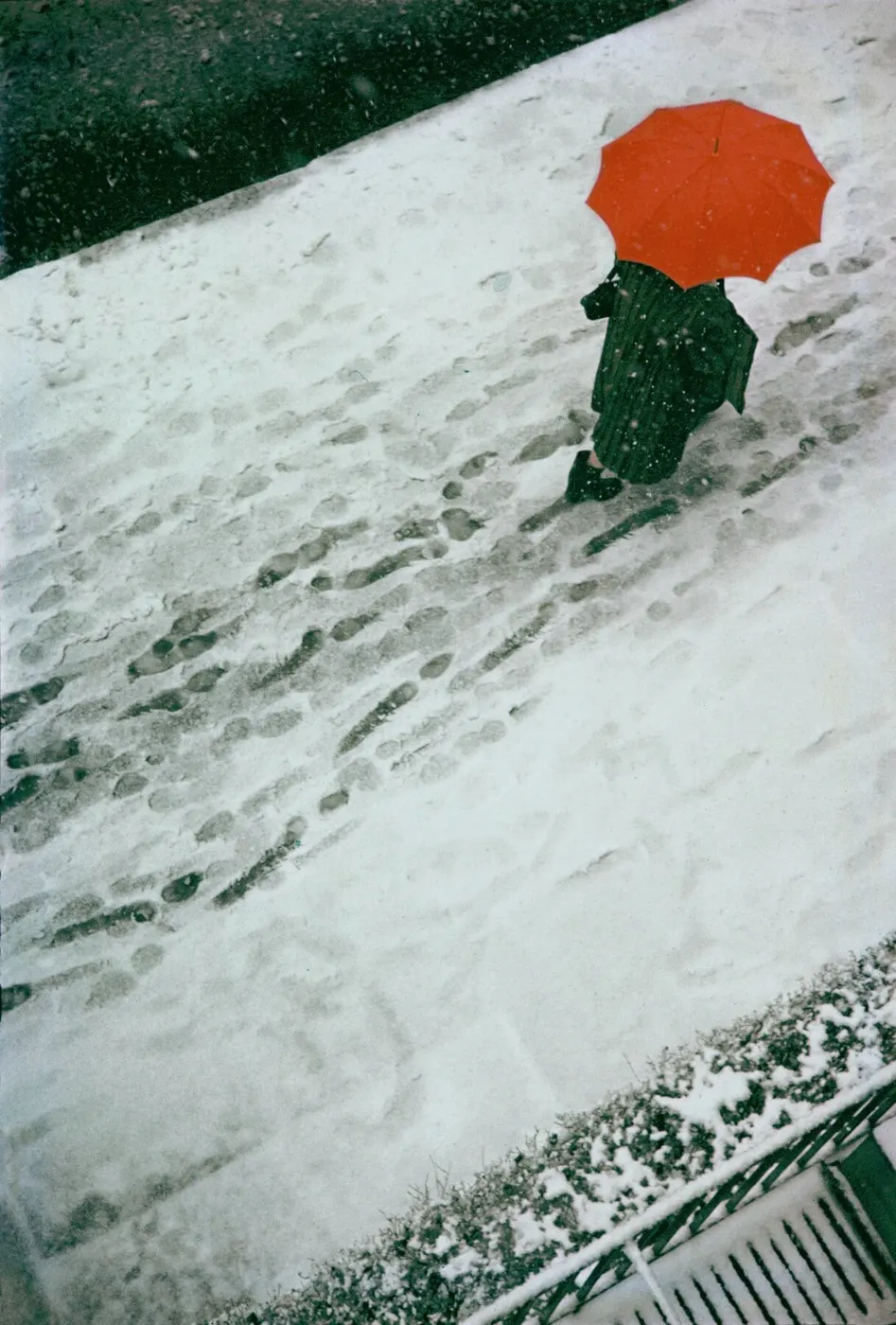
This photograph has the instant clarity of a great graphic image and the emotional softness of a remembered winter day. Saul Leiter reduces the scene to a few essential elements—snow, tracks, a lone figure, and one vivid umbrella—and lets their relationships do the work. The result feels both abstract and deeply human: a fleeting street moment distilled into shape, color, weather, and solitude.
A single red umbrella organizes the whole frame
The umbrella is the picture’s unforgettable center of gravity. Its saturated red stands apart from the muted whites, grays, and deep green-black tones around it, so the eye finds it immediately. That strong color contrast does more than attract attention: it gives the image structure. Everything else in the frame feels arranged in relation to that bright circle of color, turning an ordinary winter crossing into a composition with instant presence.

The red umbrella creates a beautifully clear focal point and gives the image its lasting visual signature.
The elevated viewpoint makes the scene feel both intimate and distant
Seen from high above, the street becomes a simplified plane of tone and movement. This vantage point removes anecdotal clutter and emphasizes the essential geometry of the scene: the diagonal sweep of the road, the smallness of the figure, and the broad field of snow surrounding them. The person remains legible as a human presence, but the distance also lends the photograph its characteristic reserve, as though the moment has been quietly observed rather than announced.

The high-angle composition gives the photograph its elegant balance of observation, distance, and design.
Footprints turn the snow into a living surface
The street is not an empty white backdrop. It is marked by footprints and slushy lines that record recent passage, effort, and weather. These patterns create texture across the frame, but they also function as subtle directional cues, guiding the eye toward the figure. The image gains narrative force through these traces: the walker is not isolated in abstraction, but moving through a street already shaped by many unseen lives.

The footprints and slush give the picture texture, rhythm, and a vivid sense of human passage.
Open snow gives the image its quiet emotional power
Much of the frame is given over to pale, open ground, and that spaciousness is essential to the photograph’s mood. The negative space makes the lone figure feel smaller, more vulnerable, and more poetic within the weather. It also lets the color and gesture breathe. Rather than filling every area with information, Leiter allows emptiness to carry feeling, which is one reason the image lingers so strongly in memory.
The large snow field creates a striking sense of solitude and calm.
Falling snow softens the scene without weakening it
The visible snowfall gives the image atmosphere and immediacy. The flakes veil the scene just enough to soften edges and deepen the sense of cold air, but the photograph never loses its graphic strength. That balance is part of its beauty: it is both clear and hushed, decisive and delicate. Weather is not just background here; it is an active visual presence that shapes the image’s tone.
The falling snow adds a gentle atmospheric veil that makes the scene feel immersive and alive.
Why this photograph stands out
What makes this photograph so memorable is its precision of reduction. A lone figure, a red umbrella, marked snow, and falling weather are enough to build an image of extraordinary grace. Leiter finds beauty not by adding drama, but by noticing how color, distance, and atmosphere can transform a passing street scene into something timeless.
About the photographer
Saul Leiter
Saul Leiter was known for his poetic, painterly approach to street photography, finding beauty in quiet, everyday moments rather than dramatic events. He used reflections, fogged windows, rain, vibrant color, and layered compositions to create images that feel intimate and dreamlike. His work often obscures or partially hides his subjects, inviting the viewer to discover the scene rather than simply observe it. Leiter’s photographs are celebrated for their subtle mood, ambiguity, and extraordinary use of color and light.