Saul Leiter echoes in a sunlit street wall
A solitary passerby, a dark doorway, and a weathered mural wall become a finely balanced study in color, texture, and human presence.
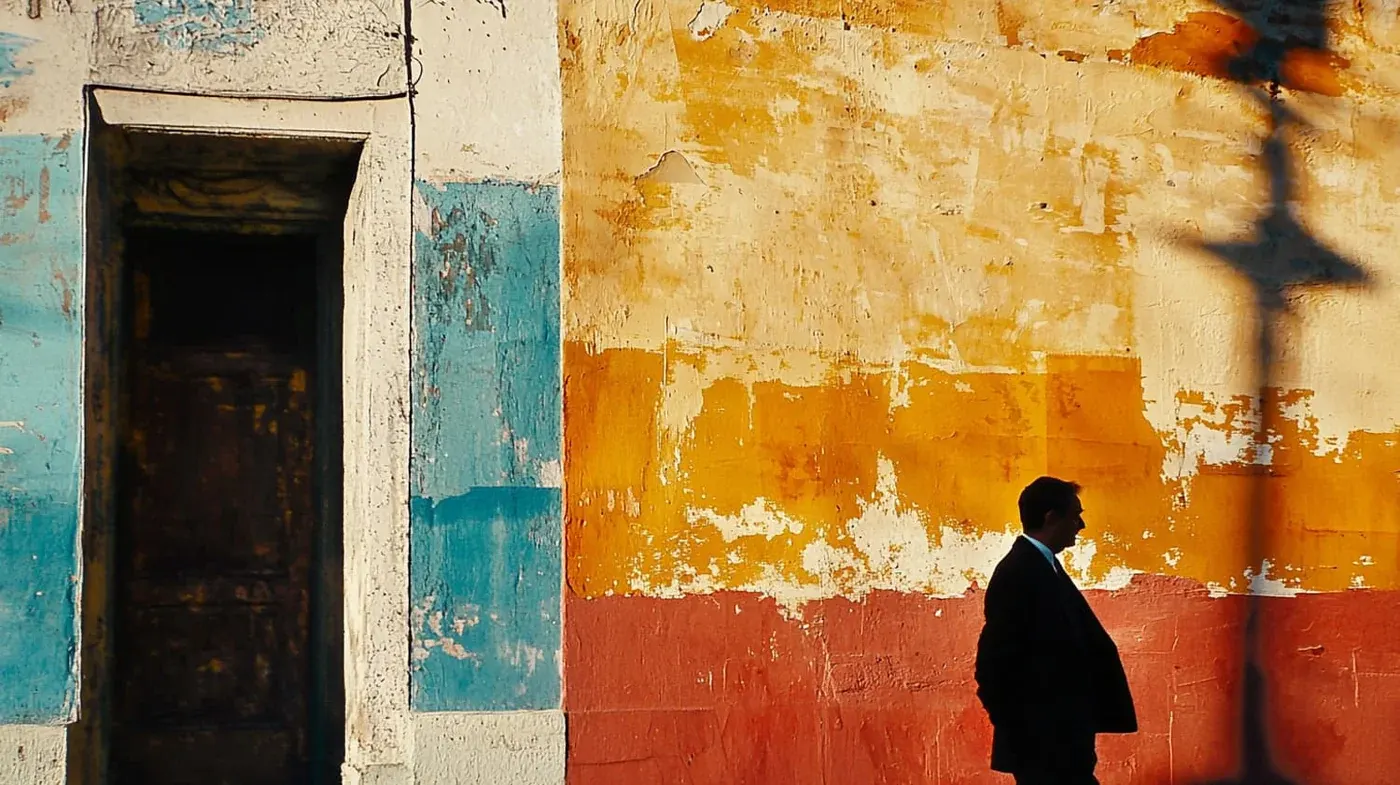
This photograph finds lyricism in plain sight. A walking figure crosses a worn wall of ochre, turquoise, white, and red, and the scene resolves into something both painterly and precise. What makes it memorable is the way human presence is held inside a larger design: the person is unmistakably important, yet the wall, doorway, and fading paint carry equal visual poetry.
A silhouette that turns design into story
The passerby on the right gives the frame its pulse. Rendered almost entirely in shadow, the figure reads instantly against the warm wall, which makes the profile and forward movement feel clean and legible. That clarity matters: without any facial detail, the body language alone carries the narrative. The result is elegant street photography—anonymous, fleeting, and deeply human at once.

The silhouetted figure gives the composition a clear emotional anchor while preserving the mystery of a passing moment.
Weathered paint as atmosphere
The wall is far more than a backdrop. Its scraped layers, peeling patches, and uneven brushwork create a surface rich with time. Ochre dominates, but the paint never feels flat; every abrasion and exposed underlayer adds variation. That patina gives the photograph its tactile quality and transforms a simple facade into something almost fresco-like.

The aged surface brings depth and history, turning color and decay into atmosphere.
Cool turquoise against warm earth
One of the image’s most distinctive pleasures is its color structure. The turquoise block near the center-left interrupts the field of warm tones with just enough coolness to sharpen everything around it. Against the ochre and rust-red bands, that note of blue-green feels vivid and memorable. The palette is restrained, but the contrast is sophisticated and striking.
The turquoise accent makes the warm palette more luminous and gives the wall a memorable chromatic rhythm.
A doorway that balances the frame
The dark doorway on the left is a powerful geometric counterweight to the pedestrian on the right. Its vertical rectangle has real visual mass, and that mass stabilizes the composition without making it static. The image works through asymmetry: one side is architectural and still, the other human and transient. That opposition creates the photograph’s quiet tension.

The doorway gives the image a strong architectural anchor and beautifully balances the moving figure.
Bands of color that stage the moment
Broad horizontal zones of white, ochre, and red simplify the scene into graphic layers. These bands act like a stage set, making the figure stand out immediately while also organizing the wall into clear visual planes. Because the structure is so strong, the photograph feels both spontaneous and composed. The eye moves easily from doorway to color fields to walker, and the whole frame holds together with calm authority.
The horizontal color bands give the photograph its graphic clarity and let the human figure emerge with immediate force.
Why this photograph stands out
What lingers here is the marriage of accident and order. A passerby, a weathered facade, and sharp sun become an image of remarkable poise. The photograph honors the beauty of surfaces, the drama of silhouette, and the grace of a split-second alignment—qualities that make ordinary street life feel enduring and artful.
About the photographer
Saul Leiter
Saul Leiter was known for his poetic, painterly approach to street photography, finding beauty in quiet, everyday moments rather than dramatic events. He used reflections, fogged windows, rain, vibrant color, and layered compositions to create images that feel intimate and dreamlike. His work often obscures or partially hides his subjects, inviting the viewer to discover the scene rather than simply observe it. Leiter’s photographs are celebrated for their subtle mood, ambiguity, and extraordinary use of color and light.