Raghu Rai’s Monument to Human Effort
An ordinary street becomes monumental as an overloaded cart, a hidden carrier, and a woman’s extended push turn labor into unforgettable form.
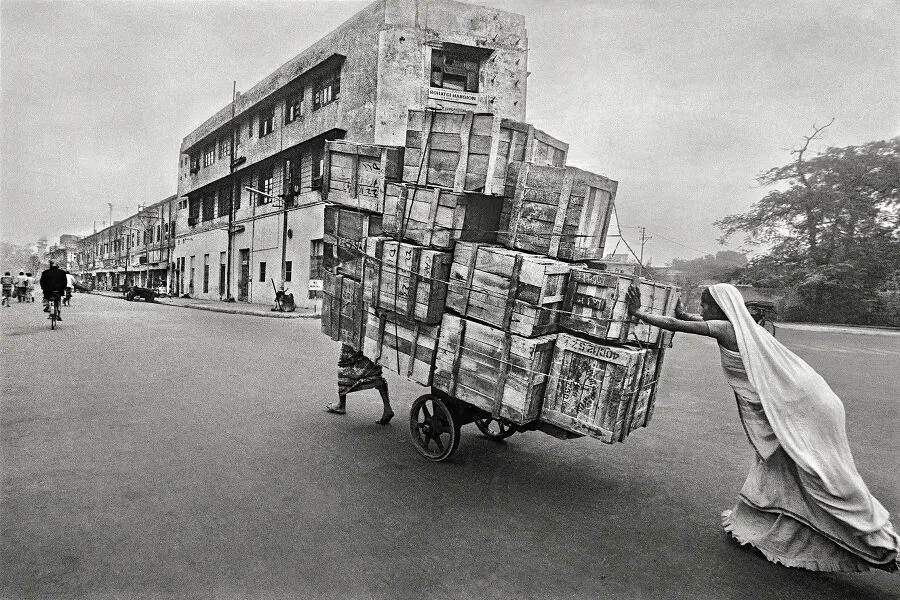
In this photograph, Raghu Rai gives physical effort the scale of architecture. A towering stack of wooden crates rolls through open road while a woman leans into the load with her whole body, her white drape catching the eye like a current of wind. What makes the picture so memorable is its fusion of documentary truth and formal precision: weight, motion, geometry, and human will all arrive in a single instant.
The cart becomes the photograph’s massive center of gravity
The overloaded cart dominates the frame immediately. Its stacked crates rise like an unstable wall, each box slightly misaligned, so the load feels both solid and precarious at once. That imbalance is crucial to the image’s power: the subject is not just a cart on a street, but an enormous physical challenge made visible. The wheel beneath the pile looks almost too small for the burden it carries, which intensifies the sense of strain and scale.

The towering block of crates gives the scene unforgettable weight and instant visual drama.
The hidden body turns observation into discovery
One of the photograph’s finest revelations sits under the crates: the legs of the person carrying the load from within. At first glance, the boxes seem almost self-propelled, then the body appears and the full reality of the labor comes into focus. That delayed recognition is beautifully handled. It deepens the image from spectacle into human story, making the burden feel not symbolic but bodily, immediate, and real.

The glimpse of legs beneath the load gives the image a powerful second read and deep human presence.
Rai binds people and structures through geometry
The surrounding architecture does more than provide setting. The long building at left echoes the cart’s rectangles, hard edges, and tilting planes, creating a visual rhyme between city and labor. Perspective lines pull the eye inward along the street, while the cart cuts diagonally across that order with urgency and force. The result is a frame where geometry is expressive rather than decorative: every angle reinforces pressure, movement, and balance.

The building’s severe lines mirror the cart’s structure and give the whole frame exceptional cohesion.
The woman’s posture gives the scene its emotional charge
At the right edge, the woman’s body forms a long, decisive line of effort. Her arms extend straight into the cart, her torso leans forward, and her trailing garment sweeps behind her in a soft curve that contrasts with the hard wooden boxes. That contrast is one of the image’s most beautiful choices: rigid crate against flowing cloth, mechanical burden against human grace. Her posture does not merely describe action; it embodies resolve.
The woman’s extended stance and flowing cloth turn exertion into a strikingly elegant form.
Street life stays present without diluting the main drama
In the distance, cyclists and pedestrians continue along the road, small but legible. These figures matter because they place the extraordinary burden of the cart within the ordinary rhythm of the street. The photograph remains rooted in lived public space, not isolated into a theatrical tableau. Their scale also enlarges the central action: by comparison, the cart feels even heavier, stranger, and more monumental.
The distant figures give the image social scale and enrich its documentary vitality.
Monochrome sharpens texture, weight, and atmosphere
The black-and-white rendering strips the scene to essentials. Wood grain, frayed fabric, concrete walls, and smooth road surface all separate through texture rather than color, which makes the physical world feel tactile and dense. The tonal range also helps unify the frame: the pale cloth of the woman stands out against the darker cart, while the soft sky and muted buildings keep attention on the labor itself. It is a restrained, deeply effective use of monochrome.
The monochrome treatment makes texture and effort feel immediate, tactile, and timeless.
Why this photograph stands out
What Raghu Rai achieves here is both simple and extraordinary: he turns a passing street moment into an image of lasting force. The cart’s overwhelming mass, the concealed carrier, the woman’s sculptural push, and the disciplined geometry of the street all work together to honor labor without reducing it to symbol. It is a photograph of movement, weight, and endurance, and its power lies in how clearly every visible element contributes to that truth.
About the photographer
Raghu Rai
Raghu Rai is renowned for his **powerful, deeply human approach to documentary photography**, capturing the complexity of Indian life through moments of emotion, movement, and quiet observation. His images range from crowded streets and everyday life to major historical events, often revealing unexpected relationships between people and their surroundings. His work is distinguished by **expressive composition, rich tonal depth, and an instinct for capturing decisive moments**. Rai combines the immediacy of photojournalism with a strong artistic sensibility, creating photographs that are not only records of reality but also deeply evocative visual stories.