Raghu Rai Finds Motion, Trace, and Presence on Kasturba Hospital Marg
A blurred passerby, a spill across concrete, and a humble cluster of utensils become a vivid study in movement and place.
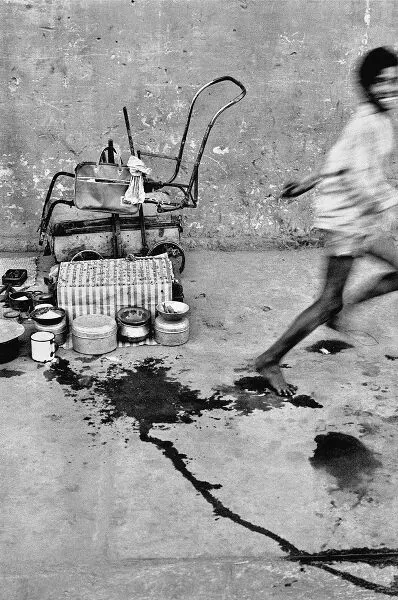
In this photograph from Kasturba Hospital Marg, Raghu Rai gives ordinary street-side details unusual force. A cart, stacked tins, scattered utensils, and a dark spill on the ground hold the frame with quiet authority, while a passing figure flashes through on the right. The image feels immediate and unforced, yet every major element contributes to a clear visual rhythm. Rai’s gift here is to let a modest scene carry both physical grit and human energy.
A spill that becomes the picture’s pathway
The dark stain on the ground does more than describe an accident or residue. It draws the eye from the lower edge inward, leading directly toward the containers and cart. That line gives the open concrete floor a strong purpose, turning empty space into active space. Because the mark is irregular and organic, it also keeps the photograph from feeling too rigid; it introduces movement before the blurred figure is even noticed.

The spill creates a natural visual route that makes the whole frame feel connected.
Everyday objects arranged with documentary richness
The left side of the frame is dense with information: metal pots, round tins, bowls, and the small cart stacked behind them. Rai makes this cluster feel substantial without romanticizing it. The varied shapes and tones give the eye plenty to examine, and the layering creates a believable sense of daily use. These objects are not props in the image; they are the image’s steady core, grounding the photograph in lived reality.

The packed grouping of utensils and cart gives the scene weight, detail, and a strong sense of place.
Wall texture as atmosphere
The weathered wall is essential to the photograph’s mood. Its scratches, stains, and tonal variations provide a plain but expressive backdrop that suits the humility of the objects below it. In black and white, those marks become more legible and more resonant, adding age and atmosphere without distracting from the main subjects. The wall holds the scene together with a calm, rough presence.

The textured wall gives the photograph its stark, tactile atmosphere.
A single curve that animates the structure
Among the boxes, circles, and horizontal edges, the cart’s looping handle stands out immediately. Its elegant curve lifts the composition and gives the upper middle of the frame a memorable graphic accent. That line keeps the object cluster from becoming merely utilitarian; it introduces grace inside a practical scene. Rai often finds this kind of visual surprise in ordinary environments, and here it becomes one of the picture’s quiet signatures.
The cart handle adds a striking graphic line that energizes the composition.
Blurred movement against stillness
The passing figure on the right brings the photograph to life through contrast. The person is not presented as a posed subject but as a fleeting presence, soft with motion against the hard clarity of wall, metal, and concrete. That difference between blur and stillness gives the image tension and pulse. The photograph becomes not just a record of objects left by a wall, but a record of a place actively being passed through and inhabited.
The moving figure gives the still arrangement a vivid sense of time and human presence.
Why this photograph stands out
What makes this photograph memorable is how completely it transforms modest evidence into expressive form. The spill becomes a line, the utensils become structure, the wall becomes atmosphere, and the passerby becomes motion itself. In Raghu Rai’s hands, a small street-side fragment holds texture, rhythm, and human life all at once.
About the photographer
Raghu Rai
Raghu Rai is renowned for his **powerful, deeply human approach to documentary photography**, capturing the complexity of Indian life through moments of emotion, movement, and quiet observation. His images range from crowded streets and everyday life to major historical events, often revealing unexpected relationships between people and their surroundings. His work is distinguished by **expressive composition, rich tonal depth, and an instinct for capturing decisive moments**. Rai combines the immediacy of photojournalism with a strong artistic sensibility, creating photographs that are not only records of reality but also deeply evocative visual stories.