Marianne North: A Portrait Suspended in Thought
Julia Margaret Cameron turns a quiet seated pose into something inward and luminous, using veil, gaze, and gesture to create a portrait full of reflection.
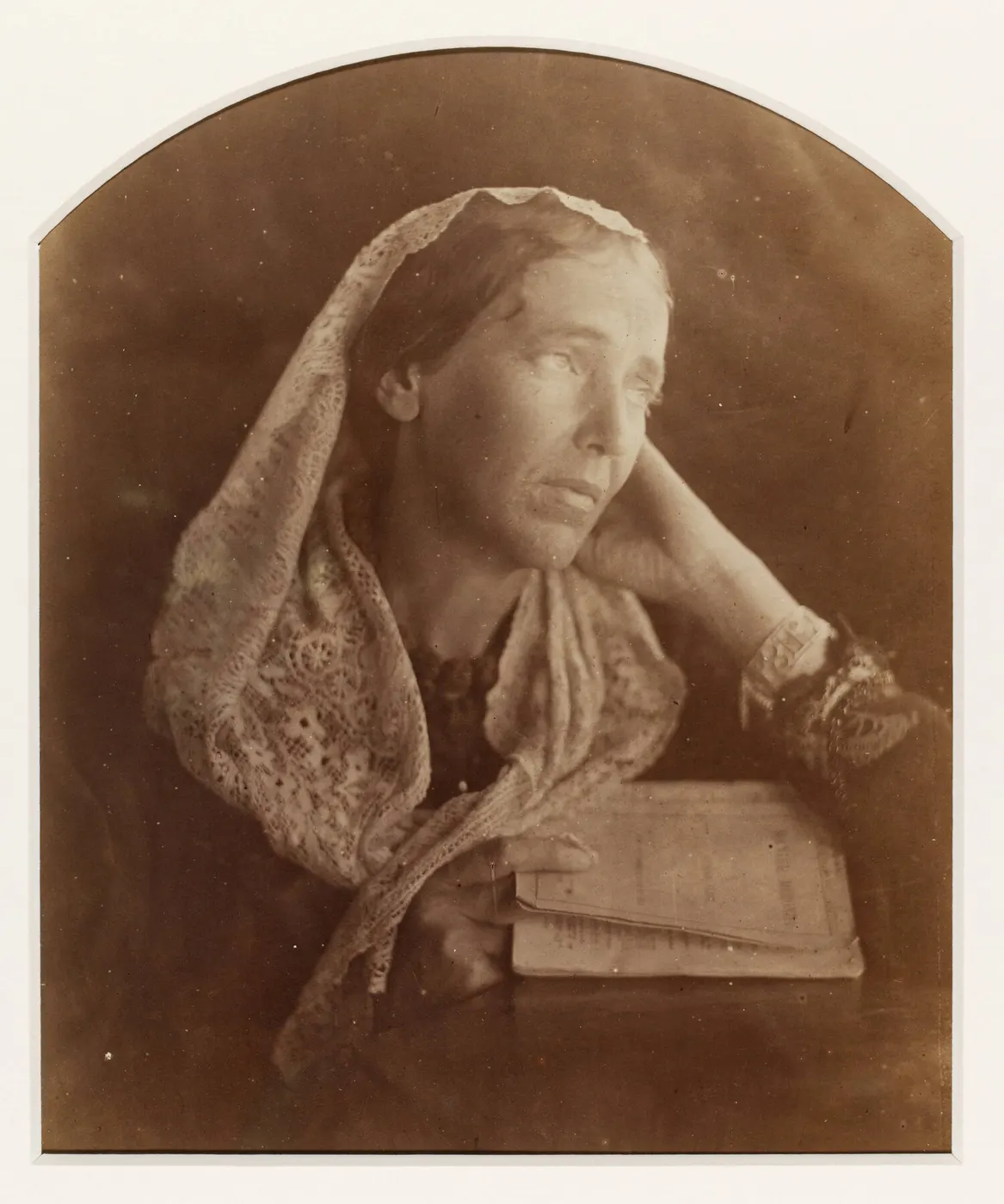
In *Marianne North*, Julia Margaret Cameron distills portraiture to presence, mood, and inward life. The photograph feels less like a record of a sitter than an encounter with a state of mind. Soft sepia tonality, a lifted gaze, and the intimate arrangement of hand, veil, and book give the image its remarkable stillness. Cameron’s gift for expressive portraiture is everywhere here: in the luminous face, in the tactile drape of lace, and in the way every element serves contemplation.
An expression that carries the whole picture
The sitter’s face is the emotional center of the photograph. Her eyes turn upward rather than outward, and that choice transforms the portrait from description into reverie. The parted lips and resting head suggest a thought continuing beyond the frame, as if we have entered the image in the middle of a private reflection. Cameron’s soft rendering is especially effective here; it keeps the expression gentle and atmospheric rather than fixed or theatrical.

The upward gaze gives the portrait its haunting inward life.
Lace as atmosphere and identity
The veil is more than costume. Its intricate lace pattern brings a delicate, tactile richness to the image, and its drape around the head and shoulders creates a visual envelope around the sitter. Against the smoother tones of skin and the darker ground, the fabric feels both ornamental and intimate. It gives the portrait a strong period character while also softening the transition between figure and shadow, deepening the image’s dreamlike beauty.

The lace veil adds both tactile beauty and a vivid sense of period character.
A prop that quietly deepens the narrative
The open book at the lower edge of the frame broadens the portrait’s meaning without competing with the face. It suggests reading, study, memory, or devotion, and that suggestion resonates with the sitter’s distant expression. Because the book sits low and remains secondary, it supports the image’s reflective mood with admirable restraint. It is a small but decisive detail that turns a pose into a fuller inner world.

The book enriches the portrait’s reflective story with quiet clarity.
Graceful structure beneath the softness
For all its atmospheric softness, the composition is carefully held together. The bent arm leads upward to the face, the hand supports the head, and the veil descends in a gentle sweep to the book below. These lines create a stable triangular structure that keeps the eye circulating through the frame. The geometry never feels rigid; instead, it gives the portrait poise, allowing the emotional openness of the expression to rest inside a beautifully ordered design.
The arm, hand, veil, and face form a poised structure that quietly steadies the image.
Why this photograph stands out
What makes *Marianne North* so memorable is the way Julia Margaret Cameron joins tenderness and design. The photograph is intimate without being casual, theatrical without losing sincerity, and soft without losing form. Its beauty lies in how completely its elements agree: the lifted face, the lace veil, the resting hand, and the open book all contribute to one sustained emotional note. The result is a portrait that feels less observed than felt, and that quality remains one of Cameron’s most distinctive achievements.
About the photographer
Julia Margaret Cameron
Julia Margaret Cameron was known for her **intimate, expressive portraits**, using photography to explore character, emotion, and the inner presence of her subjects. Rather than pursuing technical perfection, she embraced soft focus, dramatic lighting, and imperfect details to create images with a distinctly painterly and poetic quality. Her distinctive style is characterized by **close framing, luminous faces, atmospheric softness, and a dreamlike sense of intimacy**. Cameron deliberately used blur and shallow focus as expressive tools, giving her portraits a romantic, almost ethereal quality and helping establish photography as a medium capable of personal artistic expression.