Marc Riboud’s Windowed Street Poem
Seen through dark interior panes, Marc Riboud’s street scene turns ordinary passing life into a beautifully ordered, deeply human tableau.
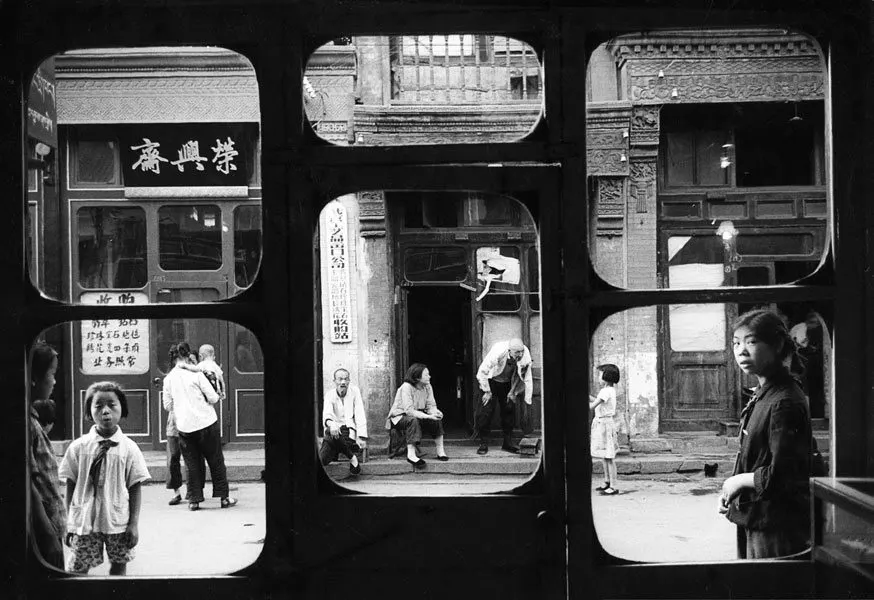
Marc Riboud’s "Windows" is a brilliant example of how framing can do more than organize a scene: it can transform it. Looking out from a dim interior, Riboud uses the window structure to divide the street into distinct stages, each alive with gesture, presence, and atmosphere. The photograph feels both spontaneous and composed, a hallmark of his humanistic eye.
A window grid that becomes the picture’s architecture
The dark mullions are not just foreground elements; they are the photograph’s governing rhythm. They split the view into rounded compartments that hold separate fragments of street life while keeping them in visual conversation. That structure gives the image immediate clarity. The geometry is firm and elegant, yet it never feels mechanical, because every opening contains something lived-in and slightly unpredictable.

The window frame turns a busy street into a lucid, beautifully ordered composition.
A memorable human presence on the right
The young woman in the right pane is the photograph’s emotional anchor. Her face is the clearest and brightest human note in the image, and her slight turn toward the camera makes the encounter feel direct without becoming theatrical. Riboud gives her enough separation within the pane that she reads instantly, yet she remains fully part of the surrounding street life. That balance between portrait presence and documentary flow is especially fine.

The right-side figure gives the scene immediacy, grace, and a lasting emotional point of entry.
Layered action at the center rewards slow looking
The central opening holds a small drama of its own: seated figures, a crouching man, and a bending gesture near the doorway. Instead of delivering a single event, Riboud lets the scene unfold in layers. The viewer moves from one figure to another and gradually senses the social texture of the street. This density is one of the photograph’s great pleasures. It feels observant rather than arranged, rich without becoming crowded.

The center pane deepens the photograph with a vivid sense of everyday life unfolding in layers.
Texture and tone give the street its timeless weight
The black-and-white rendering is especially beautiful in the facade details. Carved stone, worn wood, and weathered surfaces all register with a tactile softness that suits the scene’s age and atmosphere. Riboud uses tonal contrast carefully: the dark interior frame sets off the lighter street, while the architectural details remain crisp enough to enrich the image without overtaking the people. The result is documentary description elevated into visual poetry.
The tonal richness and architectural detail give the image depth, history, and quiet elegance.
Context arrives in fragments
Even the upper-left pane contributes to the photograph’s storytelling. The storefront sign and partial vehicle suggest a commercial street beyond the immediate figures, widening the sense of place with remarkable economy. Riboud does not need to show everything. A few precise fragments are enough to imply a whole environment. That economy makes the image feel expansive despite its tight framing.
Small contextual details make the photograph feel rooted in a vivid, fully inhabited world.
Why this photograph stands out
"Windows" shows Marc Riboud at his most distinctive: alert to geometry, sensitive to human presence, and able to find lyricism in ordinary public life. The photograph is memorable because it holds structure and spontaneity in perfect tension. Every pane offers something to discover, yet the whole image remains calm, coherent, and beautifully resolved.
About the photographer
Marc Riboud
Marc Riboud is known for his humanistic documentary and travel photography, capturing everyday life, political movements, and cultural encounters across Europe, Asia, Africa, and the Middle East. His photographs often find moments of quiet humanity within large historical events, balancing social observation with curiosity, empathy, and a keen eye for unexpected gestures. His distinctive style is characterized by elegant black-and-white compositions, precise timing, and a talent for finding visual poetry in ordinary scenes. Strong lines, geometric structures, expressive gestures, and carefully observed interactions give his images a sense of rhythm and spontaneity, often transforming a fleeting moment into a memorable visual story.