Marc Riboud’s graceful balance on the Eiffel Tower
In While Painting The Eiffel Tower, Marc Riboud turns a maintenance task into an image of poise, risk, and elegance, with one worker suspended inside the tower’s iron lattice above Paris.
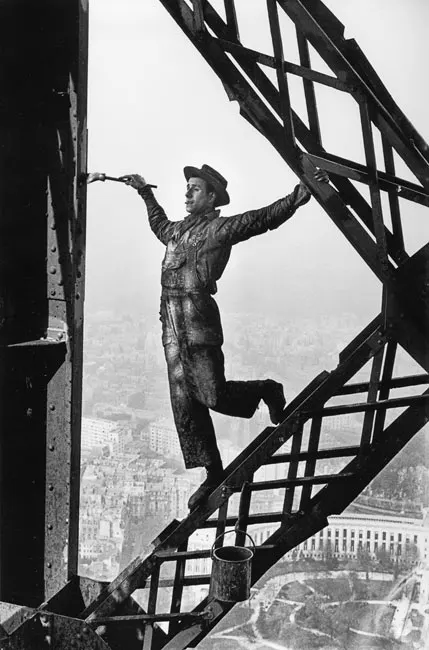
Marc Riboud had a rare ability to find visual poetry inside ordinary labor, and While Painting The Eiffel Tower is one of his clearest examples. A painter pauses high above Paris, balanced on the diagonal structure with one leg lifted, one hand holding a brush, and both arms opening into space. The photograph is unforgettable because it joins human ease with monumental scale: the ironwork is severe and industrial, yet the figure appears almost to dance within it.
A working gesture becomes a performance
The central figure gives the photograph its pulse. His outstretched arms, lifted heel, and upright torso create a silhouette that reads instantly, even before the viewer registers the details of his clothes or tools. Riboud catches a fleeting posture that feels both practical and theatrical: the man is painting, but he also seems to be balancing, presenting himself, and briefly floating inside the tower. That fusion of labor and grace is what makes the image so memorable.

The worker’s poised, open stance turns a routine task into a vivid, unforgettable human gesture.
The Eiffel Tower’s structure becomes a compositional score
The iron framework does more than provide setting. Its diagonals drive the eye upward and across the frame, while the repeating bars create rhythm around the figure. Riboud uses the tower’s geometry with remarkable clarity: the slanting stair and upper truss form a powerful visual channel, and the worker sits exactly where those forces become most expressive. The image feels engineered and spontaneous at once, a hallmark of Riboud’s best black-and-white compositions.

The tower’s diagonal ironwork gives the scene momentum, tension, and elegant structural clarity.
Small details keep the photograph grounded in real work
Part of the image’s power comes from its documentary precision. The hanging bucket near the lower stair is a modest detail, but it anchors the scene in actual labor. Without it, the photograph might drift toward pure symbol; with it, the picture keeps its footing in the physical world of maintenance, materials, and effort. Riboud lets that object quietly reinforce the truth of the moment.
The hanging bucket deepens the image by tying its lyricism to the practical reality of the job.
Paris below gives the moment its scale
The pale city in the background is essential to the photograph’s emotional charge. Riboud allows Paris to remain distant and softly rendered, so the worker and the ironwork stay dominant, yet the streets and buildings below make the height fully legible. That drop beneath him turns the pose into something more than decorative. The city expands the image outward, giving the lone figure a monumental stage and making his calm composure feel extraordinary.
The distant city below gives the image grandeur and makes the worker’s calm balance feel astonishing.
Why this photograph stands out
What makes While Painting The Eiffel Tower endure is its perfect balance of fact and feeling. Marc Riboud records a man at work, but he also reveals a moment of elegance inside steel, height, and risk. The result is both documentary and poetic: an image in which the Eiffel Tower becomes a frame for human confidence, and a single painter briefly seems to rise above the city like a dancer.
About the photographer
Marc Riboud
Marc Riboud is known for his humanistic documentary and travel photography, capturing everyday life, political movements, and cultural encounters across Europe, Asia, Africa, and the Middle East. His photographs often find moments of quiet humanity within large historical events, balancing social observation with curiosity, empathy, and a keen eye for unexpected gestures. His distinctive style is characterized by elegant black-and-white compositions, precise timing, and a talent for finding visual poetry in ordinary scenes. Strong lines, geometric structures, expressive gestures, and carefully observed interactions give his images a sense of rhythm and spontaneity, often transforming a fleeting moment into a memorable visual story.