Josef Koudelka’s "Horse" and the Drama of a Quiet Exchange
A horse lowers its head toward a crouching man, and Josef Koudelka turns the simple encounter into something monumental, intimate, and unforgettable.
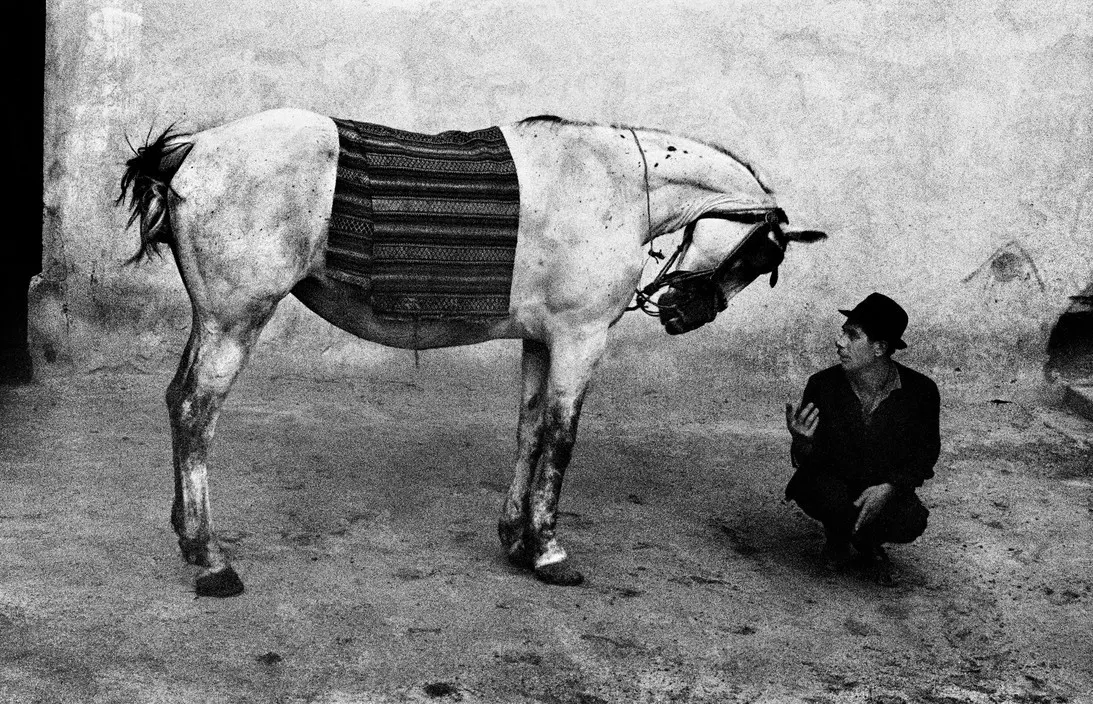
Josef Koudelka’s "Horse" has the directness of a found moment and the weight of a parable. A broad white horse fills the frame in profile while, at the right, a crouching man answers its lowered head with an open hand and attentive gaze. The picture is memorable because it holds power and tenderness in the same space. Its black-and-white treatment, rough wall, and spare setting strip the scene to essentials, leaving posture, distance, and gesture to carry the emotion.
A single gesture gives the photograph its soul
The emotional center of the image is the horse’s lowered head reaching toward the man. That small change in angle turns an ordinary standing pose into an exchange. The horse does not simply occupy the frame; it addresses someone. The man’s upward look completes the circuit, so the space between them feels charged with attention. Koudelka makes this moment vivid without exaggeration, trusting the simplest physical relationship to carry the meaning.

The meeting of the horse’s head and the man’s gaze gives the picture its emotional force.
The crouching figure makes the scene human
The man’s posture is wonderfully expressive. He is low to the ground, compact, and alert, with one hand lifted in a gesture that feels conversational rather than performative. That pose keeps the photograph from becoming a pure animal study. Instead, it becomes a scene of contact between two presences of very different scale. His hat, dark jacket, and bent silhouette also read instantly against the pale wall, so his role in the drama is clear at a glance.

The man’s crouched posture and lifted hand bring warmth, character, and immediacy to the frame.
The horse’s profile anchors the whole composition
The horse is placed with remarkable clarity: broadside, steady, and monumental. Its body forms a large, calm mass across the left and center of the image, giving the composition a strong visual foundation. That side profile is both descriptive and graphic. The legs create a measured rhythm, the blanket introduces a dark band across the torso, and the long neck arcs decisively toward the man. The result is a composition that feels balanced and inevitable, with the animal serving as both subject and structure.

The horse’s broad lateral silhouette gives the photograph its stability and graphic power.
Texture turns the setting into atmosphere
The weathered wall and gritty ground do more than provide context; they shape the photograph’s mood. Their worn surfaces echo the tactile presence of the horse’s coat, the woven blanket, and the man’s dark clothing. In monochrome, these textures become a language of age, labor, and place. Nothing feels decorative. Every surface contributes to the rustic, documentary character that Koudelka is known for, making the image feel discovered rather than arranged.

The rough wall and granular monochrome give the image a tactile, lived-in atmosphere.
Why this photograph stands out
What makes "Horse" linger is its economy. A wall, a horse, a crouching man, and a slight lowering of the head are enough to suggest trust, attention, and mutual recognition. Josef Koudelka draws monumental feeling from plain materials, letting shape, texture, and timing do the work. The photograph feels both immediate and timeless, which is exactly why it stays in the mind.
About the photographer
Josef Koudelka
Josef Koudelka is known for his powerful documentary and street photography, particularly his images of Roma communities, political upheaval, exile, and the landscapes of Europe. His photographs often convey a strong sense of movement, displacement, and human resilience, turning fleeting encounters and ordinary scenes into deeply evocative visual stories. His distinctive style is characterized by dramatic black-and-white imagery, striking compositions, and an instinct for capturing decisive moments. Wide-angle perspectives, strong geometric forms, deep shadows, and carefully balanced figures give his photographs a raw, cinematic intensity, while his sense of timing makes moments of chaos, solitude, and human connection feel almost timeless.