Josef Koudelka’s Gift for Turning a Passing Glance into Monument
A solitary woman crossing the frame brings human tension to a stately facade, as Josef Koudelka balances architectural rhythm with a fleeting, unforgettable profile.
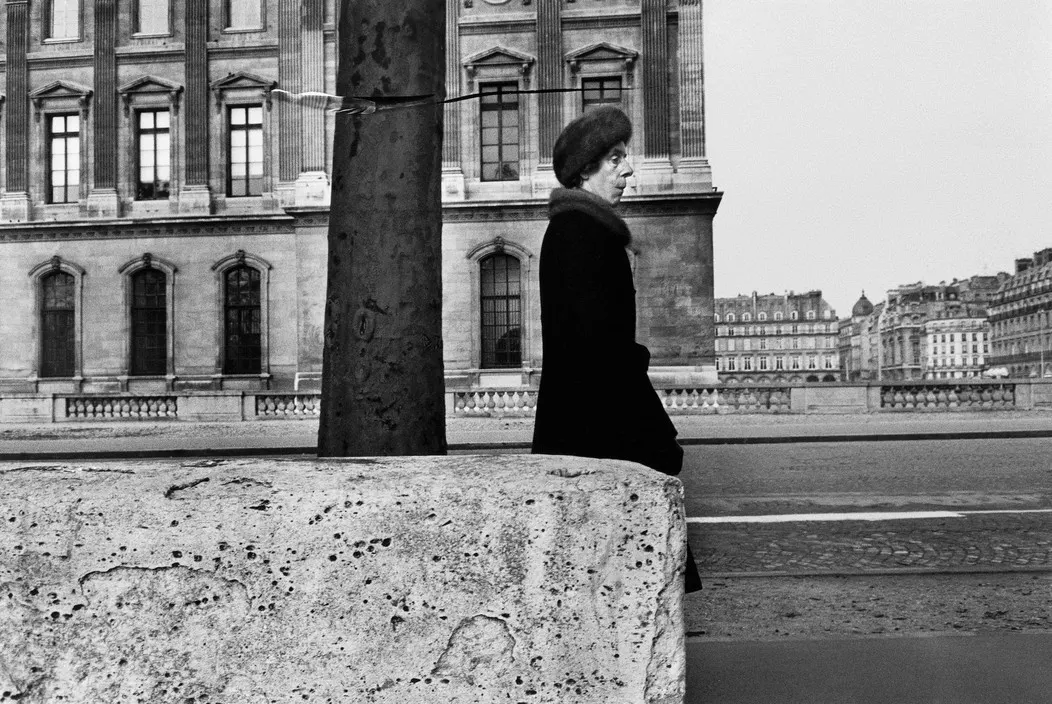
In "Par65539 Overlay," Josef Koudelka finds drama in the meeting of stone, street, and passing life. The photograph carries his signature ability to make a transient human moment feel inseparable from the larger structure around it. A lone woman in dark clothing moves across a grand architectural backdrop, and the image holds because every major element—her silhouette, the repeating facade, the tonal restraint—works toward the same idea: a brief human presence set against something monumental and enduring.
A profile that instantly becomes the story
The woman’s face, hat, and dark coat give the photograph its emotional center. Her profile is precise and legible, and that clarity turns a simple walk across the frame into an event. She is not absorbed by the city around her; instead, her expression and bearing give the scene character. Koudelka isolates that human presence so effectively that the viewer reads the image first as a lived moment, then as an architectural setting.

The passerby’s profile gives the photograph an immediate and memorable human anchor.
Architecture as rhythm, not just backdrop
The building behind her is beautifully organized through repeated windows, pilasters, and stone divisions. Those recurring forms establish a measured visual pulse across the frame. Because the facade is so orderly, the figure feels even more vivid by contrast. Koudelka uses the building not merely as scenery but as a formal system that heightens the singularity of the person moving through it.

The repeated windows and columns create a disciplined rhythm that makes the lone figure stand out more strongly.
Black-and-white that sharpens presence
The monochrome treatment is especially effective here because it strips the scene to its essentials: light stone, dark clothing, and a narrow range of grays between them. The woman’s face reads clearly against the paler background, while her coat holds a dense, graphic weight. This tonal simplicity gives the image its firmness. Nothing feels decorative; every value serves shape, separation, and mood.
Clear tonal separation gives the figure a striking presence within a restrained grayscale scene.
A fleeting figure against a permanent city
The subject’s placement on the right side of the frame brings motion into an otherwise stately composition. She appears to be passing out of view, and that sense of continuation beyond the edge adds life to the picture. The effect is subtle but powerful: the architecture feels fixed and enduring, while the figure embodies time passing through it. That tension between permanence and transience is one of the photograph’s most resonant qualities.
Off-center placement gives the image quiet tension and a vivid sense of movement through the city.
Why this photograph stands out
What makes this photograph memorable is how naturally Josef Koudelka joins formal control with human immediacy. The architecture is stately, the geometry exacting, and the tones beautifully pared down, yet the lasting impression is the woman herself: a passing figure made monumental for an instant. It is a superb example of street photography that feels both accidental and perfectly composed at once.
About the photographer
Josef Koudelka
Josef Koudelka is known for his powerful documentary and street photography, particularly his images of Roma communities, political upheaval, exile, and the landscapes of Europe. His photographs often convey a strong sense of movement, displacement, and human resilience, turning fleeting encounters and ordinary scenes into deeply evocative visual stories. His distinctive style is characterized by dramatic black-and-white imagery, striking compositions, and an instinct for capturing decisive moments. Wide-angle perspectives, strong geometric forms, deep shadows, and carefully balanced figures give his photographs a raw, cinematic intensity, while his sense of timing makes moments of chaos, solitude, and human connection feel almost timeless.