Joel Meyerowitz’s Park Scene Turns Quiet Observation Into Theater
Under a dense canopy of leaves, Joel Meyerowitz finds a park scene shaped by color, distance, and the eloquence of ordinary human presence.
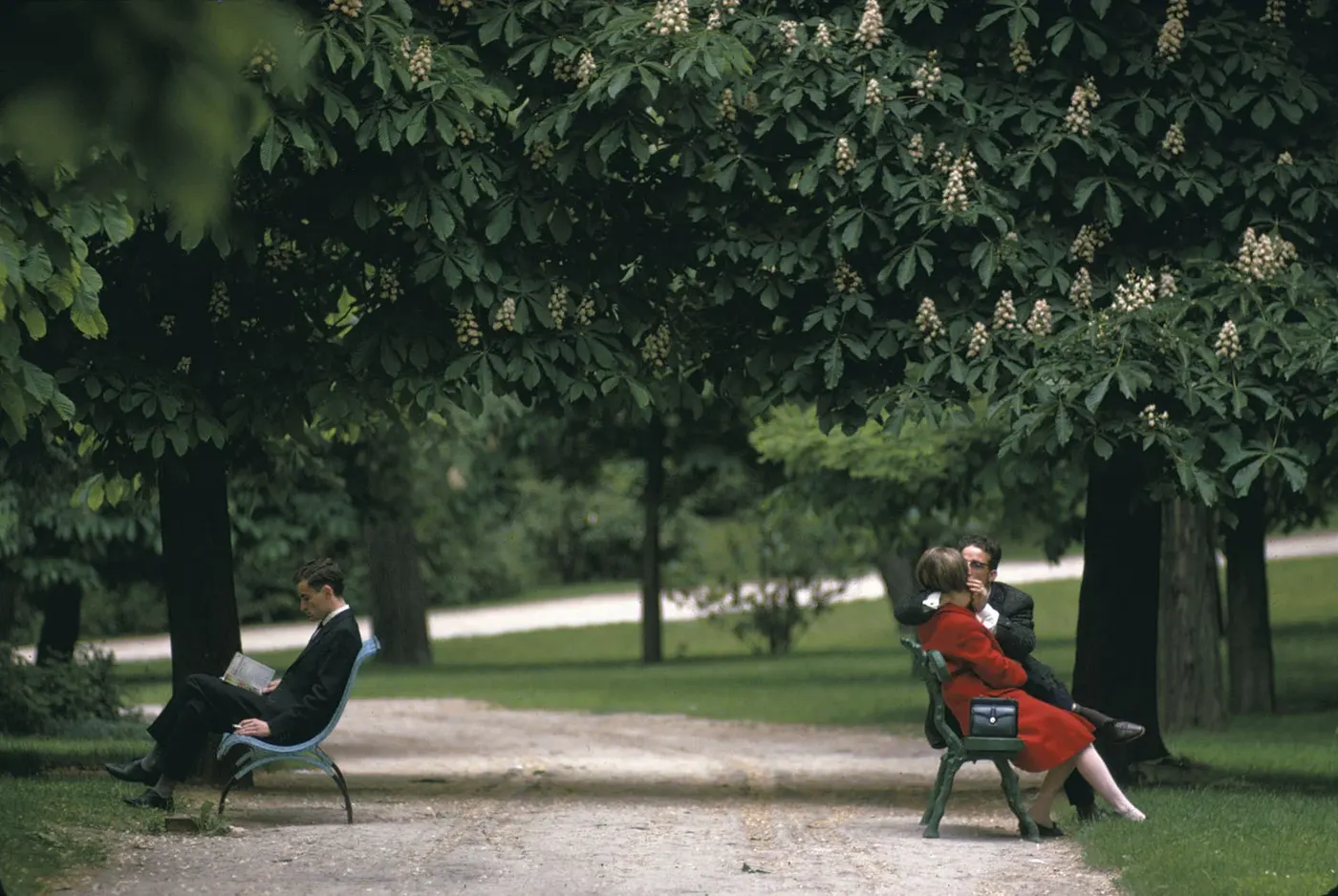
This photograph shows Joel Meyerowitz at his most observant: alert to small human gestures, sensitive to color, and able to give an ordinary public space the feeling of a stage. Two benches sit apart under a heavy canopy of leaves. On the left, a man reads alone. On the right, a couple leans into each other, the woman’s red coat glowing against the subdued greens. The picture is memorable because it holds these separate lives in one calm, beautifully ordered frame.
A canopy that feels like a curtain
The upper half of the frame is filled with dark, dense foliage, and that mass of leaves does more than describe the park. It creates enclosure. The scene below feels sheltered, almost performed beneath it, as if the trees are drawing a curtain around these private moments. Meyerowitz’s handling of scale is especially elegant here: the large canopy makes the figures feel small without diminishing them, giving the image atmosphere and emotional quiet.

The overarching foliage turns the park into a lyrical, theatrical space.
Red as the picture’s emotional center
The woman’s coat on the right bench is the photograph’s decisive color event. In a palette built from mossy greens, dark trunks, pale gravel, and muted clothing, that red lands with extraordinary clarity. It immediately locates the eye and gives the scene a pulse. Because the color is attached to an intimate human interaction, it works as more than contrast; it becomes the image’s emotional center, concentrating warmth and attention in a single, unforgettable note.

The red coat gives the composition its strongest focal point and its most memorable color accent.
Two benches, two ways of being alone together
What makes the photograph linger in the mind is the relationship between the two benches. On the left, the reader is self-contained, angled inward toward his newspaper. On the right, the couple forms a compact unit of closeness and exchange. Meyerowitz places these figures far enough apart for each to keep its own emotional register, yet close enough to feel connected within the same social world. That contrast between solitude and intimacy gives the image its narrative richness.

The pairing of the solitary reader and the embracing couple gives the scene quiet narrative depth.
Depth built through layers of looking
The image feels immersive because it is organized in layers. Soft leaves blur in the upper left foreground, the benches and figures sit clearly in the middle distance, and the path and trees recede behind them. This layering creates the sensation of looking into a scene rather than merely at it. The shallow softness at the edge of the frame is especially effective: it makes the moment feel gently discovered, as though the viewer has paused just outside the action.
Foreground blur and receding space give the photograph a strong sense of depth and intimacy.
A subdued palette with a calm, cinematic rhythm
The greens are rich but restrained, the gravel path is pale without feeling harsh, and the dark tree trunks give the frame vertical structure. These tonal relationships keep the photograph calm and cohesive. Meyerowitz, a master of color as lived experience, lets the hues describe mood as much as place. Nothing is overstated. The result is a scene with cinematic rhythm: quiet, observant, and full of subtle visual music.
The restrained greens and soft tonal contrasts create a cinematic atmosphere of stillness and observation.
Why this photograph stands out
This is a beautiful example of how Joel Meyerowitz can make everyday life feel both spontaneous and composed. The canopy, the red coat, the distance between the benches, and the layered depth all work together to turn a passing park moment into something enduring. The photograph rewards attention not through spectacle, but through balance, feeling, and the poetry of ordinary presence.
About the photographer
Joel Meyerowitz
Joel Meyerowitz is known for his observant, vibrant approach to street photography, capturing the energy, chance encounters, and visual complexity of everyday urban life. He was an important early advocate of color photography as a serious artistic medium, using color to reveal relationships between people, light, architecture, and the street. His work is distinguished by rich color, layered compositions, spontaneous interactions, and a strong sense of visual rhythm. Meyerowitz often allows multiple moments to coexist within the frame, creating photographs that reward lingering attention and reveal the poetry and complexity of ordinary scenes.