Jama Masjid
A storm-dark sky, a luminous rooftop room, and the vast spread of the city turn this black-and-white frame into something both monumental and intimate.
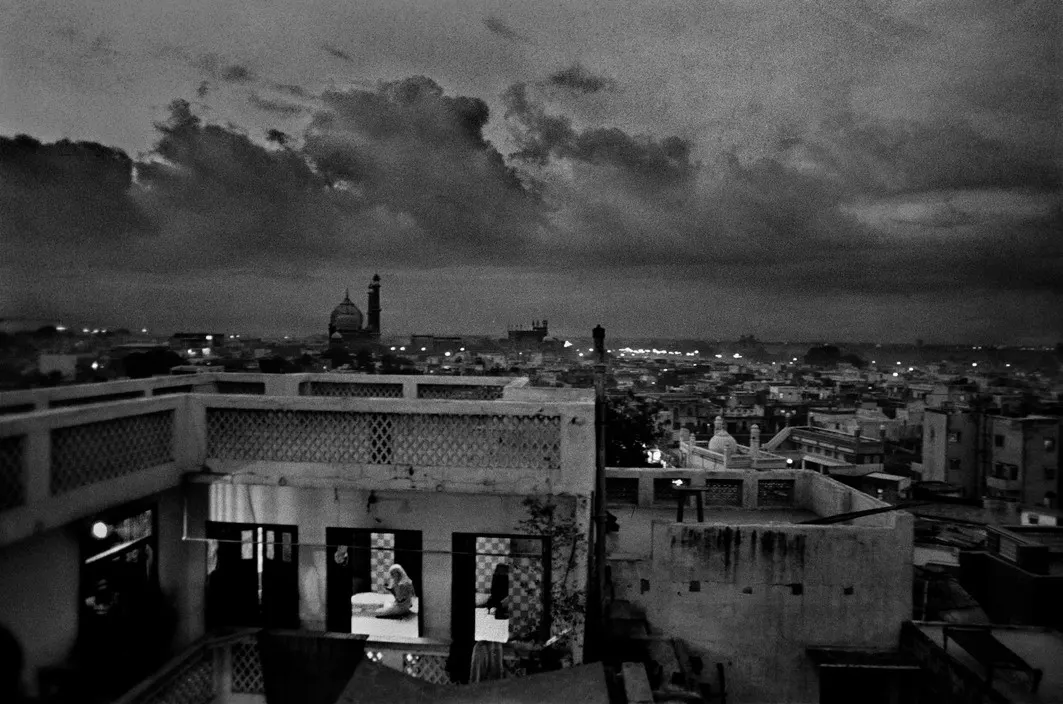
This photograph holds two experiences at once: the immensity of a city under gathering weather, and the quiet interior life of a single person within it. Its strength lies in that balance. The frame feels cinematic, but never theatrical; the mood comes from observed light, layered rooftops, and the exact placement of a human presence that gives the entire city emotional scale.
A human presence that transforms the skyline
The illuminated seated figure in the lower portion of the frame is the image’s emotional key. Without enlarging the gesture, the photograph lets that small pool of light carry enormous weight. It turns the rooftops and distant horizon from scenery into lived space. The contrast between the figure’s stillness and the city’s sprawl creates a sense of solitude that feels immediate and deeply memorable.

The tiny lit figure gives the vast city a clear emotional center and a powerful sense of scale.
Clouds used as architecture
The sky is not background here; it behaves like a second city hanging above the first. The dense storm-cloud formation fills the upper half with mass, shape, and tonal drama. Their dark, sculptural volume presses downward on the frame, making the lit horizon feel fragile and precious. That tension gives the photograph its brooding, cinematic atmosphere.

The cloud bank gives the image its commanding mood and turns weather into structure.
Rooftop layers that pull the eye inward
The foreground parapet and terrace edges create a measured path into the picture. Instead of dropping straight into a distant skyline, the eye moves through architectural layers: parapet, rooftop room, adjoining walls, then the city beyond. That sequence gives the image depth and helps the intimate lower scene feel connected to the larger urban field.

The stepped rooftop foreground creates depth and makes the city feel discovered rather than merely seen.
A city that stays alive in the distance
The scattered lights across the skyline are handled with restraint. They shimmer just enough to suggest movement, habitation, and scale, but they never overwhelm the darker tonal world of the frame. This makes the distance feel inhabited and continuous, extending the photograph’s narrative beyond the rooftop and into the wider city night.

The distant lights keep the far skyline alive and enlarge the photograph’s sense of inhabited space.
Distinctive forms within the urban sprawl
Amid the low, horizontal spread of buildings, domes and vertical architectural accents give the skyline rhythm. These forms are especially effective because they are not overemphasized; they emerge naturally from the city and provide recognizable structure beneath the heavy clouds. The result is a skyline with character, one that feels specific to place rather than generic.
The domes and vertical accents give the skyline rhythm, identity, and a strong sense of place.
Why this photograph stands out
What makes this photograph lasting is the way it joins grandeur and intimacy without strain. The weather is monumental, the city expansive, yet the image is ultimately remembered through a single lit room and the person inside it. That interplay of scale, atmosphere, and human presence is what gives Jama Masjid its quiet authority.
About the photographer
Raghu Rai
Raghu Rai is renowned for his **powerful, deeply human approach to documentary photography**, capturing the complexity of Indian life through moments of emotion, movement, and quiet observation. His images range from crowded streets and everyday life to major historical events, often revealing unexpected relationships between people and their surroundings. His work is distinguished by **expressive composition, rich tonal depth, and an instinct for capturing decisive moments**. Rai combines the immediacy of photojournalism with a strong artistic sensibility, creating photographs that are not only records of reality but also deeply evocative visual stories.