Jain Nuns: Ketaki Sheth’s Street Stage of Grace and Atmosphere
Two Jain nuns pass between vintage cars beneath the ROCKSIDE sign, and Ketaki Sheth turns an ordinary street into a poised, timeless tableau.
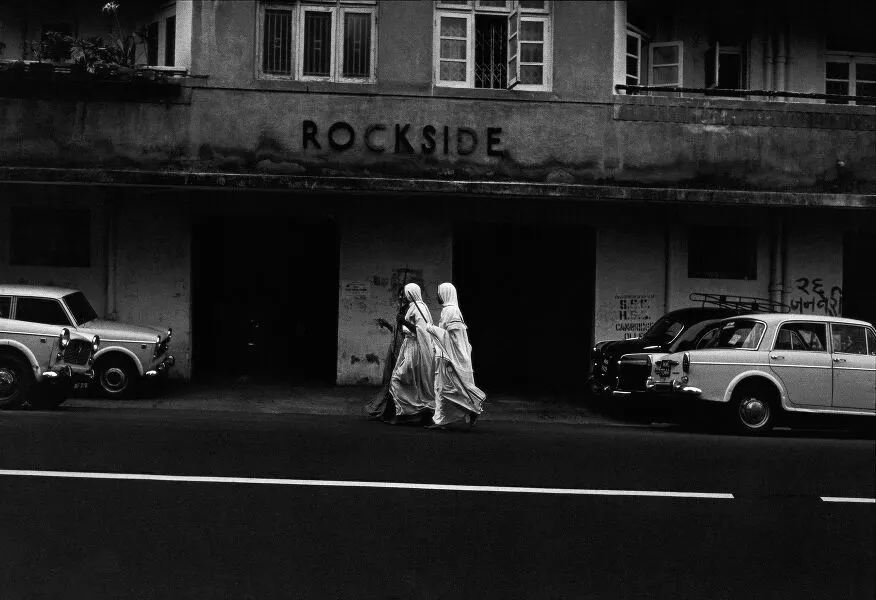
Ketaki Sheth has a gift for finding human presence inside the texture of a place, and this photograph shows that gift with unusual clarity. Two Jain nuns move through a rain-darkened street while vintage cars, a worn facade, and a bold sign hold the scene in place around them. The image feels documentary and theatrical at once: immediate in its observation, yet composed with the calm authority of a classic black-and-white print.
The figures arrive in light
The photograph’s most memorable visual event is the appearance of the two nuns at center frame. Their white robes glow against the dark recessed doorway, so the eye finds them instantly. That contrast gives the scene its structure, but it also gives it feeling: the pair seem to carry their own light as they cross the street. Their stride keeps the moment alive, and the drape of the fabric adds a soft, flowing rhythm within the harder lines of the city.

The bright robes against the shadowed entrance create a luminous, immediate focal point.
A city street becomes a stage
The parked cars on the left and right do more than provide context. They form a visual proscenium around the walkers, turning the center of the frame into a stage. Because the vehicles are older models, they also deepen the photograph’s timeless quality; the scene feels suspended between eras rather than fixed to a single date. This framing is balanced and cinematic, guiding attention inward without looking forced.

The two cars frame the center beautifully, giving the image balance and a quietly cinematic shape.
The sign gives the moment a name
The large ROCKSIDE sign is one of the details that makes the image linger in the mind. It anchors the nuns within a specific urban setting and keeps the photograph from becoming a generic street study. The word itself has graphic weight, sitting above the figures like a title card, while the weathered wall around it adds age and atmosphere. Place and mood arrive together in a single gesture.

The ROCKSIDE sign gives the photograph a distinct sense of place and a memorable graphic anchor.
Gesture, closeness, and quiet narrative
What makes the human presence here so affecting is that there are two figures, not one. Their closeness suggests companionship, shared purpose, and routine, while their nearly synchronized movement gives the image a subtle internal rhythm. Sheth does not need overt action to create narrative. The slight turn of the bodies, the gathering folds of cloth, and the way the pair move together are enough to make the moment feel full of life and meaning.
The paired movement of the nuns gives the scene warmth, rhythm, and lasting human presence.
Black-and-white as atmosphere
The monochrome treatment is essential to the photograph’s power. It unifies the wet road, the stained facade, the shadowed openings, and the polished cars into one tonal world. Within that world, the whites of the robes become even more resonant. The result is rich but restrained: full of texture, full of depth, and free of distraction. It is a black-and-white image that understands how tone can carry both narrative clarity and emotional mood at the same time.
The deep tonal range gives the street scene both clarity and a beautifully moody sense of time.
Why this photograph stands out
This photograph embodies much of what makes Ketaki Sheth’s work so enduring: intimacy without intrusion, structure without stiffness, and a deep responsiveness to the poetry of everyday life. In the meeting of white robes, dark doorway, old cars, wet street, and weathered sign, she creates an image that feels at once observed and composed. It is a street photograph with the stillness of a tableau and the pulse of lived experience.
About the photographer
Ketaki Sheth
Ketaki Sheth is known for her **intimate, energetic photography of people and communities in India**, particularly her evocative portraits of Mumbai and its diverse social worlds. Her work often finds poetry in everyday life, using close observation to capture the character, movement, and relationships that define her subjects. Her distinctive style combines **rich black-and-white imagery, expressive gestures, layered compositions, and a strong sense of rhythm and movement**. She often photographs people within their environments rather than isolating them, creating images that feel spontaneous yet visually sophisticated, with a warmth and humanity that runs through her work.