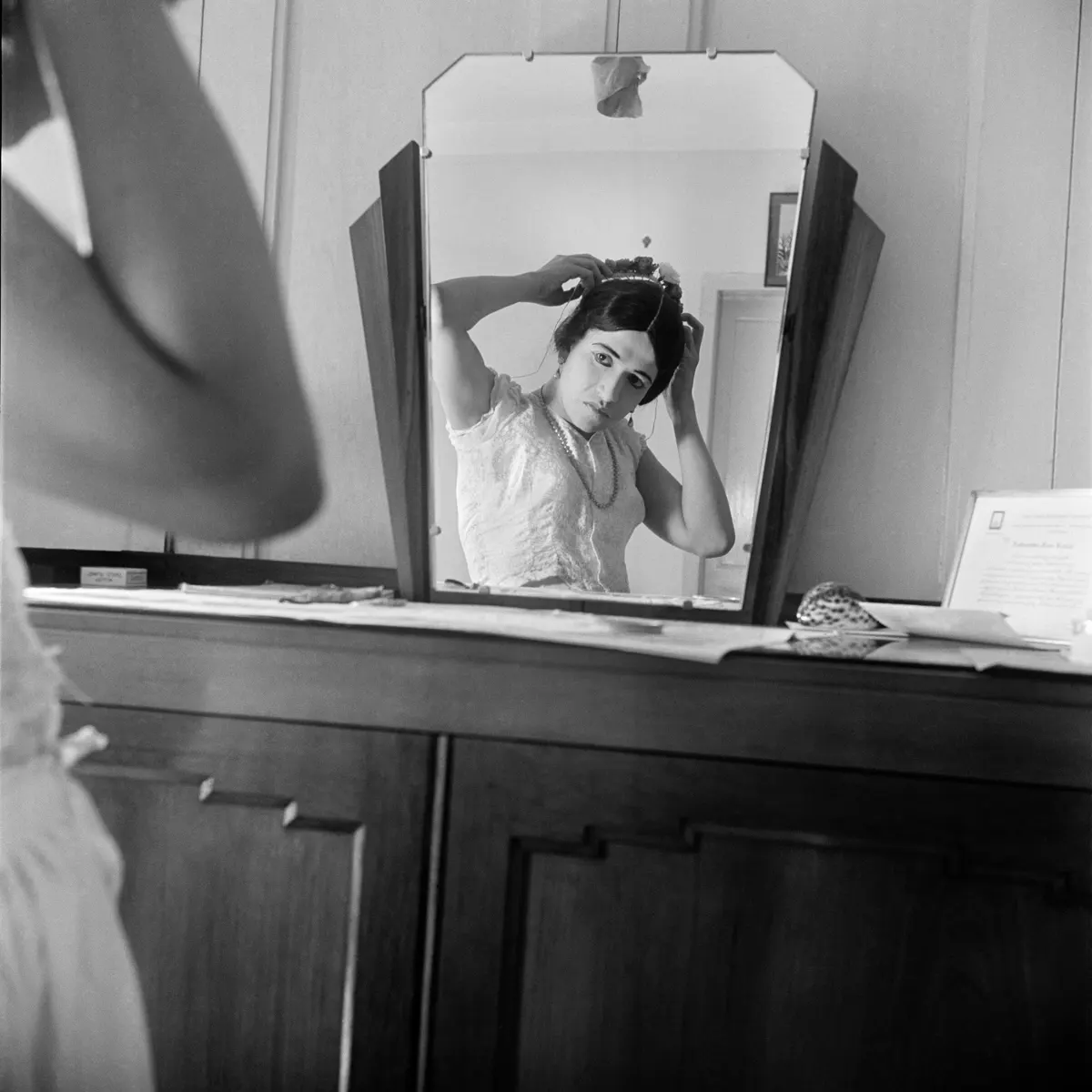
Theatre Artiste, Bombay, Early 1940s by Homai Vyarawalla
A mirror turns a private act of preparation into a poised, theatrical portrait, where gesture, structure, and soft monochrome light work in perfect sympathy.
Watch the video
This photograph finds grandeur in a quiet, personal moment. A theatre artiste stands before a dressing mirror, adjusting her hair, and the image transforms that everyday action into something graceful, self-possessed, and cinematic. Its power comes from how naturally performance and privacy meet: the subject is preparing herself, yet the photograph already feels like a fully realized stage.
A reflection that holds the whole picture together
The reflected figure lands with immediate clarity at the center of the composition. Her face, lifted arms, and concentrated gaze create a complete visual event inside the mirror, so the image feels anchored from the first glance. What makes this especially memorable is the balance between intimacy and presence: she is not performing outwardly for the camera, but the reflection gives her undeniable command of the frame.

The reflected portrait creates an instantly compelling focal point with both intimacy and authority.
The mirror becomes a stage set
The mirror’s angled side panels do more than frame the subject; they build an interior architecture around her. Those dark wings guide the eye inward and give the photograph a subtle theatricality, as if curtains have parted around a private scene. The geometry is strong but not severe, which allows the structure to feel elegant rather than imposed.

The mirror’s geometry gives the portrait depth, order, and a distinctly theatrical presence.
Gesture turns portrait into story
The moment of hair adjustment is the image’s emotional key. Her hands are active, her head tilts slightly, and the expression remains thoughtful rather than posed. That small grooming action gives the portrait specificity: this is not a generic sitter, but a person caught in a real interval of preparation. The photograph becomes memorable because it preserves that in-between moment with such calm precision.

The grooming gesture gives the portrait narrative life and a beautifully observed sense of immediacy.
Soft monochrome light enriches the mood
The tonal treatment is gentle and beautifully controlled. Light rests softly across the face and blouse, preserving detail in the fabric while keeping the mood hushed and reflective. In black and white, the textures of wood, cloth, skin, and hair all register with quiet richness, reinforcing the period atmosphere without needing any overt flourish.
The soft black-and-white tonality deepens the image’s intimacy and brings its textures vividly to life.
Why this photograph stands out
What lingers here is the photograph’s poise. It sees a fleeting, private act and gives it form, structure, and emotional resonance without disturbing its naturalness. The result is both documentary and theatrical: a portrait of preparation that already feels like performance, rendered with elegance, restraint, and lasting charm.
About the photographer
Homai Vyarawalla
Homai Vyarawalla was one of India’s pioneering photojournalists, known for her **observant, candid photographs of public life and historic moments**. Her work captured the early decades of independent India, from political leaders and cultural figures to everyday scenes, with a strong sense of composition and visual storytelling. Her photographs are distinguished by their **quiet intimacy, sharp observation, and understated elegance**. Rather than simply recording events, Vyarawalla often found revealing human moments within them, creating a visual record of a country undergoing profound social and political change.