Henri Cartier-Bresson’s Ruins Become a Stage for Human Vitality
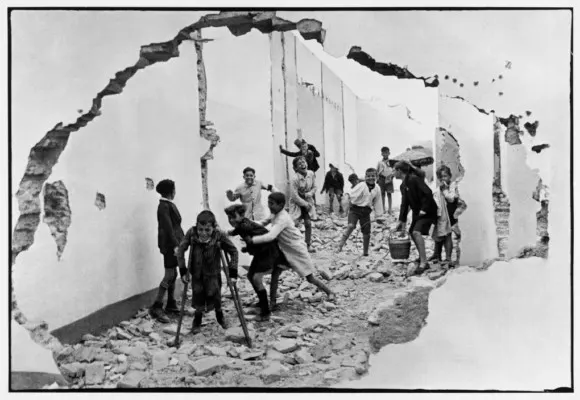
Inside a shattered corridor, children and workers move through rubble with startling energy. The photograph’s power comes from the way broken architecture, tactile ground, and vivid human gestures turn devastation into a scene of resilience and life.
Watch the video
This photograph is unforgettable for the way it holds ruin and vitality in the same frame. A collapsed interior becomes a living passageway, filled with children, workers, movement, and purpose. Cartier-Bresson finds not just a record of destruction, but a scene charged with human presence, where every broken surface and every gesture contributes to the feeling of life continuing under extreme conditions.
A foreground figure makes the scene instantly human
The child with crutches near the front of the frame gives the image its immediate emotional force. Positioned close to the camera and isolated enough to read clearly, the figure becomes the viewer’s point of entry into the photograph. The posture, the crutches, and the direct physical reality of moving through debris transform the larger scene from a general document of ruins into a deeply felt human moment. That clarity of presence is one of the image’s great strengths.

The foreground child gives the photograph instant emotional immediacy and a powerful human center.
Broken walls create a dramatic natural frame
The torn roofline and fractured wall edges form a remarkable enclosure around the action. Rather than feeling accidental, the destruction creates a contained visual stage that holds the figures together. The jagged opening across the top gives the image tension and character, while the long white walls guide attention inward. The architecture turns chaos into composition, showing Cartier-Bresson’s ability to recognize strong structure inside an unstable scene.

The ruined architecture provides a vivid, naturally occurring frame that gives the scene shape and drama.
The repeating partitions carry the eye through the picture
Along the right side, the sequence of damaged openings creates rhythm and perspective. Each partition marks another interval in space, so the viewer feels the corridor extending deeper into the photograph. This repetition gives the image order without diminishing its roughness. The eye moves from opening to opening, then back to the people moving between them, which makes the space feel active and inhabited rather than empty.
Repeating wall openings create a strong sense of rhythm and depth through the ruined space.
Activity within the frame gives the scene narrative life
The figures are not simply present in the ruins; they are engaged with them. A person carrying a bucket, others stepping over debris, and children interacting in the center all suggest work, play, survival, and communal effort happening at once. That layered activity is what gives the image such documentary richness. The photograph feels alive because each person appears to be part of an unfolding reality rather than a static arrangement.
The active figures give the image a vivid sense of shared effort, motion, and lived reality.
Rubble underfoot becomes both texture and pathway
The broken ground is crucial to the photograph’s tactile power. Chunks of masonry and scattered debris fill the lower half of the frame with rough detail, making the environment feel physically demanding and unmistakably real. At the same time, the rubble forms a receding path into the image, drawing the eye from the foreground child toward the figures deeper inside. Texture and depth work together beautifully here.
The rubble path gives the photograph tactile force while pulling the eye deeper into the scene.
Why this photograph stands out
What makes this photograph so lasting is its balance of formal intelligence and human feeling. The ruined corridor is full of strong geometry, but the image never becomes abstract; it remains anchored in bodies, gestures, and lived experience. Cartier-Bresson turns a damaged space into a resonant stage for resilience, energy, and presence, and that transformation is what makes the picture so memorable.
About the photographer
Henri Cartier-Bresson
Henri Cartier-Bresson was renowned for capturing spontaneous moments of human life with remarkable precision and timing. He pioneered the idea of the “decisive moment”—waiting for the instant when gesture, emotion, geometry, and circumstance come together perfectly. His photographs are known for elegant composition, natural light, and an ability to find extraordinary meaning in ordinary scenes. His work helped establish street photography as both a documentary practice and a form of visual art.