Finding Vivian Maier
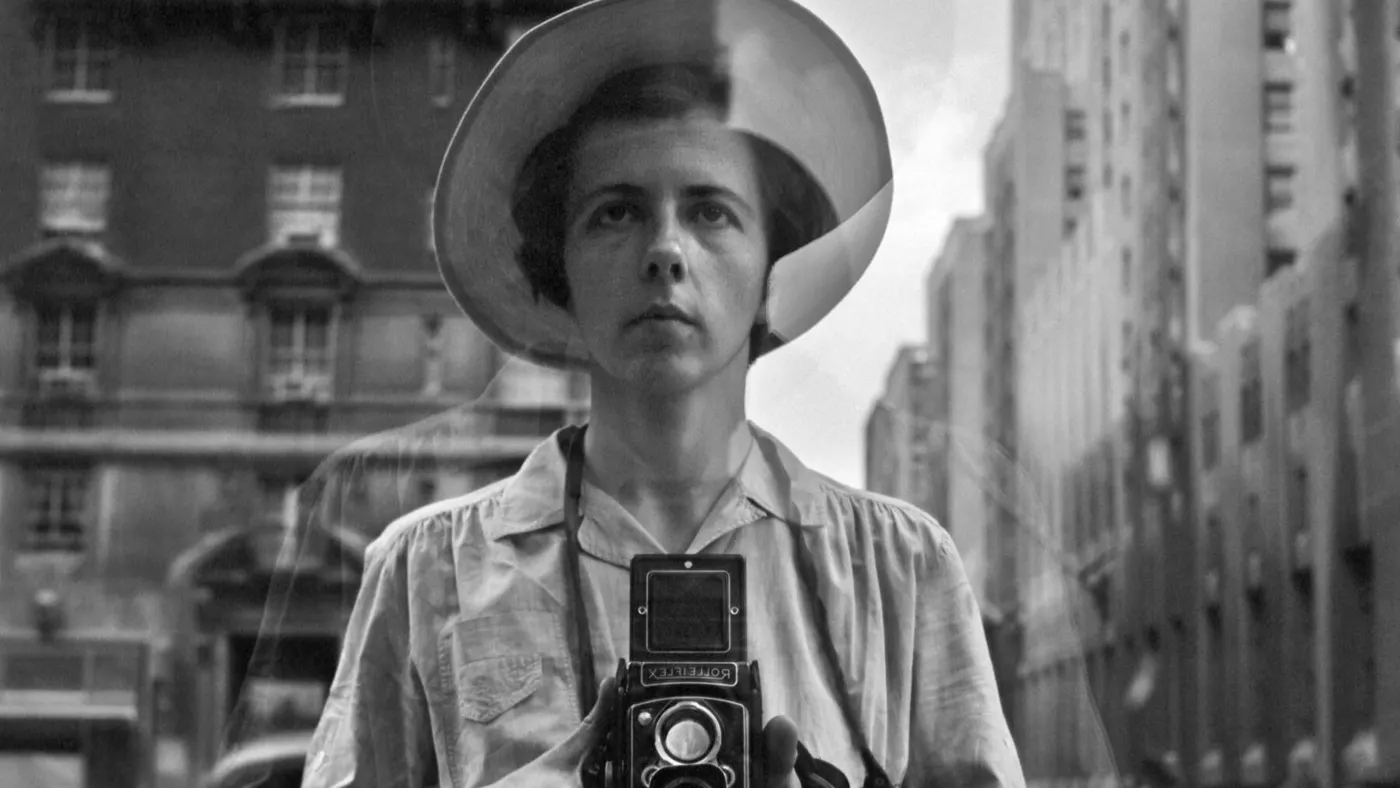
In this remarkable self-portrait through glass, Vivian Maier turns reflection into revelation. Her face, hat, camera, and the city around her lock into a precise, layered image that feels both intimate and monumental.
Watch the video
This photograph has the rare authority of an image that understands itself completely. Vivian Maier uses a shop window not just as a surface, but as a stage where identity, observation, and city life merge. The result is a self-portrait that feels exacting and mysterious at once: a direct encounter with a person, a camera, and an urban world all held in one lucid frame.
A face made unforgettable by framing and reflection
The portrait’s emotional center is the face, held firmly within the pale arc of the hat. That broad brim creates a natural frame, giving the features clarity and presence, while the vertical reflective band running through the hat and forehead adds a subtle split to the image. Instead of weakening the portrait, that division deepens it. It introduces the idea of a self seen through mediation—through glass, through light, through the act of looking itself. The expression remains calm and legible, but the reflection keeps it from becoming merely descriptive. That tension is what makes the image so memorable.

The face is both clear and elusive, giving the self-portrait its enduring psychological charge.
The camera completes the portrait
The Rolleiflex at the center of the torso is much more than a prop. It anchors the lower half of the frame and turns the image into a portrait of authorship as much as appearance. Face first, camera second: the relationship is immediate and beautifully ordered. The camera hangs with quiet certainty, its square geometry echoing the architecture around it, and its dark tonal weight grounds the lighter shirt. Because it is so prominently placed, the photograph becomes a statement about seeing and recording, not simply being seen.

The camera gives the self-portrait a second identity: not only subject, but maker.
City architecture gives the image its formal strength
The surrounding buildings do essential compositional work. On the left, the darker façade forms a heavy mass that stabilizes the portrait and gives the frame a serious, monumental feel. On the right, the receding street and lighter buildings open the image into depth, letting the city stretch away behind the reflected figure. This asymmetry keeps the centered pose from feeling rigid. It creates balance through contrast: weight on one side, openness on the other. The portrait feels embedded in the city rather than placed over it.

The architecture supplies both balance and depth, giving the portrait a strong urban skeleton.
Soft reflections enrich the surface
Across the shirt and lower frame, faint ghost reflections drift through the image like a second atmosphere. These translucent streaks soften the otherwise formal frontality and remind us that the photograph is built on layers of glass, light, and passing space. The textures are gentle rather than busy, and that restraint matters. They enrich the surface without distracting from the figure, making the image more rewarding the longer one looks at it. The photograph holds both solidity and shimmer at the same time.
The delicate reflective overlays give the photograph texture, atmosphere, and lasting visual depth.
Why this photograph stands out
What makes this image exceptional is how completely its elements belong to one another. The hat frames the face, the camera defines the role, the buildings shape the space, and the reflections turn a straightforward likeness into something layered and lasting. It is poised, architectural, and deeply personal—a self-portrait that reveals presence through indirection, and in doing so becomes unforgettable.
About the photographer
Vivian Maier
Vivian Maier was known for her **intimate, observant street photography**, capturing fleeting moments of everyday life with a remarkable eye for gesture, expression, and composition. Her photographs often reveal the humor, loneliness, curiosity, and quiet drama of ordinary people and city streets. Her work is distinguished by **layered compositions, reflections, strong geometry, and an instinct for capturing unguarded moments**. Working largely in Chicago and New York, Maier created a deeply personal visual record of urban life that was discovered and recognized only after her death.