Eve Arnold’s Tender Geometry of Family Life in Cuba
In Fisherman And Family Cuba, Eve Arnold turns an ordinary embrace into a vivid piece of human theater, where laughter, touch, and movement bind three figures into one radiant moment.
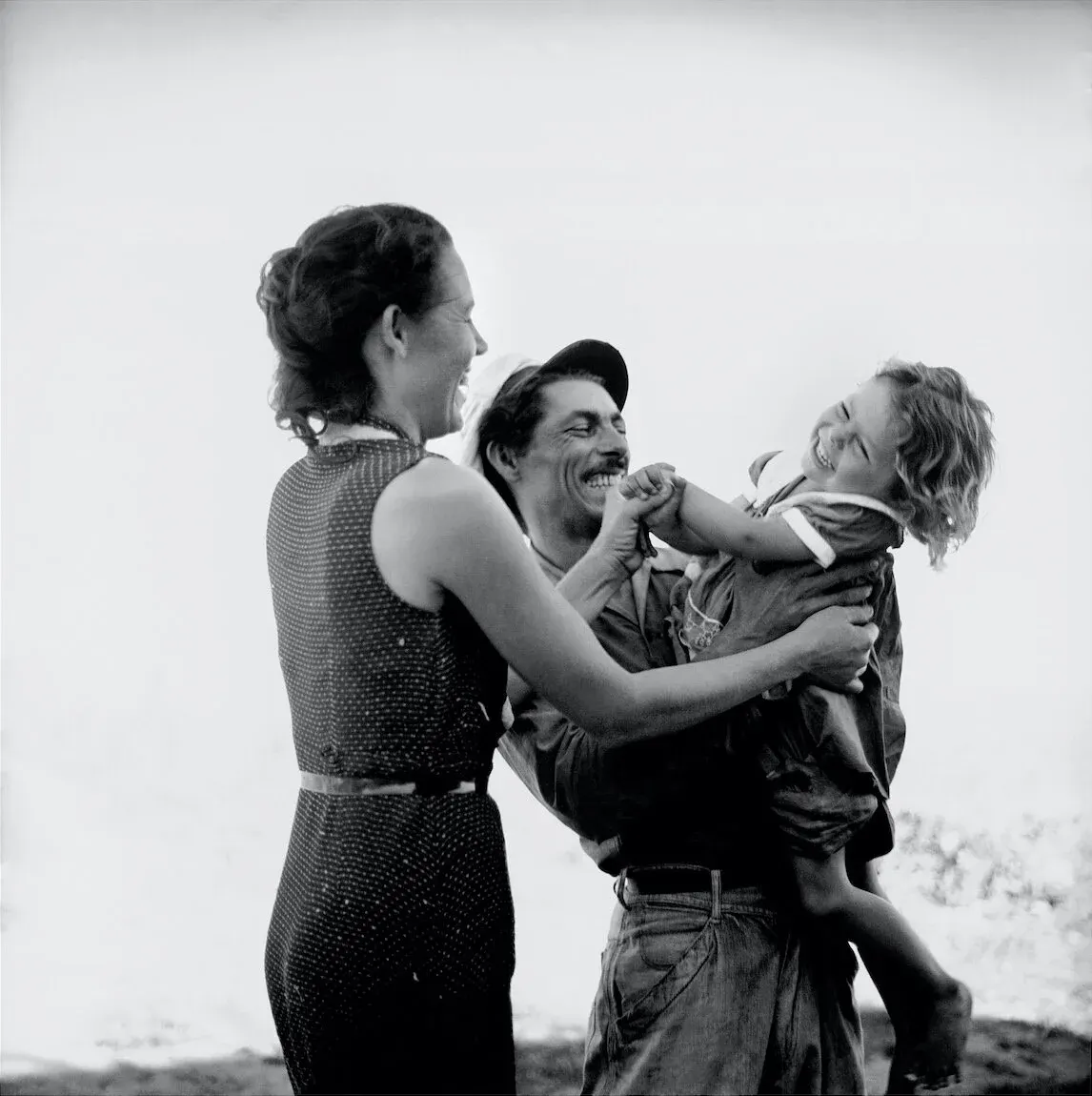
Eve Arnold was unmatched at finding closeness without forcing it, and this photograph shows that gift with quiet certainty. A man, woman, and child are joined in a small burst of play, but Arnold gives the scene lasting shape. The picture feels spontaneous and deeply composed at once: affectionate, airy, and full of life. In black and white, every smile, hand, and curve of the bodies becomes part of the story.
A family bond made instantly visible
The photograph’s emotional clarity begins in the cluster of faces and hands at the center. The father’s grin, the child’s delighted expression, and the mother’s warm participation make the relationship between all three instantly legible. Arnold does not need theatrical gesture or dramatic setting; touch does the work. The joined hands and close faces create a compact center of affection that feels both candid and complete.

The photograph makes love and play immediately readable through faces, touch, and proximity.
The child’s lifted pose gives the frame its spark
The child is the picture’s brightest note of movement. Held aloft at an angle, leaning back with a broad smile, she introduces a buoyant diagonal that keeps the scene from becoming static. Her raised position turns a simple family interaction into something jubilant and airborne. That gesture gives the image its emotional lift and its visual payoff at the same time.

The child’s joyful, tilted pose brings energy and delight to the entire composition.
Arms and bodies form a graceful visual circle
One of the photograph’s most elegant qualities is its internal structure. The mother’s reaching arms, the father’s supporting hold, and the child’s bent limbs create a looping movement that carries the eye around the trio. Rather than reading as three separate figures, they become one connected shape. This circular flow gives the candid moment unusual formal beauty, showing Arnold’s instinct for order inside lived experience.
The looping arrangement of arms and bodies unifies the family into one flowing form.
Soft light keeps the moment gentle and honest
The high, luminous background and soft side light strip the scene down to expression and silhouette. Light falls tenderly across the faces, preserving smiles and glances without hard contrast. In monochrome, that softness becomes even more eloquent: skin, fabric, and hair are simplified into tones that support mood rather than compete for attention. The result is a photograph that feels open, unguarded, and intimate.
Soft monochrome light gives the scene an open, tender intimacy.
Why this photograph stands out
What makes Fisherman And Family Cuba memorable is the way Eve Arnold joins documentary observation to compositional grace. Nothing feels imposed, yet everything holds together: the laughter, the lifted child, the circling arms, the gentle light. It is a photograph of affection caught in motion and given lasting form, exactly the kind of deeply human seeing that defines Arnold’s work.
About the photographer
Eve Arnold
Eve Arnold was known for her **intimate, empathetic approach to documentary and portrait photography**, looking beyond public personas to capture people in unguarded, vulnerable, and often deeply human moments. She photographed everyone from Marilyn Monroe and Malcolm X to migrant workers and ordinary families, bringing the same curiosity and respect to each subject. Her work is distinguished by **natural observation, emotional honesty, and a remarkable ability to create intimacy in difficult or unfamiliar settings**. Arnold often worked unobtrusively, allowing gestures, expressions, and small interactions to carry the story rather than relying on spectacle or dramatic staging.