Puerto Rico by Elliott Erwitt
A glowing doorway, a cello in silhouette, and a spare colonial room come together in a photograph that feels hushed, elegant, and full of implied music.
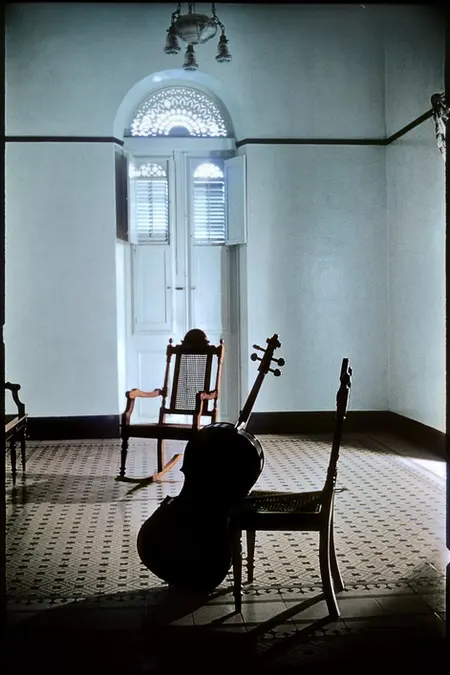
This photograph turns an empty room into a resonant stage. The backlit doorway establishes a radiant architectural center, while the cello’s dark silhouette gives the stillness emotional weight. Every major element—the arch, the chairs, the tiled floor, the hanging fixture—contributes to a mood of memory, ceremony, and quiet anticipation.
A luminous doorway gives the image its unforgettable center
The bright arched doorway immediately anchors the frame. Its fanlight pattern glows like lace, bringing delicacy to the otherwise spare room, and the tall vertical doors below it extend that sense of grace. Because the light is concentrated at the center, the architecture feels ceremonial rather than merely descriptive. The result is a powerful contrast between radiance and silence, with the room arranged almost as if it exists to receive that light.

The radiant arch transforms the room into a formal, atmospheric stage.
The cello silhouette carries the picture’s emotional life
The cello is instantly recognizable even in shadow, and that recognizability is what makes the image so affecting. Its curved body, angled neck, and grounded stance suggest music without a player, turning absence into subject matter. Set against the bright rear light, the instrument reads as a presence held in suspension. That choice gives the photograph its melancholy and its depth: this is not simply a room with furniture, but a room charged with memory.

The cello’s silhouette gives the still life narrative presence and emotional gravity.
Layered furniture makes the interior feel staged and alive
The chairs do more than fill space. The armchair near the doorway establishes a middle distance, while the chair in the foreground helps frame the cello and turns the room into a layered composition rather than a flat record of an interior. This arrangement creates a theatrical quality, as though the scene has been paused between acts. The spacing between objects feels deliberate, and that deliberateness is what makes the room feel inhabited even without anyone present.

The layered placement of chairs and instrument gives the room depth and a quietly theatrical presence.
The tiled floor grounds the mood with texture and rhythm
The patterned floor is one of the photograph’s most satisfying visual structures. Its repeating motifs add texture to the large open space, while the perspective of the tiles gently carries the eye inward toward the back wall and doorway. That rhythm prevents the lower half of the frame from becoming empty darkness; instead, it feels tactile and architectural. The floor helps connect the cello, chairs, and doorway into a single coherent interior space.
The repeating tile pattern adds tactile richness and quietly reinforces the room’s depth.
Small architectural details strengthen the image’s poise
The hanging ceiling fixture is a subtle but important touch. Positioned above the doorway, it reinforces the vertical axis and gives the composition an extra note of refinement. Along with the dark horizontal trim line across the walls, it helps organize the space into clean, measured intervals. These details make the image feel balanced and intentional, supporting the photograph’s calm authority without competing with the main subjects.
The fixture and wall lines give the composition a quiet structural elegance.
Why this photograph stands out
What makes Puerto Rico memorable is the way it joins architecture, object, and light into a single emotional atmosphere. The doorway glows, the cello stands in eloquent silence, and the room’s textures hold everything in place. It is a photograph of restraint and suggestion, where the beauty lies in how much feeling can be carried by shape, light, and stillness alone.
About the photographer
Elliott Erwitt
Renowned for his **witty, observant street photography**, finding humor, irony, and tenderness in the ordinary moments of everyday life. He had a remarkable eye for unexpected gestures, visual coincidences, and situations where people, animals, and surroundings come together in amusing or revealing ways. His work is distinguished by **timing, simplicity, strong composition, and a playful sense of the absurd**. Erwitt often turned seemingly insignificant moments into memorable photographs, showing that great street photography can be both **funny and deeply human**.