A Quiet Journey Made Unforgettable (Elliott Erwitt)
In “France,” a simple ride down a tree-lined road becomes a lasting image of tenderness, place, and everyday grace. The photograph’s power comes from its human touch, its measured geometry, and one perfect detail stretched across the bicycle.
Watch the video
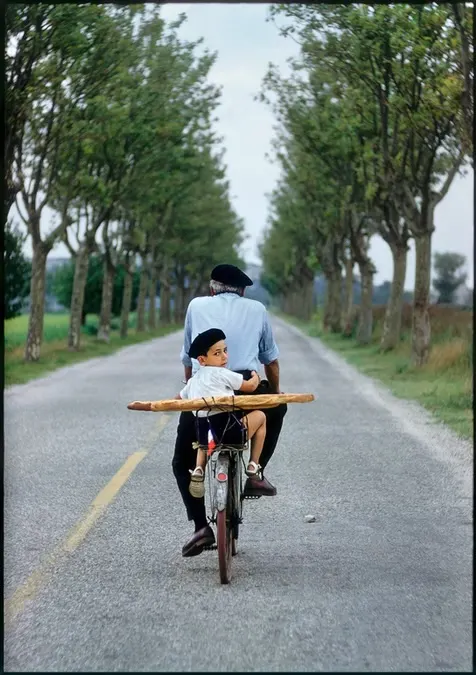
“France” turns an ordinary rural passage into something deeply cinematic. A cyclist rides away along a straight avenue of trees, carrying a child and a long loaf of bread, and the scene feels both specific and timeless. The photograph is memorable because it balances emotional intimacy with formal order: the road draws us in, the trees hold the frame steady, and the child’s turned face gives the whole image its pulse.
The child’s glance gives the scene its heart
The emotional center of the photograph is the child looking back toward the camera. That single gesture transforms the image from a rear-view travel scene into a felt human moment. We are not only watching a bicycle move through space; we are suddenly in relationship with the passengers. The child’s face introduces curiosity, awareness, and warmth, making the image instantly accessible while preserving its quiet mood.

The child’s backward glance creates an immediate, tender connection.
The road and trees create a beautifully disciplined structure
The composition is anchored by a centered road that narrows into the distance, while the rows of trees on both sides act like visual rails. This strong symmetry gives the photograph calm authority. The repeated trunks establish rhythm, and the vanishing point pulls the eye directly toward the bicycle. That clarity of structure is a major part of why the image feels so poised: everything in the frame supports the journey at its center.

The avenue of trees gives the image elegant depth and compositional clarity.
The loaf of bread makes the story vivid and unforgettable
The long loaf stretched across the bicycle is a marvelous detail. It adds specificity, humor, and cultural texture in a single shape. Without it, the frame would already be strong; with it, the photograph becomes unmistakable. Visually, the bread also plays against the verticality of the rider and trees, creating a horizontal accent that breaks the rhythm in exactly the right way. It is both a narrative clue and a graphic gift.

The bread adds charm, specificity, and a memorable visual counterpoint.
Muted color keeps the atmosphere gentle and timeless
The restrained palette of gray road, soft sky, green trees, and subdued clothing supports the photograph’s stillness. Nothing shouts for attention. Instead, the colors hold together in a quiet register that suits the rural setting and the intimacy of the scene. This softness allows the narrative details—the child, the rider, the bread—to carry the image without distraction, giving the whole frame a timeless documentary grace.
The subdued palette deepens the photograph’s calm, timeless mood.
Why this photograph stands out
What makes “France” so moving is the way its elements work in concert. The geometry is rigorous, the storytelling details are vivid, and the human presence is gentle but unforgettable. It is a photograph of travel, care, and everyday life, elevated by precision and feeling into something enduring.
About the photographer
Elliott Erwitt
Renowned for his **witty, observant street photography**, finding humor, irony, and tenderness in the ordinary moments of everyday life. He had a remarkable eye for unexpected gestures, visual coincidences, and situations where people, animals, and surroundings come together in amusing or revealing ways. His work is distinguished by **timing, simplicity, strong composition, and a playful sense of the absurd**. Erwitt often turned seemingly insignificant moments into memorable photographs, showing that great street photography can be both **funny and deeply human**.