Alan Schaller’s Street Frieze of Labor, Rhythm, and Shadow
A narrow band of city life becomes monumental here, where Alan Schaller turns passing figures, stained tiles, and hard contrast into a vivid human frieze.
Watch the video
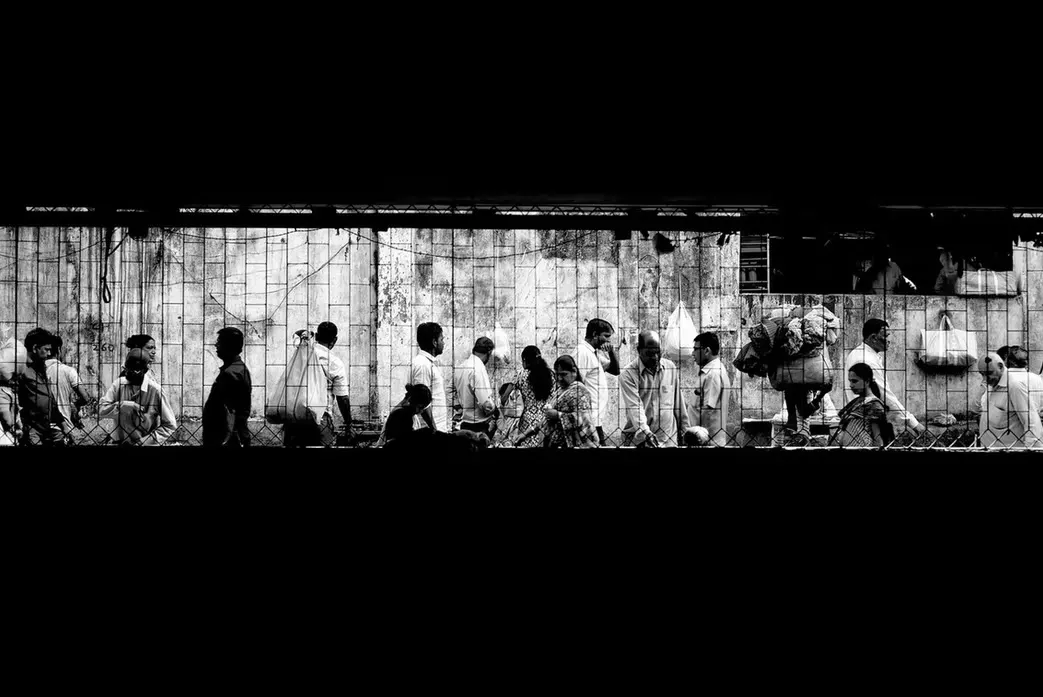
This photograph distills a busy public scene into something classical and cinematic. Alan Schaller takes an ordinary stream of pedestrians and workers and compresses it into a horizontal stage, where every silhouette, pale shirt, and patch of worn wall contributes to the whole. The image feels immediate as reportage, but it is memorable because of how rigorously it is arranged: a band of life held between deep black above and below, full of motion, weight, and quiet drama.
A panoramic strip that turns movement into theater
The most striking decision is the format itself. By reducing the visible world to a long, narrow strip, the photograph reads like a frieze: figure after figure passing across a continuous plane. The heavy black bands above and below intensify that effect, isolating the action so the eye stays with the human flow. Instead of dispersing attention into a full street scene, the frame concentrates on gestures, spacing, and repetition, making everyday transit feel staged and monumental.
The panoramic crop gives ordinary street traffic the clarity and presence of a theatrical procession.
The wall’s grid gives the crowd structure
The tiled wall is essential to why the image feels so controlled. Its vertical and horizontal seams create a measured scaffold behind the people, keeping the many bodies legible even as they overlap. That geometric order balances the unpredictability of the street. The result is one of Schaller’s signature strengths: urban complexity organized into a composition that feels both spontaneous and exact.

The tiled backdrop turns a crowded passage into a disciplined, highly readable composition.
A single burdened figure carries the emotional weight
Near the right side, the person carrying a large bundled load becomes the image’s narrative peak. The shape is instantly distinctive: broad, irregular, and heavy against the cleaner geometry of the wall and the upright figures nearby. That burden introduces effort and scale, giving the photograph social texture as well as visual tension. In a frame built from many small interactions, this one figure supplies a memorable human center.

The load-bearing figure gives the scene a vivid sense of labor, endurance, and lived reality.
Silhouettes and pale clothing create a precise rhythm
Across the frame, the alternating pattern of dark bodies and lighter shirts keeps the photograph moving. On the left, a strong dark silhouette stands out crisply against the pale wall, establishing the visual cadence that continues through the scene. This interplay of black and white is not only graphic; it creates tempo. Each figure feels like a note in a sequence, and the image gains its elegance from how those tonal accents are spaced.

The alternation of silhouette and light clothing gives the image its musical visual rhythm.
Layering keeps the human scene alive
The photograph never settles into a single flat row of people. Seated figures in the foreground, standing pedestrians in the middle band, and partially visible forms above create distinct planes of activity. The seated woman near the right is especially effective, her darker clothing and diagonal posture breaking the repeated upright forms around her. That layering adds depth without sacrificing graphic simplicity, allowing the picture to feel both condensed and spacious.

Foreground and background figures create depth while preserving the image’s clean graphic order.
Texture makes the monochrome feel tactile
The black-and-white treatment is enriched by the wall itself. Its stains, wear, cracks, and uneven tonal patches prevent the background from becoming blank or purely functional. Instead, the surface breathes with age and atmosphere, giving the scene a tactile realism that suits the human subject matter. Schaller’s contrast makes these imperfections glow and recede at once, so the wall becomes both backdrop and emotional register.
The weathered wall gives the monochrome image its rich tactile atmosphere.
Why this photograph stands out
What lingers in this photograph is the balance between order and life. Geometry, contrast, and framing give the scene its formal strength, while the people within it bring labor, waiting, movement, and presence. Alan Schaller finds beauty not by simplifying the street into emptiness, but by shaping its density into something lucid and unforgettable.
About the photographer
Alan Schaller
Alan Schaller is known for his **striking black-and-white street photography**, often finding moments of tension, solitude, and human connection within the rhythms of urban life. He uses strong light and shadow, geometric forms, and carefully timed moments to turn ordinary city scenes into visually powerful compositions. His work is distinguished by **dramatic contrast, minimalist framing, layered compositions, and an exceptional sense of timing**. Schaller often juxtaposes people with architecture, shadows, and negative space, creating photographs that feel both cinematic and emotionally introspective.