Alan Schaller’s Monumental Use of Shadow and Solitude
A towering black arch of shadow, a wedge of light, and a lone figure leaning at the wall—this photograph distills Alan Schaller’s gift for turning urban architecture into something cinematic and deeply human.
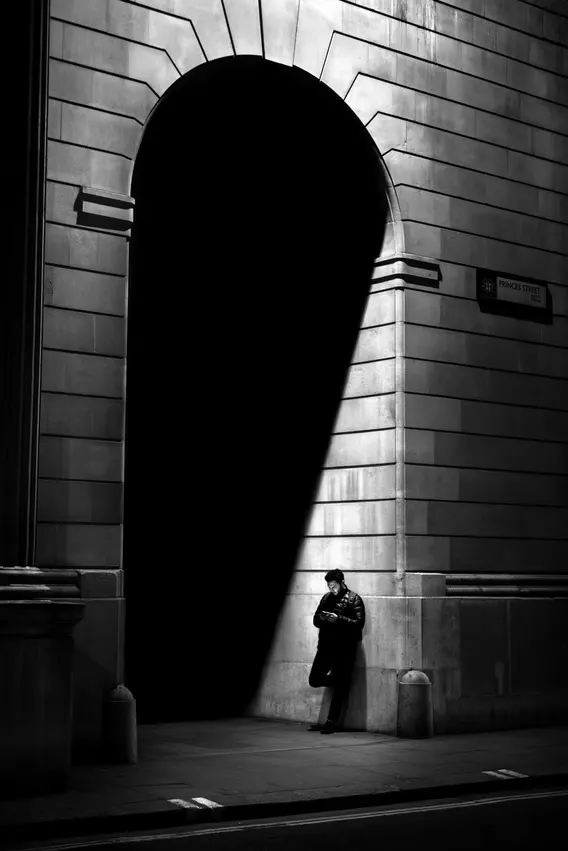
This image shows Alan Schaller at his most distilled. A single architectural shadow becomes the frame’s dominant shape, and everything else is arranged around its force: the bright stone, the sharp diagonal of light, and the solitary man standing at the base. The picture feels monumental and intimate at once, using scale and contrast to turn an ordinary street moment into something unforgettable.
A shadow that becomes the subject
The photograph’s first great achievement is the giant arch of darkness cutting down the building’s facade. It is not merely a background element; it acts as the image’s central form, almost like a sculpted void pressed into the stone. Its edges are clean and legible, so the composition reads instantly, and its sheer size gives the frame a powerful sense of weight and drama.

The dominant shadow gives the photograph an immediate graphic identity and extraordinary visual force.
A small human presence against monumental scale
Near the bottom of the frame, the man leaning within the lit area transforms the picture from architectural study into human story. His scale against the towering wall is essential: he appears vulnerable, self-contained, and quietly absorbed, while the building around him feels immense. That contrast between person and structure creates the emotional charge of the image.

The solitary figure gives the architecture scale, mood, and a resonant sense of urban solitude.
Light used like a spotlight
The diagonal boundary where shadow meets illuminated stone is handled with exceptional precision. It guides the eye naturally downward and inward until it lands on the figure. Because the brightest area narrows around him, the light feels theatrical without losing its realism. Schaller turns available light into a compositional device, not just an exposure condition.

The hard-edged light directs attention with clarity and gives the scene its cinematic intensity.
Geometry that strengthens the monumentality
Above the arch, the stone courses radiate outward in stepped lines that echo the curve below. These repeating angles enrich the upper half of the frame and make the building feel even more imposing. The geometry is orderly, but never stiff; it works in concert with the shadow shape to create rhythm, structure, and a sense of grandeur.

The radiating stone geometry adds rhythm and monumentality while keeping the frame elegantly ordered.
Monochrome that reveals form and texture
Black and white is exactly right for this scene. Stripped of color, the image depends on tonal contrast, surface, and shape, which makes the lit wall especially rich. Subtle variations in the stone remain visible inside the brightness, so the facade feels tactile rather than flat. That tonal control lets the photograph stay both stark and nuanced.
The monochrome treatment emphasizes texture, tone, and form with remarkable clarity.
Why this photograph stands out
What makes this photograph memorable is how completely its elements support one another. The vast shadow provides the graphic statement, the architecture supplies structure, the light creates focus, and the lone figure gives the scene its human pulse. In Alan Schaller’s hands, a street corner becomes something monumental, austere, and quietly moving.
About the photographer
Alan Schaller
Alan Schaller is known for his **striking black-and-white street photography**, often finding moments of tension, solitude, and human connection within the rhythms of urban life. He uses strong light and shadow, geometric forms, and carefully timed moments to turn ordinary city scenes into visually powerful compositions. His work is distinguished by **dramatic contrast, minimalist framing, layered compositions, and an exceptional sense of timing**. Schaller often juxtaposes people with architecture, shadows, and negative space, creating photographs that feel both cinematic and emotionally introspective.