Alan Schaller’s Monumental Study in Curve, Light, and Solitude
A sweeping concrete ramp, a lone figure, and a luminous opening turn this black-and-white interior into a precise, cinematic study of scale and form.
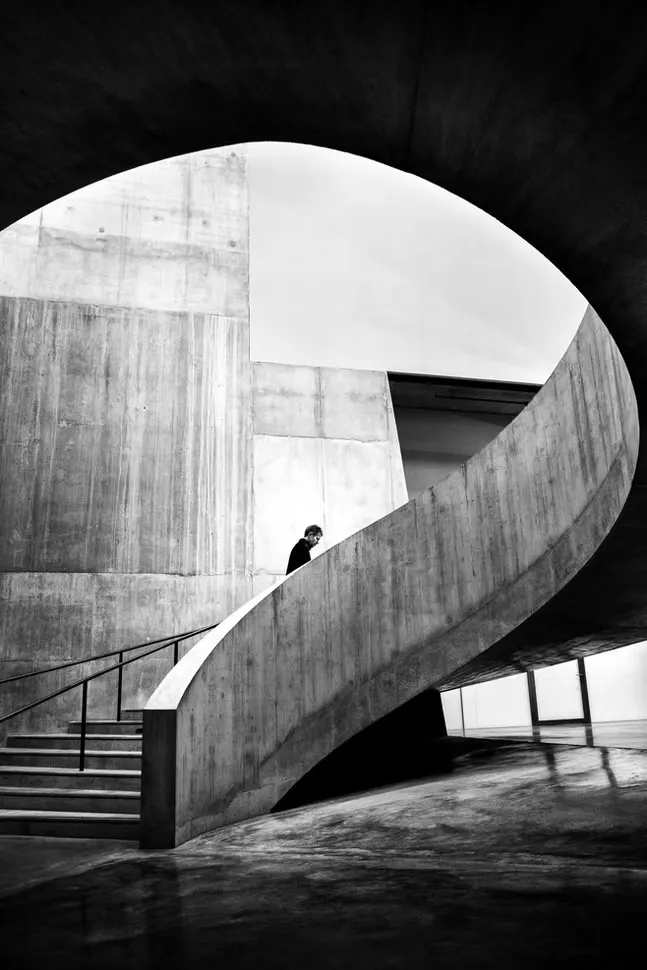
In “Staircase framing,” Alan Schaller turns a concrete interior into something both monumental and intimate. The photograph has the graphic clarity that defines his best black-and-white work: a bold spiral, a bright opening held beneath a dark ceiling, and a single person whose presence gives the architecture emotional weight. Every major shape feels deliberate, yet the image never loses its atmosphere.
A curve that gives the frame its identity
The sweeping ramp is the photograph’s defining gesture. It arcs across the picture with remarkable confidence, creating motion inside a still architectural scene. That curve does more than decorate the frame: it organizes the entire composition, carrying the eye from the lower left through the center and out toward the right edge. Because the line is so clean and continuous, the staircase reads almost like sculpture, turning raw concrete into something elegant and fluid.

The spiral ramp gives the photograph its unmistakable structure and momentum.
A solitary figure makes the space feel immense
The small person on the ramp is perfectly scaled to the architecture around them. Their dark silhouette stands out clearly against the pale concrete, becoming an immediate focal point without disrupting the photograph’s minimalist discipline. That human presence transforms the staircase from a formal study into a lived moment. It introduces solitude, measure, and quiet narrative, making the surrounding structure feel even more vast.

The lone figure gives the architecture scale, mood, and human resonance.
Light and shadow create a dramatic stage
One of the image’s most memorable qualities is its tonal design. The dark overhead ceiling forms a heavy visual canopy, while the pale opening beneath it feels luminous and open. Between those extremes, the midtone concrete planes hold the scene together with subtle gradation. This contrast gives the photograph immediate graphic force from a distance, but it also creates depth, letting the architecture unfold in layers rather than flatten into abstraction.

The interplay of deep shadow and bright opening gives the image its cinematic drama.
Concrete becomes tactile and expressive
The photograph’s surfaces are as compelling as its geometry. Vertical streaks, weathered marks, and tonal variation across the walls keep the large planes of concrete alive. These textures add richness without crowding the composition, preserving the minimal feel while giving the eye plenty to discover. Schaller’s monochrome treatment is especially effective here, emphasizing material character and turning the concrete into a surface that feels both austere and beautiful.

The textured concrete adds tactile depth while preserving the photograph’s clean, minimalist strength.
Why this photograph stands out
What makes this photograph so memorable is the way it balances precision and feeling. The architecture is rendered with exacting graphic control, yet the image never feels cold. Through curve, contrast, texture, and the measured placement of a solitary figure, Alan Schaller makes the space feel at once monumental, cinematic, and deeply human.
About the photographer
Alan Schaller
Alan Schaller is known for his **striking black-and-white street photography**, often finding moments of tension, solitude, and human connection within the rhythms of urban life. He uses strong light and shadow, geometric forms, and carefully timed moments to turn ordinary city scenes into visually powerful compositions. His work is distinguished by **dramatic contrast, minimalist framing, layered compositions, and an exceptional sense of timing**. Schaller often juxtaposes people with architecture, shadows, and negative space, creating photographs that feel both cinematic and emotionally introspective.