Alan Schaller’s Elegant Corridor of Light
A single figure, a narrowing beam, and a long shadow turn an ordinary passage into a cinematic study in solitude.
Watch the video
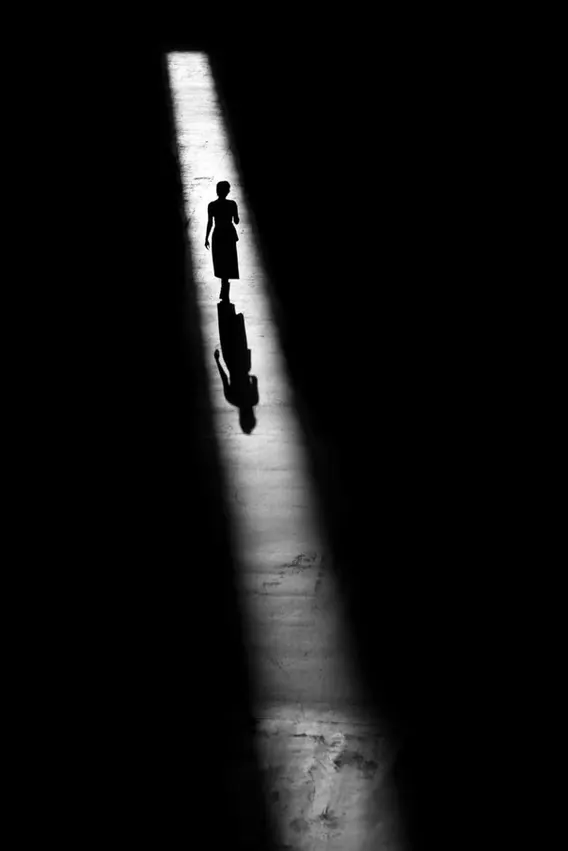
In "Woman, light," Alan Schaller distills street photography to its essentials: a person, a shaft of light, and surrounding darkness. The image feels instantly legible yet deeply atmospheric. Its force comes from how decisively every element serves the same idea—solitude made graphic, luminous, and unforgettable.
A silhouette placed with absolute clarity
The figure stands cleanly inside the illuminated strip, immediately becoming the photograph’s anchor. Because the body is rendered as a dark silhouette against the bright ground, the eye recognizes the subject in a single glance. That clarity gives the picture its confidence. The person feels solitary, self-contained, and emblematic, not simply observed but shaped into a visual statement.

The subject’s crisp placement inside the light makes the image instantly readable and visually commanding.
The beam of light as architecture
The narrowing column of light does more than illuminate the subject—it builds the whole composition. Its tapered form creates a corridor that guides the eye downward through the frame, turning light into structure. The slight asymmetry keeps the geometry alive, so the image never feels mechanical. It is precise, but still human.

The tapered light transforms the scene into a strong geometric passage with natural visual momentum.
A shadow that deepens the story
The long shadow below the figure gives the photograph emotional resonance. It doubles the subject, extending her presence and suggesting time, distance, and quiet movement. That shadow is not just a formal echo; it brings a sense of introspection to the frame. The image feels suspended between stillness and passage, which is part of its lasting power.

The extended shadow adds atmosphere and turns a minimalist scene into something cinematic and reflective.
Black space used with conviction
Most of the frame is consumed by darkness, and that bold reduction is one of the image’s greatest strengths. The black surrounding the light isolates the figure completely, heightening the sense of scale and silence. Schaller is known for using contrast and negative space to make urban scenes feel elemental, and this photograph is a striking example of that approach. The darkness does not feel empty; it feels charged.

The expansive darkness gives the photograph its drama, focus, and minimalist intensity.
Texture that keeps the abstraction grounded
Within the bright floor, faint surface detail remains visible. Those subtle marks and tonal shifts matter: they keep the image connected to a real physical place even as the composition approaches abstraction. The floor feels walked on, architectural, tangible. That touch of texture gives the photograph a convincing material presence beneath its graphic elegance.
Delicate floor texture grounds the graphic composition in a believable, physical space.
Why this photograph stands out
What makes "Woman, light" so memorable is its discipline. Nothing extraneous competes with the central experience of seeing a lone figure held inside a blade of light. The geometry is exact, the contrast is fearless, and the emotional tone remains quiet but potent. It is a photograph that shows how simplicity, in the hands of a photographer like Alan Schaller, can become monumental.
About the photographer
Alan Schaller
Alan Schaller is known for his **striking black-and-white street photography**, often finding moments of tension, solitude, and human connection within the rhythms of urban life. He uses strong light and shadow, geometric forms, and carefully timed moments to turn ordinary city scenes into visually powerful compositions. His work is distinguished by **dramatic contrast, minimalist framing, layered compositions, and an exceptional sense of timing**. Schaller often juxtaposes people with architecture, shadows, and negative space, creating photographs that feel both cinematic and emotionally introspective.