A Street Scene Turned Into Pure Form and Life
Henri Cartier-Bresson’s photograph transforms a simple wall and a passing crowd into a precise, lively tableau, where geometry, gesture, and human presence feel effortlessly unified.
Watch the video
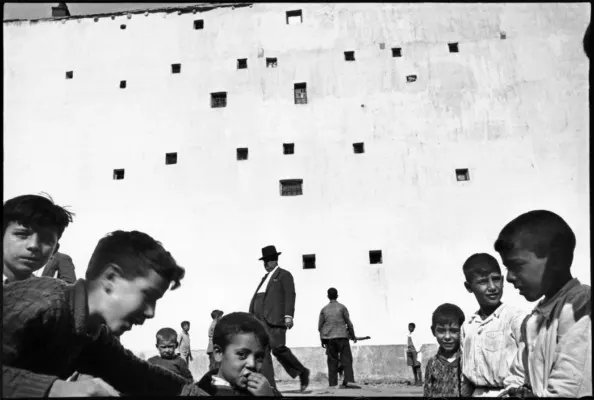
This photograph has the clarity of a stage and the unpredictability of real life. A vast white wall dominates the frame, broken only by small dark openings, while a scattered group of children and passersby animate the lower edge. At the center, a suited man in a hat crosses through the scene with quiet authority. The result is unmistakably Cartier-Bresson: graphic, humane, and alive to the exact arrangement of people in space.
A central figure with instant narrative force
The suited walker in the middle of the frame gives the image its story. His dark hat, jacket, and stride stand out against the pale wall, making him feel both solitary and purposeful. Around him, the children appear looser, more informal, more curious. That contrast creates immediate drama: one figure moving through, many others lingering, watching, or simply inhabiting the same public space. It is a simple placement, but it holds the entire scene together.

The central walker gives the photograph a memorable human anchor and a strong sense of story.
The wall becomes a monumental graphic field
The blank wall is far more than a background. Its sheer scale turns the people below into small, animated marks, and the scattered square openings create a spare rhythm across the upper frame. This large expanse of pale tone gives the image its stillness, while the figures provide motion below. The contrast between emptiness and activity is one of the photograph’s great pleasures. It feels architectural and abstract, yet never detached from lived experience.

The immense wall gives the scene its graphic power, scale, and calm.
Children bring spontaneity and social warmth
The children at the lower edges keep the image from becoming purely formal. Their faces, postures, and varying distances from the camera create a sense of immediacy that feels unposed and vivid. On the left, a leaning boy enters with quick energy; on the right, a small cluster of boys forms a conversational presence that answers him. Together they create a living border around the central action. Their expressions and body language make the photograph feel observed rather than arranged.
The children fill the frame with spontaneity, warmth, and unmistakable street life.
Depth created through beautifully staggered spacing
One of the most elegant qualities here is the spacing of the figures across the picture. Children occupy the foreground, the suited man crosses the middle ground, and smaller figures recede toward the wall behind him. This layered arrangement makes the photograph easy to read despite the number of people present. It also gives the scene a natural pulse, as if each person occupies a distinct beat within the composition. The structure feels effortless, but it is highly refined.
The staggered placement of figures gives the image clarity, depth, and graceful rhythm.
Subtle texture keeps the minimalism alive
Even the wall’s surface contributes to the image’s character. Its faint stains, tonal shifts, and worn patches prevent the large bright field from becoming empty or sterile. These details suggest age, weather, and use, deepening the atmosphere without drawing attention away from the people. In black and white, that understated texture enriches the print’s tonal life and supports the photograph’s quiet sense of place.
The wall’s subtle texture adds atmosphere while preserving the photograph’s clean visual simplicity.
Why this photograph stands out
What makes this image endure is the way it unites opposites: monumentality and intimacy, design and chance, stillness and movement. A nearly blank wall becomes a grand visual field; a handful of people turn it into a lived scene. Every strong choice visible here—central narrative focus, layered human presence, restrained geometry, and tonal subtlety—contributes to a photograph that feels both immediate and timeless. It is a masterful example of street photography distilled to its essentials.
About the photographer
Henri Cartier-Bresson
Henri Cartier-Bresson was renowned for capturing spontaneous moments of human life with remarkable precision and timing. He pioneered the idea of the “decisive moment”—waiting for the instant when gesture, emotion, geometry, and circumstance come together perfectly. His photographs are known for elegant composition, natural light, and an ability to find extraordinary meaning in ordinary scenes. His work helped establish street photography as both a documentary practice and a form of visual art.