A Journey Seen Through Glass
This photograph transforms a passing bus into a layered human stage, where reflection, landscape, and expression merge into a vivid sense of travel.
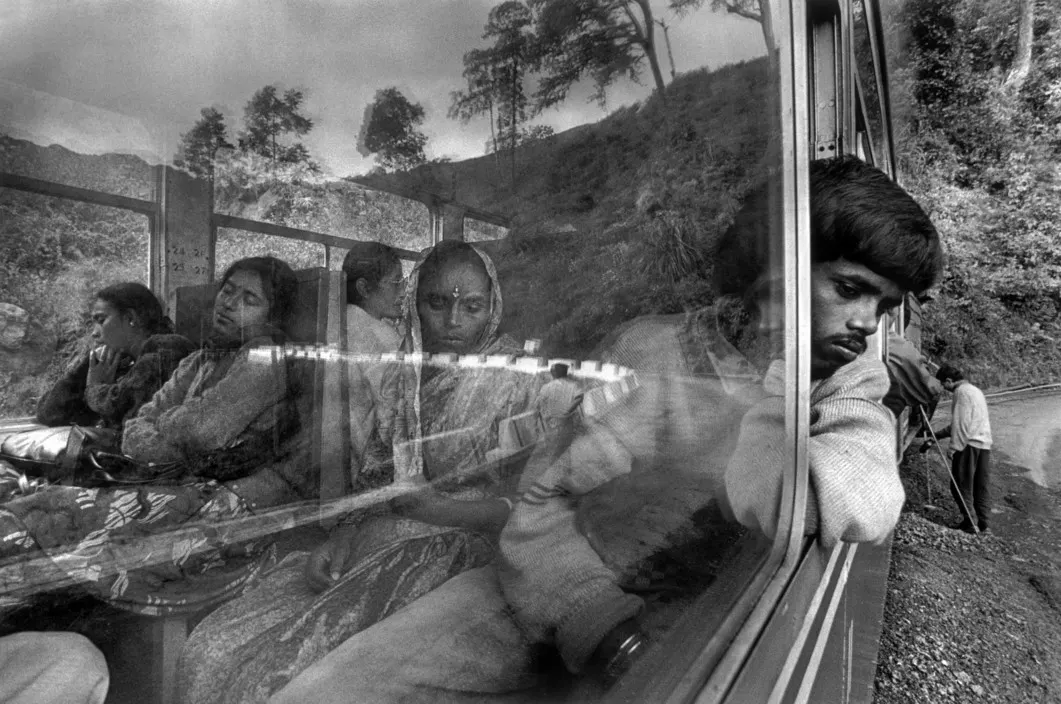
Train Journey is memorable for the way it holds several realities at once. The passengers inside, the young man leaning from the window, the reflected hillside, and the roadside figure outside all exist in the same visual field. Rather than separating these elements, the photograph lets them overlap, creating a dense, lyrical account of movement, fatigue, and shared passage.
A powerful human anchor at the frame edge
The young man at the right side gives the image its emotional center. His head tilts downward, his body leans outward, and his face sits close to the picture edge, which creates immediate tension and intimacy. That placement makes him feel both part of the bus and slightly apart from it, as though he is carrying the weight of the journey on his own. The softness of his sweater against the hard metal window frame adds a tactile contrast that makes his presence even more palpable.

The portrait at the right edge gives the photograph instant emotional gravity.
Reflections that deepen the social story
The interior faces behind the glass are one of the photograph’s most distinctive achievements. Their quiet expressions suggest weariness, thought, and inwardness, and because they are seen through reflection rather than directly, they feel suspended between private experience and public view. The layered glass turns a straightforward bus scene into something more poetic, letting multiple lives register at once without losing documentary truth.

The reflected passengers enrich the image with depth, mood, and collective presence.
Geometry that holds complexity together
What keeps the frame so coherent is its underlying structure. The repeated window divisions, the row of seated figures, and the verticals of the bus frame create a steady rhythm across the scene. That geometry organizes the many overlapping details and gives the eye a clear path through the image. Even with faces, reflections, and landscape sharing the same surface, the composition remains deliberate and legible.
The window grid and repeated seated forms give the layered scene strong visual order.
Landscape as atmosphere, not backdrop
The reflected hillside and trees across the upper part of the frame do more than indicate location. They infuse the photograph with a sense of passage through terrain, making the journey feel physical and expansive. The textures of foliage and slope soften the bus interior with a veil of nature, so the image becomes not just about people in transit, but about movement through a particular world.
The reflected landscape gives the photograph a poetic sense of place and motion.
A small exterior detail that opens the world
The figure standing by the roadside is tiny compared with the passengers, yet it broadens the image beautifully. This detail confirms that the bus is not an isolated interior but part of a larger rural environment. It introduces a second scale of human presence: the concentrated emotions inside the vehicle and the quieter life continuing outside it. That contrast makes the scene feel lived-in and expansive.

The roadside figure extends the story beyond the bus and strengthens the sense of travel.
Why this photograph stands out
What makes Train Journey so affecting is its ability to be both immediate and layered. It offers a striking portrait, a group scene, a landscape reflection, and a sense of road-bound movement in a single frame. The photograph trusts overlap, texture, and quiet expression, and that trust gives it its lasting power. It feels observed with patience and shaped with real sensitivity to how human stories gather in shared transit.
About the photographer
Raghu Rai
Raghu Rai is renowned for his **powerful, deeply human approach to documentary photography**, capturing the complexity of Indian life through moments of emotion, movement, and quiet observation. His images range from crowded streets and everyday life to major historical events, often revealing unexpected relationships between people and their surroundings. His work is distinguished by **expressive composition, rich tonal depth, and an instinct for capturing decisive moments**. Rai combines the immediacy of photojournalism with a strong artistic sensibility, creating photographs that are not only records of reality but also deeply evocative visual stories.