A Graphic Stage of Rails, Stone, and a Passing Figure
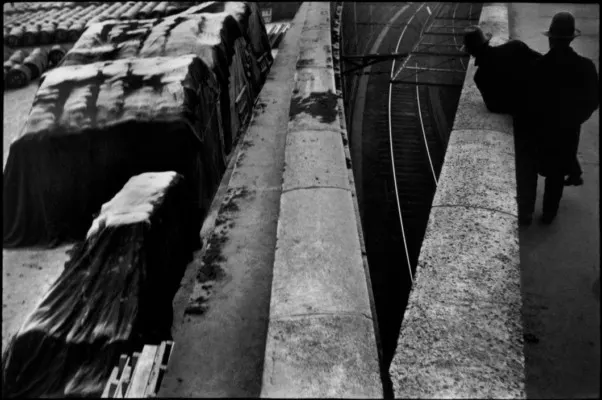
This photograph turns a railway platform into a rigorous black-and-white design, then gives that design life through a single silhouetted man. Its power comes from the meeting of strict geometry, tactile industrial surfaces, and a fleeting human gesture that feels both ordinary and mythic.
Watch the video
This image is unforgettable because it feels both engineered and spontaneous. Massive platform edges, wrapped cargo, and curving rails build a severe industrial structure, yet the whole scene is animated by one dark figure moving through it. The photograph’s beauty lies in that balance: hard geometry set against a human presence that is brief, mysterious, and full of character.
A silhouette that turns observation into story
The man at the upper right is the emotional center of the frame. His dark coat and rounded hat reduce him to a clean shape, while the lifted arm introduces motion and personality. Because he is seen from above and at a distance, he becomes less a portrait than a distilled human sign—someone passing through a vast rail space, carrying a private purpose the viewer can only imagine. That economy is part of the image’s elegance.

The silhouetted figure gives the scene mystery, scale, and a vivid sense of human presence.
Stone edges that guide the eye with absolute clarity
The central barrier is the photograph’s organizing force. Its long, pale surface runs downward through the frame, creating a stern visual spine that divides the image into distinct zones. The parallel platform edge on the right echoes it, so the viewer is pulled into depth almost immediately. This is composition at its most assured: simple directional lines that make a complex setting feel legible and exact.

The platform edges create a disciplined structure that carries the eye deep into the scene.
Curved rails that soften the architecture
Below the platforms, the rail lines sweep in graceful arcs. Those curves are crucial to the image’s rhythm. Without them, the frame would be dominated by straight, severe edges; with them, it gains flexibility, movement, and visual music. The rails feel almost calligraphic against the stone, introducing a quieter, more fluid counterpart to the rigid platform construction.

The bending rails add rhythm and motion to the photograph’s strong architectural geometry.
Industrial texture with sculptural presence
On the left, the wrapped cargo forms read as heavy, tactile masses. Their draped surfaces catch light unevenly, revealing folds, bumps, and worn fabric textures that make the setting feel physical and worked-in. These shapes are not just background detail; they deepen the atmosphere of the railway yard and give the image a rough material richness that black and white renders beautifully.
The covered forms bring tactile richness and a grounded industrial atmosphere to the frame.
Why this photograph stands out
What makes this photograph endure is the precision of its design combined with the openness of its meaning. Every major element is memorable—the stern stone ledges, the elegant rails, the rough cargo, the lone figure—and each one strengthens the others. The result is a black-and-white image that feels immediate and timeless at once: a railway scene transformed into pure visual thought, then charged with human life.
About the photographer
Henri Cartier-Bresson
Henri Cartier-Bresson was renowned for capturing spontaneous moments of human life with remarkable precision and timing. He pioneered the idea of the “decisive moment”—waiting for the instant when gesture, emotion, geometry, and circumstance come together perfectly. His photographs are known for elegant composition, natural light, and an ability to find extraordinary meaning in ordinary scenes. His work helped establish street photography as both a documentary practice and a form of visual art.