A Courtyard Reduced to Light, Shape, and Scale
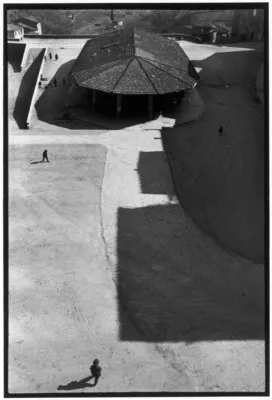
From an elevated vantage, this black-and-white courtyard scene turns architecture into pure design. The polygonal roof, bright central path, and two small figures create a photograph that feels both rigorously graphic and quietly human.
Watch the video
This photograph has the elegance of a solved visual problem. Seen from above, the courtyard becomes a field of clean planes, sharp divisions of light and shadow, and one unforgettable polygonal roof. The image feels immediate as design, then richer on a second look as the two tiny figures begin to animate the space. What makes it memorable is how confidently it balances abstraction and lived presence.
The roof gives the picture its architectural signature
Near the top center, the many-sided roof acts as the image’s defining form. Its radial structure is distinct enough to anchor the entire frame, and its dark tone sets up a striking contrast against the pale ground around it. Because the surrounding courtyard is reduced to broad, simple surfaces, the roof reads almost like an emblem: specific in detail, but powerfully graphic at a glance.

The polygonal roof gives the photograph an immediately recognizable geometric center.
The elevated viewpoint turns space into composition
The high vantage point is essential to the image’s effect. Instead of reading first as a literal courtyard, the scene becomes an arrangement of shapes: the broad open rectangle at left, the narrow pale path through the middle, the roofed structure above, and the sweeping dark wall at right. This compression of depth is what gives the photograph its modern, graphic force while still preserving a believable sense of place.
The overhead perspective transforms ordinary architecture into a bold abstract design.
The central path leads the eye with quiet precision
The pale walkway running down the middle is a beautifully simple compositional device. It links the foreground to the pavilion and creates a visual route through the frame without calling attention to itself. In a picture built from strong tonal blocks, this bright path acts as a hinge, connecting the open ground below to the clustered forms above and giving the eye a natural movement upward through the scene.
The bright central path elegantly connects the foreground space to the pavilion.
The figures make the courtyard feel inhabited
The small person in the lower portion of the frame is crucial not because of size, but because of presence. The elongated shadow makes the figure instantly legible and brings the sun’s angle vividly into the picture. A second, smaller figure at left-mid frame creates a subtle human rhythm across the courtyard. Together they do more than provide scale: they make the architecture feel observed, used, and briefly alive.

The tiny figures bring human scale and a quiet sense of life to the formal scene.
Long shadows give the light its drama
One of the photograph’s strongest pleasures is the way sunlight becomes structure. The long cast shadows stretch across the ground as sharply defined shapes, turning time of day into something visible and tactile. These shadow forms do not merely decorate the courtyard; they carve it into zones, adding rhythm and tension while preserving the photograph’s spare clarity. The result is a scene that feels both austere and cinematic.

The long shadows make the afternoon light feel physical, graphic, and dramatic.
Why this photograph stands out
What endures here is the photographer’s ability to see a courtyard not just as a place, but as a choreography of form, light, and human scale. The roof, the path, the shadows, and the two distant figures all contribute to a picture that feels distilled and exact. It is a beautiful example of how black-and-white photography can simplify the world without diminishing its richness.
About the photographer
Henri Cartier-Bresson
Henri Cartier-Bresson was renowned for capturing spontaneous moments of human life with remarkable precision and timing. He pioneered the idea of the “decisive moment”—waiting for the instant when gesture, emotion, geometry, and circumstance come together perfectly. His photographs are known for elegant composition, natural light, and an ability to find extraordinary meaning in ordinary scenes. His work helped establish street photography as both a documentary practice and a form of visual art.